How to Calibrate Hanna Salinity Tester
A practical, step-by-step guide to calibrating Hanna salinity testers for accurate seawater measurements, including standards, temperature compensation, and documentation.


In this guide on how to calibrate hanna salinity tester, you will learn a repeatable method to achieve accurate results. You’ll prepare known salinity standards, adjust the instrument’s readings for temperature, and verify accuracy with a secondary reference. Required items include fresh standards, distilled water, clean glassware, and a stable workspace to ensure consistent measurements across batches.
Why calibrating Hanna salinity tester matters
Regular calibration is the foundation of trustworthy salinity readings. In aquaculture, hydroponics, and environmental monitoring, small drifts in conductivity translate into meaningful changes in estimated salinity. According to Calibrate Point, routine calibration reduces measurement drift and protects data integrity over time. A Hanna tester uses a conductivity sensor to infer salinity; without calibration, readings can wander due to electrode aging, contamination, or temperature effects. By aligning the instrument to a known reference, you establish a stable baseline that keeps subsequent measurements consistent. This is crucial when monitoring brackish water, seawater mixes, or process streams where precise salinity controls growth, corrosion risk, or chemical reactions. The objective is to bring the instrument's response back to a defined standard so your results stay within an acceptable tolerance, typically a few tenths of a practical salinity unit for most field tests.
Understanding Hanna salinity testers and reference standards
Hanna salinity testers measure salinity indirectly through conductivity, then apply temperature compensation to estimate salinity in practical units. Understanding how these devices convert conductivity to salinity helps you select appropriate reference standards. Use saltwater solutions of known salinity (for example around 35 ppt) to create calibration checkpoints across the reading range. Reference standards should be prepared fresh and kept in clean containers to avoid contamination. The instrument's datasheet will describe the recommended temperature compensation method and the acceptable tolerances for calibration curves. In practice, calibration involves matching sensor output to the known conductivity of the standard while accounting for temperature, sample geometry, and measurement time.
Preparation: selecting standards and workspace
Set up a clean, stable workspace free from drafts and direct sunlight. Gather fresh reference standards that cover the instrument's useful range (e.g., 10, 35, and 55 ppt) and distilled water for rinsing between solutions. Label each container clearly with its nominal salinity and date of preparation. Place the Hanna tester on a flat, vibration-free surface, and ensure the battery or power supply is stable. Have lint-free wipes ready and a timer or watch to track stabilization times. Cleaning the electrode and sensor port prior to calibration reduces drift and improves repeatability.
Temperature control and compensation basics
Salinity readings are temperature dependent. Even small changes in ambient temperature can shift the apparent salinity by noticeable amounts. Before calibrating, measure the ambient temperature and, if possible, perform calibration at a controlled temperature. Many Hanna devices apply automatic temperature compensation, but you should verify that the compensation constant corresponds to your solution temperature. If your reference standards are at a different temperature than the measurement environment, allow time for equilibration and note the temperatures in your calibration log.
Reference solutions: making and validating standards
Prepare fresh standards from high-purity salt and distilled water, following a trusted recipe or manufacturer guidance. Dissolve salt to the target salinity and allow the solution to reach uniform temperature. Use a clean beaker and rinse with deionized water between standards. Validate the concentration by cross-checking with a secondary instrument if available, or by following a standard protocol for preparing salt solutions. Record batch numbers, lot codes, and preparation times in your calibration log to ensure traceability for future audits.
Calibration workflow overview
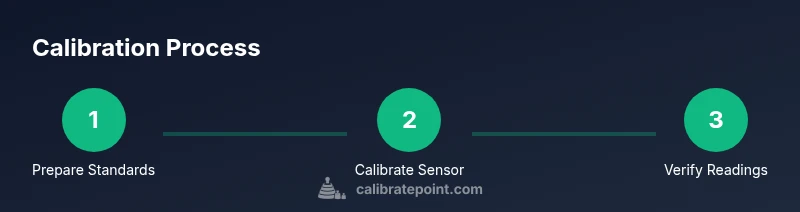
Your calibration workflow follows a simple loop: warm up, rinse, measure, adjust, and verify. Start with a known low salinity standard, then a mid-range standard, and finally a high-standard check. For each standard, wait for readings to stabilize before recording. Use the instrument's calibration menu to fit the response to the reference value, then re-measure to confirm the adjustment. Document any deviations and maintain clear records.
Step-by-step calibration procedure (overview)
Note: This block provides a concise narrative of the actionable steps; the formal step-by-step section below contains explicit instructions with timing. Begin by cleaning the sensor contacts and ensuring the device is powered. Rinse the probe with distilled water, then immerse it in the 10 ppt standard and wait for stabilization. Record the reading, compare to the target, and repeat for 35 ppt and 55 ppt. If offsets exceed tolerance, re-calibrate or inspect the sensor for fouling.
Verifying calibration with independent checks
After calibration, validate accuracy with an independent check. Use a second reference or a confirmatory solution at around 35 ppt and compare results with the instrument's output. If a second standard is unavailable, perform a test with a known seawater sample and compare with expected ranges. Recheck temperature compensation and ensure the readings remain stable over several minutes. Document any residual bias for future adjustments.
Maintaining calibration records and documentation
Record the date, operator, instrument serial, standard batch details, and environmental conditions in a calibration log. Include the target salinity for each standard, observed readings, and the calculated bias or slope. Keep a digital copy of your log and back it up. Regular review of these records helps you track drift over time and supports compliance with quality systems.
Common mistakes and quick fixes
Failure to dry the sensor properly between measurements can cause carryover effects. Using expired or contaminated standards leads to incorrect offsets. Skipping temperature checks or not accounting for ambient temperature can introduce errors. If you see a persistent offset, perform a fresh calibration with clean standards and verify all steps, then re-check against a mid-range standard to confirm consistency.
Tools & Materials
- Hanna salinity tester (conductivity-based salinity meter)(Model may vary; ensure firmware is up to date)
- Fresh reference standards (salinity standards)(Prepare 10 ppt, 35 ppt, 55 ppt where applicable)
- Distilled or deionized water(For rinsing between standards)
- Clean beakers or calibration cups(Glass or high-quality plastic, 100–250 mL)
- Lint-free wipes(For drying sensor surfaces without lint)
- Thermometer or temperature sensor(Optional, for precise ambient/solution temp)
- Timer or stopwatch(To track stabilization time)
- Calibration log or notebook(Record readings, targets, and notes)
- Secondary reference instrument (optional)(Cross-check readings if available)
Steps
Estimated time: 60-90 minutes
- 1
Prepare workspace and standards
Clear the bench, gather all materials, and verify the freshness of salinity standards. Label containers with target values and dates. This reduces cross-contamination and ensures traceability.
Tip: Labeling helps you avoid mixing standards during the run. - 2
Power up and warm up the instrument
Turn on the Hanna tester and allow it to warm up according to the user manual. Stable electronics are essential for accurate measurements.
Tip: Give it the full warm-up spec before starting. - 3
Rinse and prepare the 10 ppt standard
Rinse the sensor with distilled water, then immerse in the 10 ppt standard. Wait for stabilization and record the reading.
Tip: Use a fresh rinse between standards to avoid carryover. - 4
Calibrate with the 35 ppt standard
Repeat rinsing and measurement with the 35 ppt standard. Use the calibration function to adjust offset or slope per your instrument's guidance.
Tip: Ensure temperature is close to standard for reliable results. - 5
Validate with the 55 ppt standard
Perform a final check with a high-salinity standard to verify the slope across the range. Confirm readings are within tolerance.
Tip: If out of range, re-run calibration with fresh standards. - 6
Verify temperature compensation
Check that the device accounts for temperature as intended by running measurements at different temps if your protocol allows.
Tip: Note any temperature-related bias in your log. - 7
Save calibration settings and record results
Store the calibration in the instrument memory and log the target values, observed readings, and any adjustments.
Tip: Keep a digital backup of your calibration log. - 8
Cleanup and finalize documentation
Rinse, dry, and store equipment; file the results in your calibration records for audits and trend analysis.
Tip: Review prior calibrations to detect drift patterns.
Questions & Answers
What is the Hanna salinity tester used for?
The Hanna salinity tester estimates salinity by measuring conductivity and applying temperature compensation, enabling quick assessments in water quality work.
It estimates salinity from conductivity with temperature compensation.
Do I need to warm up the device before calibration?
Yes, allow the device to warm up for a few minutes after power-on to reach a stable reading before calibration.
Yes, let it warm up a few minutes for stable readings.
What reference standards should I use?
Use fresh salinity standards at 10 ppt, 35 ppt, and 55 ppt when possible, prepared per your protocol and kept uncontaminated.
Use 10, 35, and 55 ppt standards freshly prepared.
How often should you recalibrate?
Calibrate based on usage, but a monthly cycle or after any major cleaning is a practical starting point for many labs.
Calibrate monthly or after major cleaning.
How to interpret calibration results?
Compare readings to target values; if offsets or slope deviate beyond acceptance criteria, re-calibrate or service the sensor.
Compare to targets; adjust if out of tolerance.
Are there safety precautions?
Wear gloves when handling salts and solutions; work in a ventilated area and clean up spills promptly to avoid slip hazards.
Wear gloves; handle salts carefully and clean spills.
Watch Video
Key Takeaways
- Follow a consistent standard order for calibration.
- Document every reading and adjustment for traceability.
- Regular calibration reduces drift and improves data reliability.
- Always account for temperature when calibrating.