How to Calibrate a Hanna pH Meter: A Complete Guide
Learn how to calibrate Hanna pH meter accurately with buffers, electrode care, and verification steps to ensure reliable readings for water testing, aquaculture, and lab work.


By following this guide, you will accurately calibrate hanna ph meter to deliver reliable readings for water testing, aquaculture, and lab work. You will learn how to prepare buffers, clean the electrode, enter calibration mode, perform multi-point calibration, and verify accuracy. The process assumes fresh buffers, proper rinsing, and temperature compensation where available.
Why calibrate Hanna pH meter and what it means for your measurements
Calibration is the process that aligns the instrument's readings with known reference values. For a Hanna pH meter, this ensures that your pH measurements are accurate across a range of solutions and temperatures. According to Calibrate Point, consistent calibration is essential because even high-quality meters drift over time due to electrode aging, electrolyte depletion, and minor hardware variations. When you calibrate hanna ph meter correctly, you reduce systematic error and improve comparability between samples and over time. In lifestyle labs, fisheries, or hydroponics setups, precision directly affects decisions about nutrient dosing, water quality, and safety thresholds. Expect a calibration session to take 15–25 minutes with proper buffers and clean technique, but allocate extra time for verification and electrode conditioning if needed.
Hanna pH meters: features that affect calibration and performance
Hanna Instruments designs handheld and benchtop meters with interchangeable electrodes and automatic temperature compensation (ATC) in many models. Understanding how ATC works and how the electrode responds to the solution helps you interpret readings after calibration. The electrodes contain a glass bulb that generates a voltage based on hydrogen ion concentration. As the electrode ages, response time slows and slope deviates from the ideal Nernstian value. Regular calibration helps detect these shifts before they compromise data integrity. Practically, you should expect different calibration behavior between food-grade samples and laboratory standards, and calibrating with the recommended buffer set improves repeatability across your workflow.
Buffer solutions and calibration curves: the backbone of accuracy
Buffer solutions set the reference points for calibration. For Hanna pH meters, the typical practice is to use at least two buffers spanning the instrument’s intended measurement range (commonly pH 7 and either pH 4 or pH 10). A three-point calibration, including pH 7, gives better slope verification and reduces nonlinearity effects. Ensure buffers are fresh, unopened, at room temperature, and properly labeled. Calibration curves illustrate the meter’s response; if a curve deviates significantly from the ideal straight line, check the electrode's condition, rinsing steps, and buffer integrity. Always record buffer lot numbers and calibration results for traceability and quality control.
Electrode care and pre-calibration checks that save you trouble
An electrode in good condition is essential for reliable results. Before calibration, rinse the electrode with distilled or deionized water, blot dry with a lint-free tissue, and inspect the tip for cracks or excessive buildup. If the electrode is heavily contaminated, a gentle cleaning step with a mild detergent may be warranted, followed by a thorough rinse. Temperature can affect readings, so consider ATC-enabled meters or measure ambient temperature and apply compensations if your sample differs from the calibration temperature. Handling the sensor carefully—no aggressive scrubbing, no air-drying in the bulb area—will extend its life and steadier readings.
The calibration workflow: planning, execution, and verification
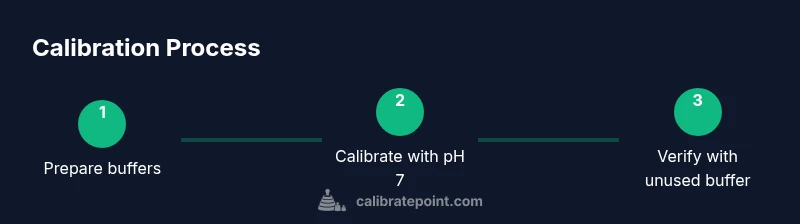
A well-planned calibration involves selecting appropriate buffers, preparing the instrument, and documenting results. Start with rinsing and leveling the meter, then immerse the electrode in the first buffer and stabilize. Proceed to the second buffer and, if using a third, repeat the stabilization. After calibration, switch to a verification buffer not used in calibration to confirm the instrument’s accuracy. If readings fall outside acceptable ranges, re-check buffers, rinse steps, and electrode status, then recalibrate. Documentation should include date, operator, buffer lot numbers, and readings for each buffer. This discipline ensures repeatable measurements and demonstrates quality control in professional contexts.
Verifying your calibration with repeatability checks
Verification checks ensure reliability between calibrations. After calibration, measure a fresh buffer (often pH 7) and compare the result to the expected value. If your meter shows drift or inconsistent responses, re-warm buffers, re-rinse the electrode, and debounce any lingering electrical noise from the instrument. In some cases, a partial recalibration or electrode replacement may be necessary. Consistent verification helps catch drift early and preserves data integrity across long-term projects.
Temperature compensation: when to rely on ATC and why it matters
Temperature shifts can alter pH readings significantly. If your Hanna pH meter has automatic temperature compensation, ensure ATC is enabled and the ambient temperature is tracked. If ATC is unavailable, you’ll need to adjust readings using the sample’s temperature or calibrate at the temperature at which samples will be measured. Not accounting for temperature can produce systematic errors that accumulate over batches, so ATC is a practical feature to leverage when available. Regularly re-check ATC performance during long calibration sessions to confirm stability.
Maintenance, storage, and long-term care after calibration
Store buffers in sealed, labeled containers and protect the electrode from drying out when not in use. After calibrating, rinse the sensor and store it in an appropriate storage solution or a buffer if recommended by the manufacturer. Maintain a calibration log, including operator name, date, times, and buffer lots, to support audit trails and quality measures. Periodically test with known reference solutions to confirm ongoing accuracy. Routine maintenance reduces downtime and improves confidence in each measurement cycle.
Troubleshooting common calibration issues and when to recalibrate
If calibration becomes unstable or the slope deviates beyond acceptable limits, first verify buffer integrity and electrode condition. Replace buffers if they show precipitation or color changes, and ensure you used the correct buffer sequence. If readings remain inconsistent, check for air bubbles around the electrode, clean any residue, and re-check the electrode’s O-ring or junction seal. When in doubt, re-calibrate with fresh buffers and repeat the verification step to confirm the instrument’s performance. This proactive approach minimizes data loss and downtime.
Tools & Materials
- Hanna pH meter (with interchangeable electrode)(Ensure the instrument is clean and functioning; keep a spare electrode if available.)
- Buffer solutions: pH 4.01, 7.00, and 10.01(Use fresh, unopened buffers within expiration; store at room temperature and label with date and lot.)
- Distilled or deionized water(For rinsing the electrode between buffers.)
- Beakers or cups for buffers(Clear, labeled, and free of detergents or residues.)
- Lint-free tissues or wipes(Blot dry electrode tip gently; avoid fibers that shed into buffers.)
- Thermometer or temp-compensation accessory(Use if ATC is not built into the meter; helpful for non-ATC models.)
- Gloves (optional)(Protect hands and avoid contaminating buffers.)
- Calibration log book or digital log(Record date, buffers, readings, and operator.)
Steps
Estimated time: 20-25 minutes
- 1
Prepare buffers and workspace
Gather fresh buffers (pH 4.01, 7.00, 10.01) and place them at room temperature. Clean and dry the electrode and prepare a clean workspace to prevent contamination during calibration.
Tip: Label each buffer clearly and never mix buffers in the same container. - 2
Rinse and condition the electrode
Rinse the electrode tip with distilled water and blot dry with a lint-free tissue. Ensure no residual buffer adheres to the tip before immersion.
Tip: A brief, gentle rinse prevents cross-contamination between buffers. - 3
Enter calibration mode
Power on the meter and access the calibration mode per the model’s user manual. If needed, lock the screen and prepare to select the calibration buffers.
Tip: Follow the sequence exactly as specified by Hanna’s interface to avoid miscalibration. - 4
Calibrate with pH 7 buffer
Immerse the electrode in the pH 7 buffer and allow the reading to stabilize. Accept the buffer value as the midpoint reference for slope calculation.
Tip: Ensure the solution is clean and free of bubbles; wait for stable reading before saving. - 5
Calibrate with a second buffer (pH 4 or pH 10)
Rinse and re-immerse in either pH 4 (acidic range) or pH 10 (basic range) to verify linearity and slope. Allow stabilization and save once the reading is steady.
Tip: Using pH 4 and 7 minimizes nonlinearity across the typical measurement range. - 6
Optional third point calibration
If your protocol requires, calibrate with the third buffer (the remaining of 4 or 10) to refine the slope and nonlinearity correction.
Tip: Three-point calibration provides a more robust curve for challenging samples. - 7
Verify calibration with an independent buffer
Rinse and measure a buffer not used in calibration, confirm the reading matches the expected value. If not, repeat from Step 3.
Tip: Verification is the key to confidence in data quality. - 8
Document and store calibration data
Record date, operator, buffers used, slope and intercept (if displayed), and verification results. Store the electrode per manufacturer guidance.
Tip: Pare down future issues by maintaining a precise calibration log. - 9
Save and exit calibration
Save calibration settings and exit calibration mode. Confirm the meter returns to measurement mode and is ready for sample testing.
Tip: A final check with a known sample helps prevent surprises during analysis.
Questions & Answers
How often should a Hanna pH meter be calibrated?
Calibration frequency depends on usage and required accuracy. For routine measurements, calibrate weekly or before critical experiments. After electrode maintenance or replacement, recalibration is recommended.
Calibration frequency depends on use, but calibrate before critical tests or after electrode changes.
What buffers are recommended for Hanna pH meter calibration?
Use at least two buffers that bracket the expected measurement range, commonly pH 4 and pH 7, or pH 7 and pH 10 for basic samples. A third buffer can improve slope accuracy.
Use pH 4, 7, and sometimes 10 to bracket the range and verify slope.
Why does my pH meter drift after calibration?
Drift can occur due to electrode aging, dirty buffers, or electrolyte depletion. Check electrode condition, replace buffers, and consider a fresh calibration.
Drift is often due to aging electrode or dirty buffers; recheck and recalibrate.
Can I calibrate with only two buffers?
Two-point calibration can be sufficient for many uses, but three-point calibration yields better accuracy and slope verification for a broader range of samples.
Two buffers work for basic checks, but three-point calibration is preferable.
How should I verify accuracy after calibration?
Use a clean, fresh buffer not used in calibration and compare the reading to the expected value. If it matches within tolerance, calibration was successful.
Verify with an unused buffer to confirm accuracy.
Is temperature compensation required?
If your meter supports ATC, enable it and measure at a known temperature. Without ATC, adjust readings for sample temperature after calibration.
Yes if your meter has ATC; otherwise adjust for temperature manually.
Watch Video
Key Takeaways
- Calibrate Hanna pH meter with fresh buffers.
- Follow the buffer sequence for accurate slope calibration.
- Verify with an independent buffer after calibration.
- Maintain a calibration log for traceability.
- Temperature compensation improves reading accuracy.