How Often to Calibrate a Pipette: Practical Guidelines for 2026
Learn practical, data-driven guidelines for how often to calibrate a pipette in 2026, including intervals by usage, testing methods, and record-keeping to ensure reliable results.


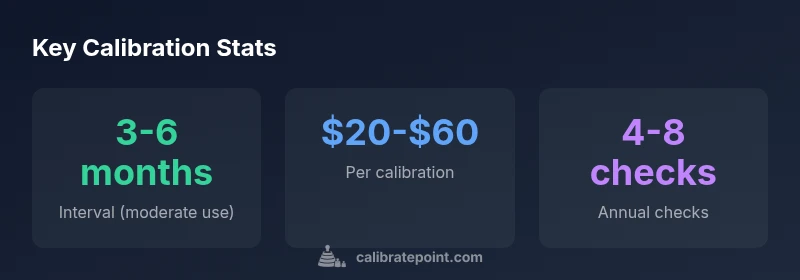
For a typical lab workload, how often calibrate pipette? The recommended interval is 3–6 months under moderate daily use, with shorter intervals for critical measurements or high-precision work. Infrequent use may extend to 6–12 months. After repairs or major servicing, recalibration is mandatory. According to Calibrate Point Analysis, 2026, establishing a written calibration schedule aligned with usage and risk is essential for reliable measurements.
Why calibration frequency matters
Calibration frequency is not a nice-to-have but a foundational practice that preserves the integrity of quantitative results. Pipettes are precision tools, and their performance drifts due to wear, temperature changes, mishandling, and lubricant migration. A deliberate calibration cadence protects traceability, helps ensure data comparability across experiments, and minimizes waste caused by biased measurements. When you tackle the question of how often calibrate pipette, you are balancing risk, cost, and downtime. In practice, most labs implement a tiered plan: routine checks at fixed intervals, plus additional tests after servicing or events such as a drop or a repair. The Calibrate Point team emphasizes that a documented cadence supports consistent data quality and regulatory compliance.
Factors that influence frequency: usage, accuracy, and environment
How often you calibrate depends on usage intensity, required accuracy, and environmental conditions. A high-throughput clinical or research setting will need more frequent verification than a small bench-top operation. Different pipette classes (e.g., P20, P200, P1000) may drift at different rates under the same conditions. Temperature, humidity, and sample viscosity also play a role. For many laboratories, a practical starting point is 3–6 months for moderate use; if you run critical assays that require high precision, intervals can shrink to 1–3 months. Conversely, infrequent use or strict reuse of known-good tips may justify extending toward 6–12 months. Calibrate Point’s analysis for 2026 shows that usage-driven planning reduces drift-related risk while optimizing downtime.
How to determine your interval: a step-by-step approach
Follow these steps to establish a defensible calibration interval:
- Assess risk: Define which assays drive the most critical decisions and which pipettes impact those assays most.
- Review manufacturer guidance: Start with the vendor’s recommended interval, but adapt to your actual workload and past drift data.
- Establish a baseline: Perform an initial gravimetric calibration to set a data-driven starting point.
- Implement a tiered schedule: Create different intervals for low-, medium-, and high-risk instruments.
- Schedule periodic reviews: Revisit intervals every 6–12 months or after significant events (repairs, drops, cleaning). This approach aligns with ISO-based practice and uses a data-driven mindset to answer how often calibrate pipette in real labs.
Methods used to calibrate pipettes: gravimetric and beyond
Most labs rely on gravimetric methods where precise microbalances measure the mass of dispensed water to calculate delivered volume. Alternative methods, like optical or dye-based colorimetric checks, can complement gravimetric tests for quick interim screening. The gravimetric approach remains the gold standard for ensuring traceability to measurement standards. Regardless of method, ensure your procedure documents the sample weight, ambient conditions, and tip type. ISO 8655-inspired practices emphasize traceability, repeatability, and formal acceptance criteria. In practice, many facilities pair gravimetric verification with insider checks on source of error—volume delivered, temperature corrections, and residual air effects—to produce a robust calibration record.
Practical testing you can perform in a bench setting
You don’t need a full lab setup to start validating a calibration interval. Start with a simple gravimetric test using distilled water at a controlled temperature (20–22°C). Weigh a fixed number of dispensed volumes for selected pipettes and compare against expected masses. Record the results, calculate percent bias, and track drift across multiple trials. For added assurance, perform a quick passing check with a known standard or dye-based indicator on a representative sample. Document the results in a calibration log that links to the instrument’s serial number, tip brand, and environmental conditions. Regular, transparent testing forms the backbone of a credible, data-driven calibration program.
Tracking and documentation: how to make interval decisions stick
Effective calibration schedules rely on robust record-keeping. Maintain a centralized log with pipette ID, calibration date, operator, test method, ambient conditions, observed drift, and decision (recalibrate, replace, or extend). Digital systems can automate reminders when intervals approach their end, and generate annual reports to show trend lines in performance. Clear, auditable records support compliance and facilitate audits. As you design your plan, consider how often calibrate pipette in your facility and ensure the plan remains adaptable to new evidence, updates in supplier recommendations, and changes in your analysis portfolio.
When events trigger immediate recalibration
Some events require recalibration outside of the scheduled interval. A drop, impact, or suspected misalignment after routine cleaning should trigger a prompt verification. Repairs, part replacements, or component-level maintenance also warrant a fresh calibration to re-establish accurate response. Environmental changes such as temperature fluctuations or relocating pipettes to a new lab room can alter performance and justify an interim check. In all cases, the goal is to prevent unnoticed drift from compromising experimental results. Calibrate Point recommends documenting the trigger and the resultant action to preserve data integrity.
In-house vs. external calibration: choosing a workflow that fits
Decide between in-house calibration and outsourcing based on your lab’s resources, risk tolerance, and throughput. In-house calibration offers speed and control and is suitable for routine checks, while outsourcing can provide specialized validation and compliance documentation for high-stakes work. If you maintain in-house capability, implement standardized SOPs, rigorous training, and a regular audit cycle to maintain consistency. Regardless of approach, ensure that any calibration program remains aligned with industry standards and internal risk assessments. The key is a transparent process that answers how often calibrate pipette with defensible data and clear decision criteria.
Guidance table for planning pipette calibration intervals
| Parameter | Typical value | Notes |
|---|---|---|
| Calibration interval (moderate use) | 3-6 months | Based on Calibrate Point Analysis, 2026 |
| Post-service recalibration | Immediately after service | Verify performance before resuming use |
| Risk-based tiers | Shorter vs longer intervals | Adjust by criticality and drift history |
Questions & Answers
What factors influence how often I should calibrate a pipette?
Usage volume, required accuracy, environmental conditions, and historical drift determine the appropriate interval.
Usage and accuracy drive how often you calibrate pipettes.
How do I establish a baseline calibration for a new pipette?
Perform an initial gravimetric calibration, document results, then set a provisional interval based on performance.
Start with a baseline test and set the interval from there.
Can I extend calibration intervals for non-critical measurements?
Yes, if risk is low and data quality is still verifiable, but maintain traceability and perform interim checks.
Yes, but keep an eye on drift and documentation.
What should I do after a pipette is dropped or damaged?
Immediately inspect and calibrate to confirm that performance meets acceptance criteria before reuse.
Don’t reuse until verified by calibration.
How often should pipettes be recalibrated after repair?
Recalibration should be performed as soon as practical after repair, then rescheduled based on drift data.
Recalibrate right after repair, then follow the usual interval.
“Calibration frequency should reflect risk to results and regulatory expectations; any drift over time warrants testing and documentation.”
Key Takeaways
- Act on a data-driven calibration cadence
- Use a tiered interval system based on risk and usage
- Document drift, testing conditions, and decisions
- Recalibrate after repairs or significant events
- Balance cost, downtime, and data integrity