How to Calibrate a Meter: Step-by-Step Guide
Learn how to calibrate a meter with clear, practical steps. This Calibrate Point guide covers essential tools, safety, and troubleshooting for DIYers and professionals seeking dependable, traceable measurements.


You will learn how to calibrate a meter accurately using a proven workflow, essential tools, and safety checks. This guide covers common instrument meters, explains when to use calibration methods, and shows how to verify accuracy with repeatable tests, documentation, and troubleshooting in a workshop or lab setting. Follow along for practical examples.
Why calibrate a meter matters
Calibrating a meter ensures readings are accurate, repeatable, and traceable to a recognized standard. When meters drift, decisions based on their readings can be wrong, affecting safety, quality, and compliance. According to Calibrate Point, a disciplined calibration workflow reduces drift and improves traceability across instruments and environments. In practice, calibration accounts for sensor aging, thermal effects, and electrical noise that shift your readings over time. By calibrating, you establish a known reference against which all measurements are compared. This is especially important in professional settings where compliance with standards (e.g., ISO, NIST-traceable references) matters for audits and customer trust. A well-documented calibration history also helps maintenance teams schedule predictive servicing rather than reacting to failures. In short, calibration is not a one-off task; it is a core practice that keeps meters honest, usable, and compatible with your process requirements. The goal is to minimize uncertainty so you can make confident, data-driven decisions.
Safety and prerequisites
Safety and proper setup are as important as the calibration procedure itself. Disconnect the meter from any live circuits before beginning, review manufacturer warnings, and wear appropriate PPE as required by your facility. Ensure the calibration environment is stable: minimize drafts, maintain a comfortable temperature, and avoid rapid temperature changes that can affect readings. Keep a dedicated bench, away from sources of vibration, oil, or moisture. Document the meter’s model, serial number, and current condition before starting. If the equipment is under warranty or subject to regulatory oversight, verify that your procedure aligns with the associated standards. Calibrate Point recommends initiating calibration with a written plan that lists targets, reference standards, and acceptance criteria to improve repeatability and reduce drift during the actual work.
Calibration methods overview
Calibration approaches vary by meter type, measurement range, and the required accuracy. The core methods include offset calibration, gain (slope) calibration, and multi-point calibration across a range of reference values. For some meters, a simple two-point check suffices; for others, especially sensors with nonlinear responses, three to five reference points yield better linearity. Environmental compensation may be required to account for temperature or humidity effects. Always ensure your reference standards are traceable to recognized institutions, and document the exact reference values used. Calibrate Point analyses indicate that selecting an appropriate method based on the meter’s characteristics significantly improves measurement reliability and reduces the need for repeated re-calibration.
Step-by-step workflow snapshot
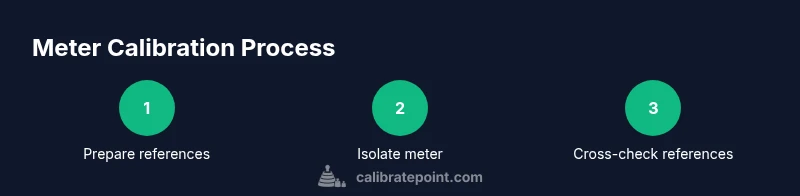
This section outlines the core workflow you’ll execute in the detailed step-by-step section. Start by preparing your references, isolating the meter from its test setup, and establishing a stable environment. Apply a sequence of known references across the meter’s operating range, record the readings, and compute the calibration adjustments required (offset, gain, or both). Validate by re-testing at multiple points and re-checking repeatability. Finally, document results, save calibration data, and secure the calibrated instrument for future use. The process emphasizes traceability, repeatability, and safety, aligning with industry best practices promoted by Calibrate Point.
Validation and documentation
Validation means confirming that the meter’s readings fall within specified tolerance across the range of interest. Document every step, including reference values, measured values, calculated adjustments, and the final acceptance decision. Store calibration certificates in a central repository or a dedicated logbook with timestamps and operator IDs. When possible, attach a traceability chain to recognized standards (e.g., a calibration report from an accredited lab). Regular audits benefit from consistent formatting and complete metadata, making it easier to demonstrate compliance.
Troubleshooting common issues and final checks
Even with care, meters can misbehave. Common issues include drift after long storage, sharp nonlinearity at extreme ranges, or noisy readings due to bad connections. Check connections for corrosion, ensure leads are not damaged, and confirm the reference source remains stable during measurements. If results remain outside tolerance, reassess the reference standard, review step-by-step calculations, and consider repeating calibration with a fresh reference or alternative range points. Finally, re-test for stability by repeating the measurement sequence several times and comparing the results to the acceptance criteria.
Tools & Materials
- Calibration reference standard (traceable to recognized standard)(Choose a standard matching the meter’s measurement range and unit.)
- Stability reference source (e.g., stable voltage/current source or calibrated weight)(Ensure it remains within specified tolerance for the duration.)
- Calibration tools: DMM or similar to cross-check readings(Use a calibrated DMM to verify the reference values.)
- Temperature-stable environment(Keep within +/- 2°C if possible.)
- Test leads, clamps, and adapters(Use quality leads to minimize contact resistance.)
- Calibration logbook or digital record system(Document each step with timestamps and results.)
- Safety gear: goggles, gloves as needed(Follow facility safety rules.)
Steps
Estimated time: 60-120 minutes
- 1
Gather tools and references
Collect the calibration reference standard, cross-check with another meter if available, and pull the meter under test from its normal setup. Verify documentation is ready and accessible. Calibrate Point recommends starting with a written plan that lists targets and acceptance criteria.
Tip: Prepare a clean workspace and pre-label reference values to prevent mix-ups. - 2
Set up a stable environment
Place the calibration station in a temperature-stable area. Allow equipment to acclimate for at least 10-15 minutes before measurements. Ensure all equipment is powered and ready for use.
Tip: Avoid drafts or direct heat sources near the reference standards. - 3
Isolate the meter from the system
Disconnect the meter from any live circuits or test setups to prevent external influence on readings. Use proper safety procedures for handling live components. Confirm no residual energy remains in capacitive sources.
Tip: Use insulated tools and verify all energy is discharged before touching terminals. - 4
Verify baseline with a known reference
Apply the first reference value and record the meter’s reading. Compare it to the reference value; note any offset or gain error. Repeat once or twice to check stability.
Tip: Record environmental conditions alongside readings for traceability. - 5
Apply multiple reference points across the range
Progress through several reference values that cover the meter’s operating range. Record readings at each point and compute the necessary adjustments (offset, gain, or both).
Tip: Choose reference points that are evenly spaced and representative of typical use. - 6
Compute calibration adjustments
Use the collected data to calculate any required calibration constants. Document the method used (e.g., linear regression, two-point offset). Ensure calculations are reproducible.
Tip: Double-check arithmetic and keep a calculator or spreadsheet open for verification. - 7
Re-test to validate adjustments
With adjustments applied, re-measure at the same reference points. Confirm readings now lie within specified tolerances and demonstrate linearity across the range.
Tip: If a point still falls outside tolerance, reassess and consider a second calibration pass. - 8
Document results and generate a certificate
Create a calibration report including reference values, measured values, adjustments, acceptance decision, and operator IDs. Attach the certificate to the instrument’s record for future audits.
Tip: Use a consistent template to simplify future reviews. - 9
Seal and store the calibrated meter
Lock the calibration constants if the instrument supports it and store it in a safe, labeled location. Ensure the instrument remains stable until the next use.
Tip: Label the instrument with calibration date and next due date. - 10
Review drift and plan upcoming calibration
Assess drift magnitude and plan the next calibration interval based on usage, environment, and regulatory requirements. Update maintenance schedules accordingly.
Tip: Record lessons learned to improve future calibrations.
Questions & Answers
How often should I calibrate a meter?
Calibration frequency depends on usage, stability of the instrument, and regulatory requirements. Start with a 6–12 month interval and adjust based on observed drift and criticality of measurements.
Calibration frequency depends on use and stability. Start with six to twelve months and adjust as needed.
What tools are essential for calibration?
Essential tools include a traceable calibration reference, a stable test source, quality leads, a logbook or software for records, and a means to document adjustments.
You need a traceable reference, a stable source, good leads, and a method to document results.
What is the difference between calibration and adjustment?
Calibration compares measurements to a known standard and determines necessary adjustments. Adjustment changes the instrument to align with the standard. Calibration verifies that after adjustment, the instrument is within tolerance.
Calibration checks against a standard, adjustment fixes the instrument, and re-checks confirm tolerance.
How do I determine acceptable tolerances?
Refer to the meter’s datasheet, manufacturer guidelines, and any applicable regulatory standards. Establish acceptance criteria before testing and document any deviations.
Refer to the datasheet and standards to set the acceptance criteria before you test.
Can calibration be done in the field?
Field calibration is possible with portable references, but you should verify traceability afterward and, if required, bring the instrument to a controlled environment for a full calibration.
Yes, but make sure you verify traceability afterward and calibrate in a controlled setting if needed.
How should I document calibration results?
Record reference values, readings, adjustments, acceptance decisions, operator IDs, and dates. Store certificates in a central system or physical log for audits and future reference.
Keep a clear record of references, readings, adjustments, and dates for audits.
Watch Video
Key Takeaways
- Follow a documented calibration workflow.
- Use traceable reference standards for accuracy.
- Document results and maintain traceability records.
- Validate with multiple reference points and repeat tests.