How to Calibrate a Spectrometer for Accurate Measurements
Learn to calibrate a spectrometer with traceable standards and documented procedures to ensure accurate, repeatable spectral measurements in your lab and reliable results.


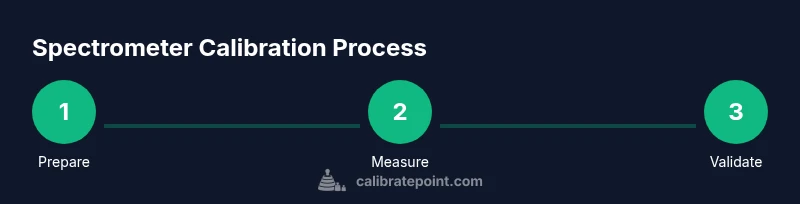
Calibrate a spectrometer to ensure accurate wavelength and intensity readings. This guide covers preparing traceable standards, aligning the instrument, running wavelength and baseline calibration, and validating results with independent references. By following a structured workflow, you’ll reduce drift, improve repeatability, and produce reliable spectra in your lab. See our detailed step-by-step calibration guide.
What is calibrating a spectrometer and why it matters
Calibration of a spectrometer is the process of aligning the instrument's wavelength scale and its intensity response with known references so that the measured spectra reflect true values. For researchers and technicians, accurate calibration underpins data validity, cross-instrument comparability, and regulatory compliance. According to Calibrate Point, regular calibration reduces drift and maintains data integrity across instrument lifetimes. In practice, this means you'll verify that the device reads wavelengths where expected, and that the signal strength corresponds to the actual light reaching the detector. Mastering how to calibrate a spectrometer is not a one-off task; it’s a repeatable routine that protects your data through daily use and over time. In this guide, we will walk through concepts, standards, environmental controls, and documentation practices so you can implement a robust calibration program in your laboratory. Calibrate Point's perspective on calibration emphasizes that precision grows from consistent method use and careful record-keeping.
Calibration concepts: wavelength accuracy, intensity response, and baseline correction
Three core aspects drive a reliable spectrometric measurement: wavelength accuracy, which ensures spectral features appear at correct positions; intensity response, which guarantees that the signal scale matches the true optical power; and baseline correction, which removes instrument-originated background. If a line around the expected wavelength is shifted, or if the baseline drifts with ambient light or temperature, interpretation can be biased. Baseline corrections help distinguish genuine spectral features from artifact. A robust calibration routine checks wavelength against certified lines, validates intensity with traceable standards, and confirms a clean baseline under identical conditions to measurement runs. The Calibrate Point framework stresses maintaining stable temperature, consistent illumination, and a documented calibration history to separate instrument drift from sample variability.
Reference standards and traceability: selecting materials that align to standards
Reference standards are the backbone of credible calibration. Use NIST-traceable wavelength standards whenever possible, supplemented by certified absorbance or emission references for intensity checks. Maintain certificates that list the exact lot, expiry, and calibration methods used to derive the standard values. When selecting materials, prefer those with proven stability over the instrument’s expected use period and consider both primary standards and ready-to-use secondary references. Keep a log of each standard's serial numbers, manufacturer specifications, and acceptance criteria. This careful attention to traceability ensures that your calibration is defensible and repeatable, which is critical for quality control and regulatory audits. In practice, you’ll assemble a small kit of line references, dark references, and colored standards that you can re-check on a routine schedule.
Environmental and setup prerequisites: warm-up, light control, and stability
Before calibration, ensure the instrument is in a stable environment. Power the spectrometer on well before starting to allow full digital and thermal stabilization. Eliminate stray light by calibrating in a light-tight enclosure or using a dedicated dark chamber when recording baselines. Check ambient temperature and humidity, as significant drift can affect detector response and lamp stability. Use a consistent lamp warm-up time as specified by the manufacturer, and perform calibrations at the same time of day if your workflow requires repeatability. Proper setup minimizes variability, helping you separate instrument drift from sample-related changes. Remember to follow a safety protocol for handling any high-intensity sources, and avoid touching optical surfaces with bare hands.
Data management and record keeping: calibration logs and version control
A robust calibration program requires thoughtful data management. Create a calibration log that records instrument ID, date, operator, calibration standards used, environmental conditions, and raw and processed results. Include the exact calibration equations, any coefficients derived, and the final instrument state after calibration. Store data in a central, backed-up repository with version control so you can track how calibration baselines evolve over time. Regularly audit logs for completeness and consistency, and ensure that multiple team members can reproduce historic results if needed. Good data management supports traceability, audit readiness, and long-term reliability of spectral measurements.
Common mistakes and how to avoid drift
Common pitfalls include inconsistent lamp warm-up, measuring in a poorly controlled environment, and failing to document reference lot information. Another frequent issue is using outdated or non-traceable standards, which undermines calibration validity. Users also neglect to verify the entire optical path, including fiber, cuvettes, and sample holders, which can introduce hidden losses or scattering. To avoid these issues, implement a standard operating procedure that specifies warm-up times, enclosure conditions, reference checks, and a mandatory calibration review after each lamp replacement or optical adjustment. Regular external quality checks, such as using a second reference standard, can catch drift early and prevent cumulative errors. Finally, ensure you have a clear plan for archiving both successful calibrations and failed attempts to learn from mistakes.
Case study: applying calibration in a small lab
In a compact teaching lab, a spectrometer used for colorimetric analysis required monthly calibrations. The team used a NIST-traceable white reference for intensity and a neon lamp line for wavelength checks. They followed a fixed warm-up protocol, recorded environmental data, and logged all results in a shared spreadsheet. After implementing the procedure, they observed a notable reduction in wavelength drift and improved repeatability across measurement days. The workflow became a standard part of their routine, and results could be compared with confidence to those from neighboring labs using similar equipment. This case demonstrates how a careful calibration program scales from research to education settings with modest resource investment.
Tools & Materials
- NIST-traceable wavelength standard(Neon or mercury-argon lamp with certified lines; factory certificate must be current)
- Spectrometer-compatible calibration software(Include wavelength calibration module and support for dark/reference frames)
- Reference standards for intensity(Certified absorbance/fluence references or calibrated light sources)
- Optical cleaning supplies(Lint-free wipes, optical cleaning solution; handle optics with care)
- Cuvettes or reference samples(Use clean, defect-free samples for baseline checks)
- Dark-reference tile or cap(For baseline dark current measurements)
- Calibration logbook or digital log(Template or spreadsheet to capture all calibration details)
- Timer or clock(Accurate timing for warm-up and measurement windows)
Steps
Estimated time: 2-3 hours
- 1
Prepare instrument and environment
Power on the spectrometer and allow full warm-up per the manufacturer’s guidelines. Verify the lab is free from stray light and temperature/humidity are monitored. Ensure all accessories (lenses, cuvettes, and holders) are clean and ready.
Tip: Document the actual warm-up time and any deviations from the standard procedure. - 2
Configure calibration software and reference frames
Open the calibration module, select wavelength and intensity calibration, and load the reference standards. Set the instrument to the same optical configuration used for routine measurements.
Tip: Ensure software versions and standard certificates are current. - 3
Record dark (baseline) spectrum
With shutter closed or in dark enclosure, acquire a dark spectrum to characterize detector offset and dark current. Use the same exposure settings as for standard measurements.
Tip: Store dark frames separately and label by date and time. - 4
Measure wavelength reference lines
Place the wavelength standard in the optical path and capture spectra. Identify peak positions and compare them to certified line centers. Note any systematic shifts across the scan range.
Tip: If lines are broadened, check slit width and optical alignment. - 5
Adjust wavelength calibration
Apply linear or polynomial corrections to align observed lines with reference centers. Recompute residuals to confirm the fit meets acceptance criteria.
Tip: Avoid overfitting; keep residuals within the manufacturer-specified tolerance. - 6
Validate intensity response
Measure a stable intensity standard and verify that signals scale linearly with known input. Capture multiple frames to assess repeatability and check for lamp drift.
Tip: Perform a quick second check with an independent reference if available. - 7
Document results and archive
Record all measurements, calibration coefficients, environmental conditions, and the instrument state after calibration. Save the data, certificates, and a concise summary in the calibration log.
Tip: Tag the calibration with a version number and sign-off by the operator.
Questions & Answers
What is the purpose of wavelength calibration in a spectrometer?
Wavelength calibration aligns observed spectral lines with their true wavelengths, ensuring correct identification and quantification of samples. It reduces systematic errors in peak positions and supports comparability across instruments.
Wavelength calibration makes sure the spectral lines line up with their true wavelengths, reducing measurement bias.
How often should calibrations be performed?
Frequency depends on usage, stability, and regulatory requirements. Critical labs may calibrate weekly or after lamp changes; routine checks monthly are common for educational settings.
Calibration frequency depends on use; more demanding setups need more frequent checks.
What standards are needed for calibration?
Use traceable wavelength standards for wavelength checks and calibrated references for intensity. Always verify expiry dates and maintain certificates for traceability.
Wavelength checks require traceable standards; keep certificates handy.
Can calibration be performed without reference standards?
Calibration without references is possible but less reliable. You can use known samples or internal lamps as provisional references, but you should acquire proper standards as soon as possible.
You can calibrate with internal references, but it's less reliable without certified standards.
What is the difference between wavelength and intensity calibration?
Wavelength calibration fixes the position of spectral features; intensity calibration corrects the detector’s response across wavelengths to reflect true optical power.
Wavelength aligns positions; intensity corrects the signal strength across the spectrum.
How should calibration results be documented?
Document date, instrument ID, standards used (with lot numbers), environmental conditions, calibration coefficients, and post-calibration state. Store data securely with backups and version control.
Keep a detailed log with all standards and conditions for traceability.
Watch Video
Key Takeaways
- Plan calibration with traceable standards and documented procedures
- Maintain a stable environment to reduce drift
- Record complete calibration data for traceability
- Validate both wavelength and intensity to ensure accuracy