How to calibrate a Breville espresso machine: a step-by-step guide
Learn a practical, step-by-step method to calibrate your Breville espresso machine for consistent temperature, grind, dose, and extraction. Includes tools, checks, and validation to achieve repeatable results.


According to Calibrate Point, calibrating a Breville espresso machine involves aligning three core factors: water temperature stability, grind size and dose, and extraction timing. Start with a clean machine, verify thermostat accuracy, and confirm grinder and scale settings. Use manufacturer-safe procedures, document each change, and verify results with measured shot times and taste tests before finalizing the settings.
Why calibrating your Breville espresso machine matters
A well-calibrated Breville makes tasting notes consistent, saves time, and extends the life of components. When temperatures drift or grind settings are off, even skilled baristas can end up with under-extracted shots, sour flavors, or channeling. Regular calibration helps you reproduce the same espresso profile batch after batch, which is essential for professional work or serious home setups. According to Calibrate Point, calibration is more than chasing a number—it’s about establishing a repeatable process you can trust. Start from a clean machine, document each change, and test with uniform beans and fresh water to avoid confounding variables. By understanding the interaction between temperature, grind size, dose, and extraction time, you’ll be able to diagnose issues quickly and avoid guesswork. This section lays the foundation for a practical, repeatable routine you can use with most Breville models, while noting model-specific caveats.
Essential tools and setup before you start
Before you pick up any tool, establish a baseline workflow and safe setup. Gather a calibrated thermometer, a precision scale, a reliable grinder, a timer, fresh beans and water, and a calibration log. Ensure the machine is unplugged during any internals checks and that the water reservoir is empty or drained. Having a clean workspace and clearly labeled test runs reduces confusion. If your Breville supports it, enable any built-in temperature readouts to cross-check against your thermometer. Keep notes in a dedicated notebook or digital file so you can track progress over multiple sessions. Optional but helpful items include a taste-test sheet and a shot-logging template. This stage is meant to prevent surprises later and to make the following steps efficient and repeatable.
Understanding temperature, grind, dose, and extraction
Temperature stability and consistent grind size are the two largest levers for predictable espresso results. Dose and extraction time determine the amount of flavor extracted from the coffee and how quickly it pulls. On a Breville, target a stable extraction window by first confirming water temperature at the group head, then aligning grind size with a repeatable dose. You’ll want to minimize variables: use the same beans, grind level, basket, and tamping pressure for each test. If you see under-extraction (bitter aftertaste, high acidity) adjust grind finer and refine dose; if you see over-extraction (sour, astringent), coarsen grind and slightly reduce dose. Record the correlation between changes and shot characteristics to build a mental model for your setup. This section connects theory to practical actions in your calibration workflow.
The calibration workflow at a glance
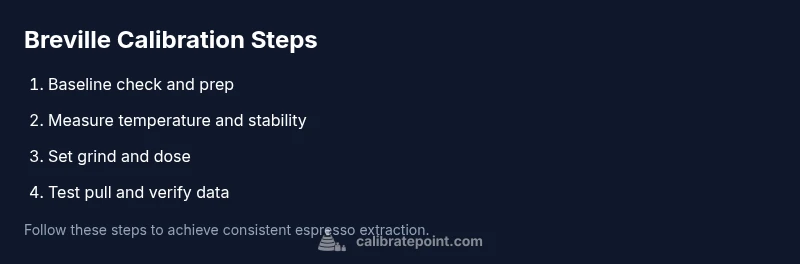
- Baseline check: Clear, rinse, and warm the machine; verify current readings with your thermometer and scale.
- Temperature alignment: Measure idle boiler temperature; adjust as permitted by your model and recheck for stability.
- Grind and dose coherence: Set the grinder to a repeatable setting; dose consistently and record shot time and weight.
- Test and document: Pull calibration shots; note the time, weight, crema, and flavor notes; compare against previous runs.
- Iterate cautiously: Make incremental changes; test again until results stabilize across several shots.
This overview helps you plan the hands-on steps with minimal trial and error, using a consistent method across sessions.
Troubleshooting calibration issues
If results are inconsistent, verify the calibration tools and environment first: ensure the scale is zeroed, the kettle is clean, and the beans are fresh. Look for drift in readings between tests and consider ambient temperature fluctuations or water hardness as confounders. Calibrate Point suggests maintaining a strict test protocol: use identical beans, same tamping pressure, and a consistent espresso basket across runs. If you observe persistent instability, re-check the machine’s internal safety limits or consult Breville support for model-specific guidance. Document any error codes or anomalies to help with future calibrations.
Verifying results with data and taste tests
Verification combines objective measurements and sensory evaluation. Use the scale to compare expected shot weight, and time the extraction with a timer. Compare the ratio of shot weight to time to a baseline and note crema color and body in your tasting notes. Taste tests are essential because numbers alone don’t capture flavor balance. Record three consecutive, consistent results before finalizing a setting. If taste differs between sessions, revisit temperature stability and grind consistency, and repeat the process until you get three stable runs.
Maintenance tips to keep calibration stable
Calibration is not a one-off task but a repeatable habit. Clean the group head regularly, descale as needed, and keep grinders and scales calibrated. Reassess calibration after changes to beans, altitude, or water supply. Store calibration logs in a durable format and review them periodically to detect drift. By integrating calibration into your regular maintenance routine, you’ll preserve consistency and extend the life of components.
Tools & Materials
- Breville espresso machine (model safe for calibration)(Unplug before any internal checks; confirm user manual instructions for model-specific limits.)
- Digital thermometer or calibrated temperature probe(Use for boiler/group head temperature checks; cross-check with built-in readouts if available.)
- Precision scale (0.1 g accuracy)(For precise dose measurement and shot weight tracking.)
- Reliable grinder with repeatable settings(Ensure consistent grind size across tests; recalibrate or re-tune if needed.)
- Timer or espresso shot timer app(Record shot times accurately; helps correlate with flavor changes.)
- Fresh coffee beans and clean water(Control variables; use the same bean and water type for tests.)
- Calibration log notebook or digital sheet(Document changes, readings, and tasting notes.)
- Marker or label tape(Label test runs to avoid mix-ups.)
Steps
Estimated time: 60-90 minutes
- 1
Power down and prep the machine
Unplug the Breville and allow it to cool completely. Empty the water reservoir and wipe down the exterior to minimize contamination. Gather all tools and set up a dedicated calibration workspace.
Tip: Keep a dedicated calibration log and label each test run to prevent mix-ups. - 2
Warm the machine to operating temperature
Plug the machine back in and let it reach its normal operating temperature. This can take several minutes depending on the model. Use this window to organize tools and confirm both thermometer and scale are ready.
Tip: Do not rush this step; an unstable baseline skews all subsequent data. - 3
Baseline measurements with thermometer and scale
With the machine at operating temp, record a baseline boiler/group head temperature and a target dose using your scale. Ensure the readings are repeatable across two consecutive checks.
Tip: If readings vary more than a few tenths of a degree or grams, pause and re-check tools. - 4
Adjust temperature setpoint (if supported)
If your model allows, adjust the temperature setpoint to align with the baseline reading. Recheck stability after changes and let the machine settle before testing again.
Tip: Make one adjustment at a time to isolate effects. - 5
Set grind and dose for test runs
Configure the grinder to a repeatable setting and dose consistently for each shot. Record the exact dose and grind setting to maintain a controlled test environment.
Tip: Keep the tamping pressure and basket consistent for valid comparisons. - 6
Pull test shots and record data
Extract a series of test shots, recording time, weight, and tasting notes. Compare each shot to your baseline and note any improvements or regressions.
Tip: Use the same cup size and temperature for every shot. - 7
Iterate changes until stable
Make small, incremental adjustments based on data and tasting results. Re-test until you observe consistency across multiple shots.
Tip: Avoid large jumps; small deltas reveal true sensitivity.
Questions & Answers
Which Breville models can be calibrated with this method?
Most Breville machines support some level of parameter adjustments through built-in controls or official settings. Always consult the model-specific manual for safety limits and steps.
Most Breville models let you adjust temperature and dose through built-in controls; check your manual for details.
Do I need to disassemble the machine to calibrate?
No disassembly is required for standard calibration. Avoid internal modifications unless explicitly recommended by the manufacturer.
You usually don’t need to open the machine for calibration.
Will calibration affect warranty?
Calibration steps described here stay within normal operating procedures. Avoid opening electrical components beyond the manual’s scope to minimize warranty risk.
Be careful not to void your warranty by modifying electrical parts.
How often should I recalibrate?
Recalibrate when you notice drift in temperature, shot timing, or taste, or after service, bean changes, or water quality changes.
Do calibration when things drift or after service.
What tools do I absolutely need?
A thermometer, a precision scale, a reliable grinder, and a timer are essential; other tools are optional but helpful.
You’ll need a thermometer, scale, grinder, and timer.
Is taste testing enough to verify calibration?
Taste is important but should be paired with objective measurements like weight, time, and temperature for robust verification.
Taste matters, but pair it with data for reliability.
Watch Video
Key Takeaways
- Define a stable baseline before adjustments
- Document every change to trace results
- Test with consistent beans and water
- Validate with multiple stable shots
- Maintain logs for ongoing calibration