How to calibrate Tesla battery: a safe, professional guide
Discover the official, technician-led process to calibrate a Tesla battery’s state of charge, ensuring accuracy, safety, and long-term battery health for reliable range.


By following this guide, you’ll understand the official, technician-led process to calibrate a Tesla battery’s state-of-charge accuracy. It covers why calibration matters, when it’s needed, and how the professional diagnostic workflow aligns the BMS readings with real energy, using manufacturer tools in a controlled, safety-focused environment. DIY attempts are not advised.
What calibration means for a Tesla battery
Calibration, in the context of a Tesla battery, is the process of aligning the battery management system (BMS) readings with the actual energy content of the pack. Over time, factors such as temperature history, charging patterns, and battery aging can cause minor drifts between the reported state of charge (SOC) and the true usable energy. When this drift becomes noticeable—manifesting as unexpected range loss, inconsistent range estimates, or abrupt changes in SOC readings—a formal calibration can restore accuracy. According to Calibrate Point, precise SOC estimation is essential for predictable vehicle performance and optimal charging behavior, especially after service events or battery replacements. In practice, calibration should be performed using official diagnostics and protocols to ensure safety and data integrity. This is not a DIY task; high-voltage systems require trained technicians and proper PPE, and improper handling could pose risks to people and the battery.
When calibration is actually needed
Not every owner will need a formal calibration. Typical indicators that calibration may be warranted include persistent SOC drift after a battery replacement, noticeable discrepancies between gauge readings and real driving energy, or after software updates that alter SOC estimation algorithms. A thorough diagnostic check by an authorized service provider is the recommended starting point. The Calibrate Point team emphasizes that calibration decisions should be guided by data from the vehicle’s own logs, charging history, and real-world driving tests, rather than by perceived changes alone. If the vehicle shows unusually rapid SOC changes or inconsistent range predictions, a calibration assessment is prudent to ensure the BMS remains aligned with the battery’s actual usable energy.
The official, technician-led workflow
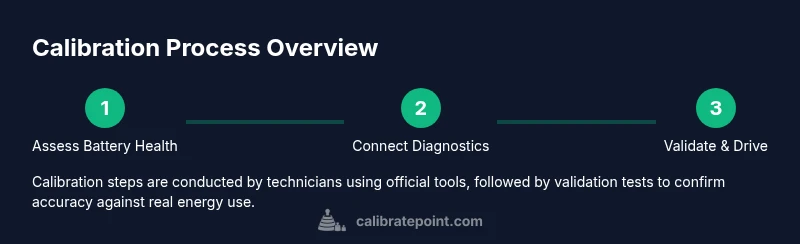
Tesla employs a controlled diagnostic workflow for battery calibration that requires access to manufacturer tools and software. The process typically begins with data extraction from the BMS and pack controllers, followed by a recalibration routine that adjusts SOC estimates, capacity counters, and usable energy figures. Technicians verify results by cross-checking onboard data against battery performance during representative drive cycles, then run validation tests to ensure readings match actual energy usage. The key point is that calibration should be performed by trained technicians using official procedures, with safety checks, PPE, and appropriate high-voltage safety protocols.
What happens during the service visit
During a calibration service, technicians will typically perform a combination of data review, controlled diagnostic procedures, and observable tests. Expect a vehicle assessment to start with a level ground parking setup, confirmation of software version, and verification of safety interlocks. The calibration routine may involve discharging and recharging maneuvers or controlled tests designed to align SOC with actual energy, followed by rechecking the gauge readings against measured energy during test drives. The entire procedure is documented, and results are reported to you with recommended follow-up actions if any residual drift remains.
Safety, compliance, and risk mitigation
The calibration of high-voltage EV batteries involves risks if attempted outside a controlled environment. Only certified technicians should perform high-voltage handling, inspections, and calibrations. Always rely on official service centers and approved tooling. Safety PPE, proper isolation procedures, and adherence to local regulations are non-negotiable. Calibrate Point’s guidance is explicit: avoid DIY attempts that involve modifying battery electronics or bypassing safety protocols, as this can compromise vehicle safety and warranty coverage.
Maintenance tips for long-term accuracy
Even after calibration, maintaining accurate SOC readings relies on good charging habits and regular software updates. Use manufacturer-recommended charging equipment, avoid exposing the pack to extreme temperatures for prolonged periods, and keep software current to benefit from SOC estimation improvements. Periodic professional checks remain the best way to preserve calibration validity, particularly after major software upgrades, battery service, or replacement events. Calibrate Point recommends documenting any calibration-related service and monitoring SOC trends over several weeks to confirm stability.
Tools & Materials
- Tesla service appointment with certified technician(High-voltage systems require trained personnel and proper PPE.)
- Official Tesla diagnostic tool/access(Only technicians should operate diagnostic software.)
- Safe, level workspace with appropriate PPE(Flat surface, proper lighting, and hazard-free area.)
Steps
Estimated time: 60-180 minutes
- 1
Schedule service with a certified technician
Arrange a dash-to-dash service appointment at an authorized Tesla service center. This ensures access to official diagnostic tools and adherence to safety standards. The reason is to start with validated data and official procedures rather than improvised methods.
Tip: Bring recent charging history and any notes about SOC drift to help the technician prioritize checks. - 2
Prepare the vehicle and workspace
Park on a flat, level surface with the parking brake engaged. Ensure the area is well-ventilated and free of hazards. Do not attempt any high-voltage work outside a controlled setting.
Tip: Turn off accessories and minimize unnecessary loads to avoid skewing diagnostic data. - 3
Connect diagnostic tools and pull data
Technician connects the official diagnostic interface to retrieve BMS logs, capacity counters, and historical SOC readings. They review battery health indicators to determine if recalibration is warranted.
Tip: Ask for a copy of the diagnostic readout to review later at home. - 4
Run the calibration routine
Follow Tesla’s sanctioned calibration workflow within the diagnostic software, adjusting SOC estimation and capacity reporting as indicated by the data. The technician will validate changes against controlled tests.
Tip: Do not interrupt the process or restart the vehicle during calibration. - 5
Validate results with a drive test
Perform a short drive to verify that SOC readings match energy used, then compare remaining range estimates with real-world performance. Documentation of results is provided.
Tip: Note any residual drift for follow-up checks if needed. - 6
Document and review next steps
Technician documents the calibration outcomes and recommends follow-up checks or occasional re-calibration after software updates or battery service. Review the findings with the vehicle owner.
Tip: Keep a record of the date and software version for future reference.
Questions & Answers
What does battery calibration actually change in a Tesla?
Calibration adjusts the SOC estimation and usable energy counters in the BMS to reflect real energy. It does not alter chemistry or hardware; it improves accuracy of range estimates and charging behavior.
Calibration updates the battery management readings to better reflect real energy, improving range estimates and charging behavior.
Is it safe to calibrate a Tesla battery at home?
No. High-voltage battery calibration requires certified technicians and official tools. DIY calibration can be dangerous and may void warranties.
High-voltage calibration should only be done by trained technicians with approved tools.
How long does a calibration typically take?
Most calibrations occur during a scheduled service visit and take roughly 60 to 180 minutes, depending on vehicle data and required verifications.
Typically between one to three hours during a service appointment.
Will calibration improve my range immediately?
Calibration can improve the accuracy of range estimates, but it does not change the battery’s physical capacity. Real-world range will reflect actual energy now more accurately.
It improves the accuracy of range estimates, not the battery’s physical capacity.
How do I know if my vehicle needs calibration?
If you notice persistent SOC drift, inconsistent range readings, or after battery service/software updates, request a diagnostic review to decide if calibration is appropriate.
If you see drift or inconsistent readings after service, ask for a diagnostic review.
Could calibrating cause damage to the battery?
When done by authorized technicians with proper procedures, calibration is low-risk. DIY attempts carry significant safety and warranty risks and should be avoided.
With the right procedures, it’s low-risk; DIY attempts can be dangerous and void warranties.
Watch Video
Key Takeaways
- Calibration aligns SOC with actual energy; it requires professional tools.
- Only trained technicians should perform high-voltage calibration.
- Post-calibration validation confirms accuracy across real-world driving.
- Maintain documentation and monitor SOC trends after service.