How to Find Calibrated Airspeed: A Practical Guide
Learn how to determine calibrated airspeed (CAS) from indicated airspeed (IAS) at various altitudes and temperatures. This step-by-step guide covers concepts, data you need, calculation methods, common errors, and practical tips for accurate CAS in planning and flight operations.


By the end of this guide you will know how to determine calibrated airspeed (CAS) from your indicated airspeed (IAS) and current atmospheric conditions, including altitude and temperature. You’ll learn the practical steps, the tools you’ll need, and the common sources of error to ensure CAS accuracy in flight planning, testing, and maintenance.
What is Calibrated Airspeed (CAS) and why it matters
Calibrated airspeed (CAS) is the airspeed shown by an aircraft's instrumentation, corrected for compressibility errors and instrument/position errors. It is a more accurate reflection of the airflow over the wing than the uncorrected Indicated Airspeed (IAS), especially at higher speeds and altitudes where air density and compressibility change. Understanding CAS is essential for accurate performance calculations, flight planning, and adherence to operating procedures.
In practical terms, CAS represents how the air interacts with the aircraft's surfaces under standard conditions. For pilots and technicians, CAS provides a consistent basis for speed limits, fuel planning, climb and descent performance, and stall protection margins. While IAS is affected by instrument errors and installation geometry, and TAS accounts for true density-corrected speed, CAS sits between IAS and TAS and serves as a stable reference for many flight planning calculations. It is not a separate measurement or device; it is a corrected reading that aligns aerodynamics with flight planning and control.
The Calibrate Point team notes that CAS is critical for safety and efficiency. By using CAS, you reduce the risk of overspeeding during high-altitude climbs, optimize propulsive efficiency, and improve stall margin assessments. When you know how to determine CAS reliably, you gain a practical tool for calibrating airspeed in both maintenance and operations. This guide keeps the concepts grounded, focusing on accessible methods and widely available tools.
Distinguishing CAS from IAS and TAS
To use CAS effectively, you must understand how it relates to IAS and TAS. IAS is the speed read from the airspeed indicator after accounting for instrument errors and installation factors, but before compressibility and density corrections. TAS is the actual speed relative to the air mass, accounting for air density that changes with altitude and temperature. CAS is the intermediate corrected value that compensates for compressibility and instrument effects, providing a stable basis for many performance calculations in subsonic flight.
The practical upshot: IAS can differ from CAS as you climb, especially at higher speeds where air behaves more like a compressible fluid. TAS diverges further as density drops with altitude. For pilots performing climb or cruise planning, CAS usually sits between IAS and TAS, offering a readable, corrected speed that better reflects the aerodynamics of the wing and propulsive efficiency. Ambiguity often arises when you switch between instruments, altimeter settings, and ISA deviation data; staying aware of these relationships helps prevent misinterpretation of speeds during critical phases of flight.
The data you need to compute CAS in practice
Calculating CAS requires accurate, time-stable inputs. Gather the following before starting any CAS calculation:
- IAS reading from the aircraft's airspeed indicator, after stabilization at the target condition.
- Altitude or pressure altitude to determine air density and compressibility effects.
- Outside air temperature (OAT) or ISA deviation data to apply density corrections.
- Altimeter setting and local atmospheric data to ensure readings reflect the current conditions.
- Corrections data, such as compressibility correction tables or a CAS calculator (E6B, flight computer app, or avionics).
If you are in a maintenance or flight planning scenario, document the source of each input (instrument, weather data, etc.) to maintain traceability. When conditions vary rapidly, consider re-measuring IAS and temperature to ensure your CAS remains representative of the moment.
Having reliable inputs is the backbone of accurate CAS results. Inaccurate IAS, faulty OAT readings, or using outdated ISA deviation data can produce misleading CAS values that lead to unsafe or suboptimal flight decisions. The right data flow makes the subsequent corrections straightforward and dependable.
Manual methods: calculating CAS using E6B or online tools
Manual CAS computation can be done with traditional flight computers (E6B) or modern calculator apps that simulate the same corrections. The typical process is to start with a measured IAS, then apply compressibility corrections that depend on altitude and IAS/Mach, and finally apply density corrections to align with standard atmosphere at your altitude. If you’re outside the instrumented speed range, use caution and avoid extrapolation beyond chart limits.
Using an E6B, you will enter IAS and altitude to receive the corrected CAS value directly, with the app or calculator performing the necessary intermediate steps. When using online tools, verify the input format (IAS, altitude, and temperature) and check the tool’s source of correction data for transparency. It’s important to consistently apply the same correction model when comparing CAS across different flight profiles. In all cases, document the method used so you can repeat it under similar conditions.
Field-ready workflow: quick CAS estimation in flight planning
In a field or preflight context, you can estimate CAS quickly with a stable IAS, known altitude, and OAT. Start by stabilizing IAS, then obtain the local altitude and temperature. Use your calculator or E6B to apply compressibility and density corrections, if available, or rely on a well-vetted CAS table. Cross-check the result by performing a secondary method (another calculator or instrument) and ensure both agree within an acceptable range. Finally, incorporate the CAS value into your planning calculations (fuel, climb, and maneuver margins).
The goal is to produce a consistent, auditable CAS reading you can defend in performance planning or during flight. If corrections are marginal at low speeds or low altitudes, note that the difference between IAS and CAS will be small. As conditions shift toward higher Mach numbers or higher altitude, the CAS value becomes more critical for precise performance planning and safe operation.
Common errors and how to avoid them
Common errors include using IAS directly as CAS without applying the necessary corrections, relying on TAS-derived values for CAS without density adjustments, or using incorrect ISA deviation data. Instrument miscalibration, altimeter setting errors, and ignoring temperature deviations can all introduce bias into CAS. To avoid these issues, always validate inputs from reliable sources, use a single consistent calculator model, and document the method and inputs used. In-flight conditions can change quickly; if any input is uncertain, pause and re-measure rather than guess.
Safety, standards, and when CAS matters most
CAS is central to accurate performance planning and safe operation, particularly for high-altitude climbs, field performance testing, and evaluating stall margins. While there are no universal cockpit rules that apply to every aircraft, maintaining an accurate CAS helps ensure compliance with recommended speeds and performance data. When in doubt, rely on manufacturer guidance and validated calculation tools, and use CAS as a consistency check against IAS and TAS rather than the sole determinant of speed selection. The key is traceability and repeatability of the method used to determine CAS.
Bringing it together: recommended workflow and resources
A practical workflow for CAS starts with stable IAS, verified altitude and OAT, and trusted correction data. Use a single calculator or method, cross-check results against a second source, and document inputs and outputs. Build a small CAS log for performance planning sessions, noting the date, conditions, inputs, and method. For resources, maintain access to correction tables or apps with transparent data origins, and revisit inputs whenever conditions or aircraft configuration changes. Regularly test the consistency of your CAS method to maintain confidence in flight planning and maintenance activities.
Tools & Materials
- E6B flight computer or approved CAS calculator app(For manual CAS calculations and corrections)
- Indicated airspeed (IAS) readings(From your airspeed indicator during stabilization)
- Altitude data (pressure altitude or field elevation)(Needed to determine air density and corrections)
- Outside air temperature (OAT) or ISA deviation data(Apply density corrections for CAS)
- Altimeter setting and reference weather data(Ensures readings reflect current atmosphere)
- Calibration tables or reference charts(Helpful if not using an electronic calculator)
Steps
Estimated time: 20-30 minutes
- 1
Collect stabilized IAS, altitude, and temperature
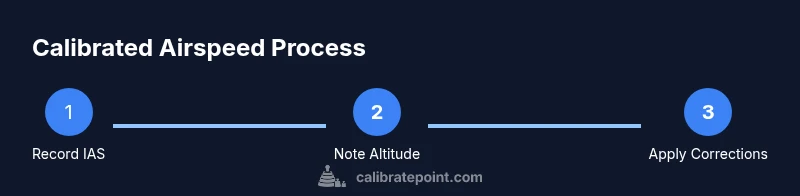
Record a stabilized IAS from the airspeed indicator, note altitude and outside air temperature (OAT) or ISA deviation. This ensures inputs reflect current operating conditions rather than transient readings.
Tip: Ensure the airspeed is stable for at least 15-30 seconds before taking measurements. - 2
Choose a CAS calculation method
Decide whether you will use an E6B flight computer, a dedicated CAS calculator, or an online tool. Consistency matters for comparability across calculations.
Tip: Stick to a single method for a given project to avoid input/data format mismatches. - 3
Enter altitude and IAS into the calculator
Input the measured IAS and current altitude (or pressure altitude with appropriate corrections) into the selected tool to initialize the correction process.
Tip: Double-check units and ensure altitude matches the calculator’s reference pressure setting. - 4
Apply compressibility corrections
Allows the tool to account for air density and Mach effects that influence CAS at higher speeds and altitudes.
Tip: Remember that corrections grow with speed and altitude; avoid extrapolating beyond chart ranges. - 5
Apply density corrections using OAT
Incorporate ISA deviation or OAT to adjust for air density effects on CAS; this aligns the reading with current atmospheric conditions.
Tip: If OAT data is uncertain, perform a quick re-check with a secondary source. - 6
Compute and record CAS
Note the resulting CAS and document the inputs and method used for traceability and future verification.
Tip: Store CAS in your flight plan or maintenance log with date, source, and method. - 7
Cross-check with a second method
Validate CAS by repeating with another calculator or tool to ensure results are consistent within an acceptable tolerance.
Tip: Discrepancies beyond the tolerance threshold warrant data re-check and instrument verification. - 8
Integrate CAS into planning
Use CAS for performance calculations (climb, cruise, and approach speeds) and ensure it informs decisions with documented confidence.
Tip: Always compare CAS-based planning with published performance charts for the airframe and configuration.
Questions & Answers
What is calibrated airspeed (CAS) and how does it differ from IAS and TAS?
Calibrated airspeed is the indicated airspeed corrected for compressibility and instrument errors. IAS is the instrument reading before those corrections, and TAS is the true speed relative to the air mass. CAS sits between IAS and TAS and is used for more accurate performance planning in many flight conditions.
CAS is the IAS corrected for instrument and compressibility errors. IAS is the raw instrument reading, and TAS is the true airspeed; CAS sits between IAS and TAS for practical performance planning.
Why would I need to find CAS.
Finding CAS improves accuracy in performance calculations, fuel planning, and stall margins. It helps ensure safe adherence to speed limits across altitude bands and reduces the risk of overspeed or slow flight during critical phases.
CAS improves accuracy for performance calculations and safety margins, especially during climbs and high-altitude operations.
Can CAS be calculated without instruments?
In principle, you can estimate CAS using manual methods and known atmospheric data, but you still need reliable IAS or speed indication and altitude inputs. Modern tools and calculators simplify this and reduce the chance of input error.
You can estimate CAS using manual corrections if you have reliable data, but calculators make it safer and faster.
Is CAS used in everyday flight planning?
Yes, CAS is commonly used for performance planning and safety analyses, particularly for climb and approach speeds. It aligns speed references with actual aerodynamic performance under current conditions.
CAS is routinely used in planning to ensure speeds reflect actual aerodynamics under current conditions.
What sources provide CAS corrections?
Corrections come from standard atmosphere tables, compressibility charts, and dedicated CAS calculators or flight computers. Always verify the data source and ensure it matches your aircraft's configuration.
Corrections come from standard atmosphere tables and trusted CAS calculators; verify data sources and aircraft configuration.
How accurate is manual CAS calculation?
Manual calculations can be accurate when inputs are trustworthy and corrections are applied correctly. However, small errors in inputs or extrapolations beyond chart limits can degrade accuracy, so cross-check with a secondary method.
Manual CAS can be accurate with careful inputs and checks; cross-check to avoid errors.
Watch Video
Key Takeaways
- Understand CAS as IAS adjusted for compressibility and density effects.
- Collect accurate IAS, altitude, and temperature before calculating CAS.
- Use a consistent method (E6B or app) for reliable results.
- Cross-check CAS via multiple tools when possible.
- Document inputs and results for traceability and safety.