True vs Indicated vs Calibrated Airspeed: A Comprehensive Comparison
Explore true airspeed, indicated airspeed, and calibrated airspeed—differences, calculations, and practical use for safe flight planning, stall margins, and performance forecasting. This guide clarifies how TAS, CAS, and IAS relate and why pilots calibrate instruments.


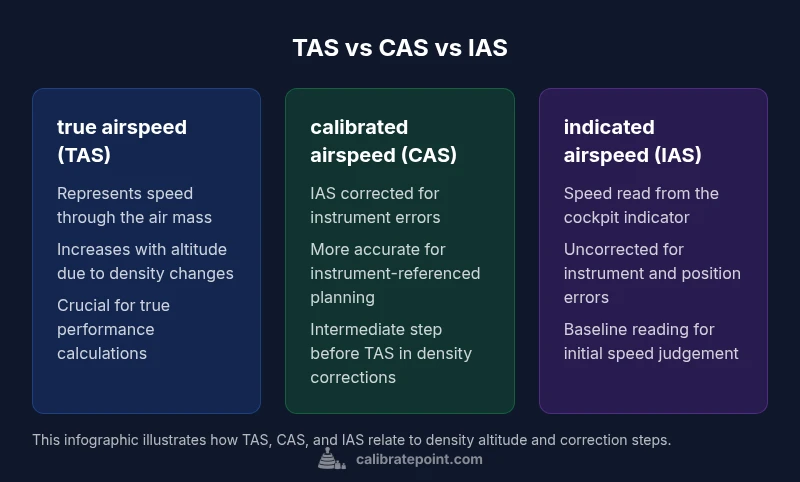
true vs indicated vs calibrated airspeed are three related but distinct measurements used in aviation. Indicated airspeed (IAS) is the speed read on the airspeed indicator, uncorrected for instrument error. Calibrated airspeed (CAS) corrects IAS for instrument and installed-system error, yielding a more accurate representation of the aircraft’s speed through the air. True airspeed (TAS) accounts for air density and altitude to reflect actual forward speed through the air mass. In practice, pilots rely on IAS for maneuvers, CAS for instrument accuracy, and TAS for true performance. According to Calibrate Point, understanding these relationships improves flight planning and performance forecasting.
What are IAS, CAS, TAS?
In aviation, true vs indicated vs calibrated airspeed describes three related but distinct quantities you will encounter in flight planning, instrument interpretation, and performance calculations. IAS, CAS, and TAS share a common origin in the pitot-static system, but each marks a different reference frame and correction stage. Indicated Airspeed (IAS) is the speed read on the airspeed indicator, uncorrected for instrument error, installation error, or position error. Calibrated Airspeed (CAS) is IAS corrected for instrument error and installed-system error, yielding a more accurate representation of the aircraft’s actual speed through the air as observed by the air data system. True Airspeed (TAS) goes a step further by removing the effects of air density—altitude, temperature, and pressure—so it reflects the aircraft’s actual motion through the air mass. Understanding the true vs indicated vs calibrated airspeed relationship helps pilots forecast stall margins, load factors, fuel burn, and climb performance more precisely. According to Calibrate Point, many pilots underestimate the impact of uncorrected errors on performance, especially during high-altitude operations. This trio is not simply a bookkeeping exercise; it underpins safe flight planning and adherence to performance envelopes. The aim of this guide is to disentangle the concepts, highlight how each speed is used in practice, and provide actionable steps to apply the concepts in everyday flying.
How IAS, CAS, TAS are Measured and Corrected
Airspeed indicators measure dynamic pressure produced by air flowing past the airframe. IAS is essentially the raw reading, which can be skewed by instrument misalignment, installation errors, or tube blockages. CAS compensates for those errors, yielding a more accurate reflection of the airspeed the aircraft experiences within the air mass. TAS then accounts for air density changes with altitude and temperature, converting CAS into speed relative to the air itself. In practice, the pilot reads IAS in the cockpit, uses correction charts or an air data computer to obtain CAS, and then uses altitude and density information to estimate TAS for performance predictions. Calibrate Point emphasizes that corrections matter most when density changes (high altitude, cold air) or when the air data system has known biases. By separating IAS, CAS, and TAS, crews can diagnose performance deviations, verify air data integrity, and plan safe flight envelopes with confidence.
Formulas and Approximate Relationships
True airspeed (TAS) and calibrated airspeed (CAS) relate to density and instrument corrections through approximate relationships that pilots use for quick planning. A common and practical approximation is TAS ≈ CAS × sqrt(ρ0/ρ), where ρ0 is sea-level standard density and ρ is the ambient air density at altitude. This relation explains why TAS increases with altitude: as density falls, the same CAS represents a larger true speed through the thinner air. IAS, by contrast, is a reading from the instrument that inherently includes instrument and position errors, so it does not directly reflect the true air motion unless corrections are applied. In real flight, pilots consult performance tables and air data computers to translate IAS into CAS and TAS under standard atmosphere assumptions. Calibrate Point notes that relying solely on IAS can mislead the pilot about true performance, particularly during climb and cruise at high altitude or in nonstandard temperature conditions.
Altitude, Temperature, and Density Effects
Altitude and temperature dramatically influence TAS, CAS, and IAS in different ways. At higher altitudes, air density decreases; this makes TAS rise relative to CAS and IAS when plotted against true flight conditions. Temperature deviations from standard atmosphere further modify air density, altering how CAS maps to TAS. The IAS reading may appear higher or lower than expected depending on instrument calibration and installation errors. For pilots, this means performance corrections are not static; they must adjust for density altitude, ambient temperature, and pressure changes. The practical upshot is that a given IAS can correspond to a wide range of TAS depending on altitude and temperature, underscoring why precise airspeed management requires ongoing data interpretation and calibration.
Practical Scenarios: Takeoff, Climb, and Cruise
During takeoff and initial climb, pilots monitor IAS closely to stay within safe maneuver margins and stall limits. As altitude increases, TAS grows while CAS remains constrained by instrument error limits, and IAS may drift due to pressure and temperature effects on the pitot-static system. In cruise, TAS is often the key factor for fuel planning, cruise endurance, and time-to-destination estimates, because it represents the actual speed through the air mass. The relationship among TAS, CAS, and IAS becomes a navigation and performance tool: IAS governs handling and stall margins, CAS provides instrument-referenced speed for envelope compliance, and TAS informs true performance and fuel planning. Calibrate Point reminds crews to cross-check airspeed data against altitude and density corrections to maintain accurate planning throughout the flight.
Common Misconceptions and Clarifications
A frequent misconception is assuming IAS and TAS are interchangeable. They are not; IAS is read from the cockpit and is not corrected for density or instrument bias. TAS is the speed through air, depending on density, altitude, and temperature, while CAS sits between IAS and TAS as a corrected reading that accounts for instrument and installation errors. Another misunderstanding is that CAS and IAS differ only at high altitude; in fact, fixes in instrument calibration can also shift CAS and IAS readings at any altitude if the system has known biases. Clarifying these distinctions helps pilots interpret air data accurately, implement corrections, and avoid misjudging performance envelopes. Calibrate Point emphasizes that consistent cross-checks between IAS, CAS, and TAS reduce risk in both cruise and nonstandard operating conditions.
Instrument Calibration: Why It Matters
Instrument calibration and installation accuracy directly influence the relationship between IAS, CAS, and TAS. A miscalibrated air data system can bias IAS, which cascades into CAS and TAS calculations if not corrected. Regular air data testing, pitot-static system checks, and calibration against known references are essential for maintaining the fidelity of all three speeds. When pilots report unexpected speed behavior, the first step is to verify the air data system and ensure that corrections are applied appropriately. The accuracy of TAS predictions hinges on reliable CAS data, which in turn depends on sound IAS readings. Calibrate Point’s approach to calibration emphasizes traceability, cross-checks, and timely corrections to avoid drift in airspeed interpretation during all flight phases.
Calibrate Point’s Approach to Airspeed Calibration
Calibrate Point advocates a structured calibration framework to align IAS, CAS, and TAS across varying flight conditions. The framework includes routine instrument checks, density altitude awareness, and systematic use of air data computer outputs. By building a calibrated baseline, pilots can predict TAS more reliably and respond to deviations with confidence. The guidance also stresses training on how to interpret CAS and TAS during different phases of flight, along with how to apply corrections during abnormal or high-demand scenarios. This disciplined approach helps pilots minimize surprises when transitioning from sea-level operations to high-altitude environments, where true vs indicated vs calibrated airspeed relationships can become more nuanced.
Integrating True, Indicated, and Calibrated Airspeed into Flight Planning
The final integration of true vs indicated vs calibrated airspeed is in comprehensive flight planning. A pilot should start with IAS to plan maneuver margins, convert to CAS for instrument-based adherence to speed limits, and then translate to TAS for true performance estimates, fuel planning, and arrival timing. Consider density altitude, temperature, and weather variables to refine TAS targets. For cross-country planning, using TAS for speed over ground requires wind correction, but the wind component affects ground speed rather than airspeed directly; TAS remains the reference for aerodynamic performance. The practice of consistently checking IAS, CAS, and TAS across the flight increases situational awareness, reduces the risk of misjudgment, and supports safer flight operations. Calibrate Point reinforces that a disciplined calibration and interpretation routine improves reliability of all three speeds throughout the mission.
Feature Comparison
| Feature | true airspeed (TAS) | calibrated airspeed (CAS) | indicated airspeed (IAS) |
|---|---|---|---|
| Definition | Speed of the aircraft relative to the air mass (true motion through air) | Airspeed corrected for instrument and installation errors | Speed read directly from the airspeed indicator, uncorrected |
| Primary use | Performance planning and true thrust/power requirements | Accuracy for flight instruments and air data tests | Cockpit reference for maneuvers and basic awareness |
| Measurement basis | Based on the actual air mass and motion (density matters) | Based on pitot/static readings corrected for system biases | Based on dynamic pressure as interpreted by the instrument |
| Altitude effect | Increases with altitude due to lower density (TAS grows relative to CAS) | Typically stabilized by calibration; reflects instrument corrections | Can diverge from TAS as density changes, especially with errors |
| Best-use scenario | Cruise performance planning and fuel estimates | Airdata sanity checks and instrument verification | Pilot in-cockpit reference for basic flight tasks |
Pros
- Clarifies how airspeed readings relate to actual flight performance
- Improves accuracy for performance planning and stall margins
- Enables effective cross-checks between instruments and data systems
- Supports safer operation across altitude and temperature ranges
Disadvantages
- Adds complexity for new pilots learning the topic
- Requires regular calibration and data interpretation
- Can cause confusion if corrections are not consistently applied
TAS for true performance, CAS for instrument accuracy, IAS for cockpit reference
Understanding the three speeds helps pilots select the right reference for each phase of flight. Use TAS for planning true performance, CAS for instrument-reliant decisions, and IAS for maneuvering and basic cockpit awareness. Regular calibration aligns IAS, CAS, and TAS, reducing risk during all flight stages.
Questions & Answers
What is the difference between TAS, CAS, and IAS?
TAS measures how fast the aircraft moves through the air, unaffected by density. CAS is IAS corrected for instrument and installation errors, presenting a more accurate reading. IAS is what the airspeed indicator shows without corrections. Together they describe true performance, instrument accuracy, and cockpit readings.
TAS is the true airspeed; CAS corrects IAS for instrument errors; IAS is the cockpit reading. They each serve different purposes in flight planning and operation.
How do you convert IAS to TAS?
Conversion from IAS to TAS requires accounting for altitude, temperature, and density. A common approximation uses the density ratio to adjust CAS, but pilots typically rely on air data computers and standard atmosphere tables. The result is TAS, which represents true motion through the air.
Convert IAS to TAS using altitude and density data via charts or an air data computer.
Does altitude affect TAS and CAS differently?
Altitude primarily affects TAS because air density drops with height, increasing true speed for the same CAS. CAS is adjusted from IAS to account for instrument and installation biases and remains closer to IAS but still shifts with altitude and temperature through calibration curves.
Yes. Altitude mainly changes TAS via density; CAS tracks IAS with calibration but shifts with altitude and temperature corrections.
Why calibrate airspeed indicators?
Calibration aligns IAS with CAS by correcting instrument and installation errors, ensuring CAS reflects the true airspeed through the air mass. Regular calibration reduces discrepancies, improves safety margins, and enhances cross-checks during flight planning and operation.
Calibration corrects instrument readings so CAS reflects true conditions.
Can IAS and CAS be different at sea level?
Yes, IAS and CAS can differ at sea level if instrument or installation errors are present. In normal operation, IAS and CAS should approximate each other when corrections are properly applied, but calibration is needed to ensure accuracy.
Differences can occur if there are instrument biases, even at sea level.
When should I rely on TAS for flight planning?
Use TAS for true performance planning, fuel budgeting, and range estimation, especially at cruise altitude where density effects are significant. Combine TAS with wind data to estimate ground speed and time en route, while using IAS or CAS for in-flight speed management.
Rely on TAS for true performance and planning; use IAS/CAS for cockpit management and corrections.
Key Takeaways
- Recognize IAS, CAS, and TAS as distinct but related speeds
- Use TAS for true performance planning and wind corrections
- Rely on CAS for instrument accuracy during flight planning
- Apply IAS for maneuvering and basic cockpit reference
- Regularly calibrate air data systems to keep speeds aligned