Calibrated Airspeed vs Indicated Airspeed: Understanding CAS and IAS
Explore calibrated airspeed vs indicated airspeed, how they differ, why calibration matters for flight safety, and practical conversion methods with examples for common aircraft.


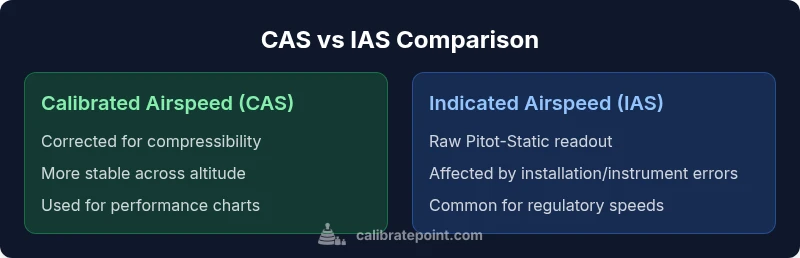
Calibrated airspeed (CAS) and indicated airspeed (IAS) measure how fast an aircraft moves through the air, but they are not the same. CAS corrects for compressibility and instrument error to reflect airspeed more accurately under various flight conditions, while IAS is the raw readout from the pitot-static system. Understanding their difference is essential for accurate performance planning and safety.
What calibrated airspeed and indicated airspeed measure
Airspeed is a critical parameter for flight safety and performance, but the numbers pilots rely on are not a single universal speed. In aviation, two primary metrics describe how fast the aircraft moves through the air: calibrated airspeed (CAS) and indicated airspeed (IAS). IAS is the most basic reading you see in the cockpit—the airspeed indicator’s display is driven by dynamic pressure in the pitot-static system. CAS is a refined figure that corrects IAS for instrument position errors, installation quirks, and compressibility effects that become noticeable at higher Mach numbers. The distinction matters because it affects how you interpret speed across different altitudes, configurations, and flight regimes. According to Calibrate Point, this distinction is essential for accurate performance planning and flight safety. When you compare CAS vs IAS, you are comparing a corrected, performance-oriented speed to a raw cockpit readout that can vary with sensor quality and installation.
The core idea is that IAS is a direct sensor output, CAS is a calculation that accounts for known biases in the air data system, and TAS (true airspeed) is related but not the same as either CAS or IAS. For pilots, the practical takeaway is simple: IAS gives you a fast, local sense of speed, while CAS offers stability across changing air density and compressibility, which is what performance charts and engine power calculations rely on. This foundation is why training emphasizes understanding both values and when to use each in the cockpit.
Comparison
| Feature | Calibrated Airspeed | Indicated Airspeed |
|---|---|---|
| Definition | Airspeed corrected for compressibility and instrument errors to reflect actual air interaction under flight conditions | Raw readout from the air data system, uncorrected for instrument errors or compressibility |
| Measurement Basis | Dynamic pressure with corrections for compressibility and installation biases | Dynamic pressure captured by the Pitot tube, subject to position and instrument errors |
| Altitude/Density Influence | More stable across altitude changes after corrections, aiding comparison across flight levels | Varies with altitude and air density due to uncorrected effects |
| Typical Use | Performance charts, engine power settings, and calculations for climb/descent planning | Basic speed checks, training, and regulatory speed references |
| Relation to TAS | CAS approximates TAS when compressibility corrections are applied, aiding performance estimates | IAS is not TAS; TAS rises with altitude while IAS tends to drop with altitude if density changes are ignored |
| Cockpit Readout | Not directly displayed; requires air data computer or chart-based interpretation | Direct readout from the airspeed indicator |
Pros
- CAS provides a performance-oriented speed that remains meaningful across altitude and configuration changes
- Better alignment with performance charts, engine settings, and takeoff/landing calculations
- Reduces the impact of instrument setup differences by applying corrections
- IAS remains a simple, intuitive baseline for basic flight and training
Disadvantages
- CAS calculations require correct sensors and air data system calibration to be reliable
- Not a direct cockpit readout; pilots often convert CAS to TAS for true performance
- IAS is still needed for regulatory speeds and basic speed management, so both values matter
CAS is generally more useful for performance planning; IAS remains essential for basic flight checks and regulatory speeds
Choose CAS when you need a stable basis for performance charts, engine management, and Mach-related planning. Use IAS for day-to-day speed awareness and legal limits; convert to TAS as needed for true airspeed assessments.
Questions & Answers
What is the practical difference between calibrated airspeed and indicated airspeed?
CAS is IAS corrected for compressibility and instrument error, reflecting a more true performance reference. IAS is the raw cockpit readout. In practice, use CAS for performance planning and IAS for basic speed checks.
CAS is the corrected speed used for performance planning, while IAS is the uncorrected cockpit readout used for basic speed checks.
When should a pilot rely on CAS vs IAS during flight?
Rely on CAS when performing performance calculations, engine setting determinations, and chart-based planning. Use IAS for basic situational awareness and regulatory speed checks in level flight.
Use CAS for performance planning; IAS for everyday speed references and regulatory limits.
How do you convert CAS to TAS or IAS to CAS?
Conversions between CAS, IAS, and TAS require air data, temperature, pressure, and altitude inputs. Most pilots rely on flight computers or onboard systems to perform these conversions accurately.
Use flight computers or the flight management system to convert between CAS, IAS, and TAS based on altitude and temperature.
Do altitude changes affect CAS and IAS the same way?
Altitude affects IAS and CAS differently because IAS is density-dependent while CAS corrective factors account for compressibility and instrument bias. As altitude increases, IAS generally decreases for a given true airspeed, while CAS behavior depends on the specific corrections applied.
Altitude changes impact IAS more directly; CAS adjusts to maintain a stable reference for performance planning.
Is CAS used in performance charts and engine operations?
Yes. CAS is the speed used in many performance charts and engine power calculations because it accounts for real-world air properties and instrument corrections.
CAS is the speed you see in performance charts and engine settings.
What maintenance checks affect CAS and IAS accuracy?
Regular calibration of sensors, Pitot-static system checks, and maintenance of the air data computer ensure both CAS and IAS readings remain accurate. Faulty sensors can bias both readings but CAS corrections rely on reliable data.
Keep sensors calibrated and air data systems healthy to maintain accurate CAS and IAS.
Key Takeaways
- Know the definitions of CAS and IAS before flight planning
- Use CAS for performance planning and charts across altitude changes
- Rely on IAS for basic speed checks and regulatory limits
- Understand the need to convert between CAS, IAS, and TAS for comprehensive situational awareness
- Regularly verify airdata system calibration to maintain accuracy