Calibration Verification vs Linearity: Practical Guide
Explore the differences between calibration verification and linearity, why both matter, and how to apply them in practice for accurate, traceable measurements in calibration programs.


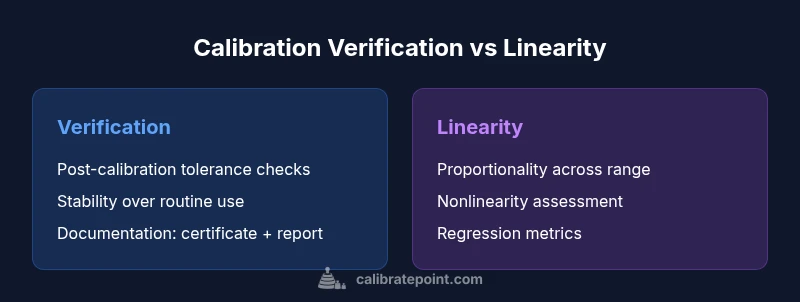
Calibration verification is not the same as linearity. Verification confirms that a instrument's output remains within an allowed tolerance after calibration, while linearity assesses how accurately the response matches a theoretical straight line across the measurement range. They address different error sources and serve complementary roles; many standards require both steps to ensure accurate, traceable results across the full operating span.
Is Calibration Verification the Same as Linearity? Clarifying the terms
Is calibration verification the same as linearity? In practice, the answer is no. These two tests target different aspects of an instrument's performance, and they are typically performed at different stages of a calibration cycle. Verification focuses on whether the instrument stays within established tolerances after calibration, while linearity examines how well the instrument’s response tracks a proportional, ideally linear relationship across its operating range. Understanding this distinction is essential for building a robust calibration program, especially in regulated environments where traceability and accuracy are paramount. Throughout this article, we will compare these tests, discuss when to run them, and outline practical guidance for labs of any size. The goal is to help you implement a structured approach that minimizes uncertainty and supports defensible measurement results, regardless of whether you work in a university lab, a manufacturing line, or a calibration service provider.
The Role of Verification in Calibration Systems
Calibration verification functions as a check that accompanies the post-calibration state of a device. It uses reference standards to confirm that the instrument’s readings fall within predefined acceptance criteria under a representative set of conditions. A well-documented verification plan will specify the reference artifacts, the environmental conditions, the number and distribution of test points, and the tolerance bands used to judge pass/fail decisions. The emphasis is on confirming stability and reliability after the calibration has been applied, rather than mapping the exact response curve across the entire range. In many labs, verification becomes part of the routine quality assurance (QA) framework, ensuring ongoing confidence in measurements between full calibrations.
Understanding Linearity: What It Tests and Why It Matters
Linearity testing probes the proportionality of the instrument’s response across its measurement span. In other words, it asks whether a change in input yields a consistent, proportional change in output. Nonlinearity can introduce bias that grows with the signal magnitude, contributing to systematic uncertainty. This kind of testing often involves multiple calibration points distributed across the full range, sometimes including low, mid, and high values, to detect curvature or slope changes. Linearity is especially important for instruments used in process control, analytical chemistry, or any application where high-precision data across the range are critical. By characterizing nonlinearity, you can adjust or compensate for it in data processing, or set appropriate measurement ranges and acceptance criteria.
How They Relate: Overlapping Concepts and Distinct Goals
A common question is is calibration verification the same as linearity? The short answer remains no, but the two tests are not mutually exclusive. They complement one another: verification ensures that, post-calibration, the instrument behaves within tolerance for typical use, while linearity provides a map of how far off the ideal response can be at different points in the range. If an instrument passes verification but shows nonlinear behavior at higher readings, you may still need a linearity assessment to understand and mitigate potential measurement bias at those points. In risk-based calibration programs, both checks contribute to a more complete uncertainty budget and a better understanding of instrument performance over time.
Standards and Industry Practices: Where Verification and Linearity Fit
Many national and international standards require evidence of both verification and linearity in different contexts. For example, quality systems in manufacturing often mandate post-calibration verification to demonstrate stability, while analytical laboratories may perform linearity studies as part of method validation. In some sectors, linearity is a criterion in instrument qualification, particularly when measurements feed into decision-making that depends on proportional responses. Always consult your relevant standards (e.g., ISO/IEC 17025 family, or sector-specific guides) to determine the precise expectations for verification and linearity in your organization. The overarching takeaway is that both tests support traceability, reliability, and defensible data in daily operations.
Practical Testing Scenarios: When to Run Verification vs Linearity
A typical calibration workflow includes both verification and linearity at different times. Verification often occurs after calibration to confirm that the instrument remains within tolerance under standard operating conditions. Linearity testing is usually scheduled during instrument qualification, method validation, or whenever a new measurement range is introduced. In high-accuracy environments, both tests may be performed routinely or at defined intervals, depending on risk assessment, usage frequency, and regulatory requirements. Always document the test plan, specify acceptance criteria, and maintain a complete audit trail to support compliance.
Methods and Metrics: How We Measure Linearity and Verification
For verification, you’ll typically use a fixed set of reference values and document whether the instrument’s outputs stay within acceptance bands. Metrics include drift from the last calibration, deviation from the reference point, and passing/failing rates across test points. Linearity assessment relies on regression analysis, examining residuals, R-squared values, and slope deviations from the ideal line. Some labs also plot the measured values against the true inputs to visually assess curvature. The choice of reference standards, environmental controls, and data analysis methods all influence the robustness of both tests.
Potential Pitfalls and Common Mistakes
Common errors include using an insufficient number of test points for a meaningful linearity evaluation, neglecting environmental effects (temperature, humidity), or applying verification criteria that are not aligned with the instrument’s measurement range. Another pitfall is assuming that passing verification implies perfect linearity across the full range; this is not necessarily true. Conversely, performing a lengthy linearity study without a clear verification plan can lead to wasted time and resources. A balanced approach pairs a practical verification with a targeted linearity assessment to address critical risk areas.
Step-by-Step Implementation Guide for Your Lab
- Define the scope: decide which ranges and operating conditions to include for both verification and linearity. 2) Select reference standards with appropriate traceability and documented uncertainties. 3) Establish acceptance criteria that reflect the instrument’s intended use and regulatory requirements. 4) Plan the sequence: verification as a routine check after calibration, followed by a linearity assessment when expanding or validating ranges. 5) Collect data at predetermined points, perform regression analysis for linearity, and compare results to acceptance criteria. 6) Document everything in a calibration certificate and a separate linearity report if applicable. 7) Review outcomes and adjust calibration intervals or procedures as needed. 8) Archive data in a way that supports traceability and auditability.
Decision Framework: Choosing Between Verification and Linearity Checks
When designing your calibration program, a practical rule of thumb is to start with verification to confirm routine stability, then add linearity testing where risk or scope requires a deeper understanding of the response curve. If your instrument serves a narrow range with well-behaved responses, verification may suffice for day-to-day use. If measurements cover a broad range or feed into high-stakes decisions, linearity testing becomes essential. Use regulatory expectations, risk assessment results, and performance data to determine the appropriate balance between these two tests.
Authoritative sources and references
This section provides references to industry standards and credible sources for calibration practices. For formal guidance, consult ISO/IEC 17025, NIST measurement guides, and other recognized standards organizations. Access to official standards and foundational texts helps justify test plans, acceptance criteria, and documentation practices in audits and regulatory examinations.
Comparison
| Feature | Calibration verification | Linearity assessment |
|---|---|---|
| Purpose/What it tests | Confirms measurements stay within tolerance after calibration | Evaluates proportionality of response across the full range |
| Data/metrics | Tolerance bands, passing criteria, drift over time | Residual error vs ideal linear response, slope deviation, R^2 |
| Measurement setup | Uses reference standards; defined acceptance criteria | Multiple points across range; regression analysis |
| When to perform | Post-calibration routine QA; ongoing verification | During instrument validation or before critical measurements |
| Impact on uncertainty | Controls overall stability within tolerance | Characterizes nonlinearity as a source of uncertainty |
| Documentation | Calibration certificate, verification report | Linearity report, data plots, regression metrics |
| Best for | General accuracy maintenance and routine checks | Situations requiring assessment of proportional response |
| Typical duration | Depends on range and points; relatively quick | Depends on number of points; can be longer |
Pros
- Helps ensure measurement accuracy across the full range
- Identifies drifts and systematic errors after calibration
- Supports traceability and regulatory compliance
- Provides data to refine calibration intervals
- Can be integrated into standard operating procedures
Disadvantages
- Can be time-consuming to perform at multiple points
- May require additional reference standards and equipment
- Not a substitute for ongoing routine checks
Do both: run calibration verification for ongoing accuracy and perform linearity assessment to ensure proportional response; together they provide the most reliable results.
Calibration verification and linearity testing serve complementary roles. Verification ensures stability and tolerance, while linearity quantifies how measurements deviate from an ideal straight line. Implementing both improves uncertainty management and supports robust, auditable calibration programs.
Questions & Answers
What is the difference between calibration verification and linearity?
Calibration verification checks that a device remains within stated tolerance after calibration. Linearity tests how the device response changes across its measurement range, detecting curvature or proportionality issues. Together they cover short-term stability and range accuracy.
Verification confirms tolerance after calibration, while linearity checks the proportionality of response across the range. They address different risks and are often performed together in a complete calibration program.
When should I perform calibration verification?
Perform verification after calibration as part of routine QA to ensure the instrument remains within acceptance criteria during normal use. It is also useful between major maintenance events when drift could occur.
Do a post-calibration check to confirm the instrument stays within tolerance between full calibrations.
When should I perform linearity testing?
Linearity testing is typically done during instrument qualification, method validation, or when expanding the measurement range. It helps identify nonlinearity that could bias results at higher or lower ends of the scale.
Linearity testing is used during qualification or range expansion to catch nonlinearity across the range.
Can linearity testing replace verification?
No. Linearity assesses proportionality; verification confirms continued tolerance post-calibration. They serve different purposes and are often both required for a robust metrology program.
No—linearity and verification test different aspects of performance and both are typically needed.
What data are collected for a linearity test?
A set of calibrated points across the range is collected, and residuals from the ideal response are analyzed. Metrics like slope, intercept, and R-squared help quantify nonlinearity.
Linearity uses multiple points across the range and analyzes residuals to quantify nonlinearity.
How do I document these tests for compliance?
Keep separate reports for verification and linearity, including test points, reference standards, environmental conditions, acceptance criteria, and regression results. Link both to the calibration certificate to support traceability.
Maintain clear, linked reports with data, criteria, and outcomes for verification and linearity.
Key Takeaways
- Define objectives before testing
- Run verification to confirm tolerances
- Assess linearity for proportional response
- Document criteria and results consistently
- Integrate both checks into routine calibration plans