How to Calibrate a Scale: A Practical Guide
Learn how to calibrate a scale accurately with certified weights, zeroing, and verification to ensure precise measurements for kitchen, postal, or lab use.


You will learn how to calibrate a scale accurately for kitchen, postal, or lab use. This guide covers selecting calibration weights, properly zeroing the balance, adjusting hardware or software, and verifying accuracy with standard references. By the end, your scale should read within tolerance across a range of loads and deliver repeatable results.
Why calibrate scale matters
Accurate weight measurements underpin quality control, recipe consistency, shipping costs, and scientific experiments. If your scale is off, even slightly, results drift over time and lead to waste, mislabeling, or incorrect dosing. Calibrating a scale involves adjusting its response to a known mass so the display aligns with the true weight across the operating range. The aim is traceability to recognized standards, so measurements can be compared and audited. Small errors multiply: a 0.1% bias on a 1 kg load becomes 1 gram, which matters in precision tasks. According to Calibrate Point, starting with a level surface, stable surroundings, and certified calibration weights yields the most reliable results. Regular calibration reduces drift caused by temperature changes, vibration, and wear in springs or load cells. Establishing a routine builds confidence in measurements and protects against costly mistakes. This section sets the stage for a practical, repeatable calibration workflow that you can adopt in your shop or lab.
Types of scales and accuracy classes
Scales come in several varieties, from simple kitchen balances to precision analytical balances and industrial load cells. Mechanical scales rely on springs and mechanical deflection, while digital scales use load cells and electronics. Readability (the smallest unit displayed) and linearity (how evenly the response scales with weight) define accuracy classes. Higher-precision devices often require traceable calibration with certified weights and documented procedures. When selecting a scale for calibration work, consider the stated accuracy, the maximum capacity, the operating temperature range, and the availability of a calibration or service mode. Calibration approaches differ: a high-precision analytical balance may require microweights and exact room conditions, whereas a kitchen scale benefits from routine checks with mid-range weights. Regardless of type, the core principle remains the same: align readings with a known reference and prove consistency across the operating range.
Prerequisites and safety considerations
Before you begin, ensure you have a clean, level workspace free from drafts, vibration, and temperature fluctuations. Use certified calibration weights appropriate for the scale’s range, and verify their mass with a trusted standard if possible. Protect the weighing surface from dust, oils, or residues that can alter mass readings. If you’re calibrating a digital scale, review the user manual for the correct sequence to enter calibration mode. Avoid handling weights with bare hands for long—finger oils can transfer onto weights and affect readings. Finally, never attempt to calibrate around heat sources or in a humid environment, as these conditions introduce drift and instability. The goal is to create a stable, repeatable environment that minimizes external influence on measurements.
Calibration workflow overview
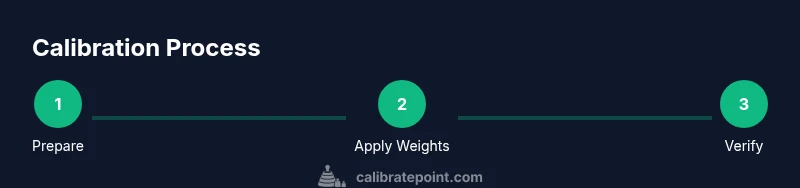
Calibration is a structured process that establishes the relationship between a known mass and the scale’s displayed reading. A typical workflow includes leveling the scale, zeroing or taring, sequentially applying known weights across the operating range, recording readings, adjusting the scale’s gain or offset, and re-checking with multiple weights. This combined approach ensures accuracy at multiple points and guards against nonlinearity. Traceability is achieved when the calibration process references recognized standards or certified weights with a documented procedure. In practice, you’ll perform a multi-point check instead of relying on a single weight, which reduces the risk of undetected drift at other masses. This section provides the framework for the step-by-step procedure you’ll execute in the next block.
Verification after calibration
Verification confirms that the calibration remains valid over time and under typical use. After completing calibration, test with several weights spanning the scale’s range (for example, light, medium, and heavy loads). Calculate the percent error for each weight and ensure it falls within the predefined tolerance. If any reading fails, revisit the calibration factors and repeat the process for the affected points. Documentation should capture the weights used, readings observed, tolerance, and the date of calibration. Regular verification is essential for maintaining confidence in measurements and supports ongoing quality assurance. Calibrate Point emphasizes that regular re-verification helps catch drift before it impacts results or customers.
Maintenance and documentation
Maintain calibration records in a dedicated log or calibration management system. Include the device model, serial number, calibration date, next due date, weights used, and observed readings. Store calibration weights in a clean, sealed container to prevent contamination, and periodically inspect them for signs of corrosion or damage. Schedule recurring calibrations based on usage intensity, criticality of measurements, and environmental stability. For teams, establish a standard operating procedure (SOP) that specifies roles, data formats, and acceptance criteria. By keeping thorough records, you enable traceability, audits, and continuous improvement. The Calibrate Point team recommends building a simple template to capture all essential details and to standardize your workflow across devices.
Tools & Materials
- Certified calibration weights (set covering the scale's range)(Include multiple masses (e.g., 100 g, 500 g, 1 kg) for multi-point checks)
- The scale or balance to calibrate(Ensure it is clean and functioning)
- Bubble level or carpenter's level(Used to verify level surface)
- Tare container or weighing boat(Tare to zero before weighing each reference weight)
- Soft brush or lint-free cloth(Keep weighing pan clean; optional)
- Calibration manual or device instruction (digital scale)(Follow manufacturer steps if available)
Steps
Estimated time: 60-90 minutes
- 1
Prepare the workspace
Clear the area and place the scale on a level, vibration-free surface. Ensure good lighting and a quiet environment to minimize disturbances during measurement stabilization. This initial setup reduces drift and improves repeatability.
Tip: Use a dedicated table or bench and verify level with a built-in or separate level. - 2
Gather certified calibration weights
Assemble a weight set that covers the scale’s operating range and select several points for testing (e.g., light, mid-range, heavy). Inspect weights for cleanliness and ensure they are traceable to a standard.
Tip: Check the weight masses against a trusted reference before use. - 3
Power on and level the scale
Turn on the scale and allow it to warm up if required by the manufacturer. Use the bubble level to confirm the platform is perfectly horizontal and stable.
Tip: Make micro-adjustments to leveling feet and recheck the display stability. - 4
Tare with an empty container
Place the tare container on the pan and press tare to reset the display to zero. Remove any container mass so subsequent readings reflect only the reference weights.
Tip: Ensure the container doesn’t tip or shift during taring. - 5
Apply the first calibration weight
Place a known weight on the pan and record the displayed mass. Use the same container if you tare again for subsequent weights to maintain consistency.
Tip: Record to the nearest 0.1 g or the scale’s finest resolution. - 6
Record and compare reading
Note the reading and compute the difference from the nominal weight as well as the percent error. Repeat for additional weights across the range.
Tip: If the error exceeds tolerance, prepare to adjust the calibration factor. - 7
Adjust calibration factor or software
Follow the device’s manual to adjust offset or gain (or both). Make small changes and re-test with the same weights to observe the effect.
Tip: Avoid large jumps; calibrate incrementally and re-check after each adjustment. - 8
Verify with additional weights and finalize
Test with at least two more weights across the range to confirm linearity and accuracy. If readings remain stable, finalize the calibration and document the results.
Tip: Store the final settings and seal or lock calibration if the device offers this feature.
Questions & Answers
What is calibration and why is it important?
Calibration is adjusting a measurement device to align with a known standard. It ensures accuracy, traceability, and repeatability across uses.
Calibration aligns your scale with a standard to ensure accurate, repeatable results.
What weights should I use for calibration?
Use certified weights that cover the scale's working range; start with mid-range weights and test at multiple points.
Use certified weights that cover the range and test multiple points.
How often should I calibrate a scale?
Frequency depends on usage, but calibrate routinely before critical measurements and after any impact or drift.
Calibrate before critical measurements and after any shock or drift.
Can I calibrate digital and mechanical scales the same way?
Principles are similar, but follow each device's manual; digital scales may have zero, tare, and gain settings.
Principles are similar, but follow each device's manual.
What if readings are inconsistent across weights?
Check surface, re-zero, verify weights, ensure weights are clean, and recalibrate if necessary.
Clean surfaces, re-zero, and verify weights; recalibrate if drift persists.
Is calibration the same as verification?
Calibration sets the device response; verification checks current accuracy against standards.
Calibration sets response; verification checks accuracy.
Watch Video
Key Takeaways
- Always calibrate with traceable weights
- Zero and level the scale before weighing
- Use multiple weights across the range
- Document results for traceability
- Re-test periodically to prevent drift