How to Calibrate a Scale for Grams
Learn a reliable, step-by-step method to calibrate a gram-scale with traceable weights, a stable workspace, and proper documentation for accurate measurements in labs, kitchens, and workshops.


By the end of this guide, you will calibrate a scale for grams using a known calibration weight, a stable surface, and a repeatable procedure. You will verify accuracy with multiple trial weights, adjust the tare and offset as needed, and document results for traceability. This ensures precise, reliable measurements for cooking, hobby projects, or professional work.
Why grams calibration matters
According to Calibrate Point, precise gram calibration is foundational for any task that depends on accurate mass. Whether you’re preparing chemical reagents, portioning ingredients in a bakery, or inspecting parts in a workshop, a properly calibrated scale minimizes systematic error and drift. Calibrated readings enable traceability to recognized standards, making it easier to audit results, reproduce experiments, or meet quality-control requirements. When a scale is out of calibration, even small deviations can compound through multiple measurements, leading to costly waste and incorrect decisions. Regular calibration creates a reliable baseline, so repeated weighings stay consistent over time and across operators.
Understanding calibration terminology
Before you begin, familiarize yourself with core terms: accuracy (how close a measurement is to the true value), precision (repeatability of repeated measurements), tare (the amount subtracted from the total weight to yield the net weight of the sample), and offset (the scale’s inherent deviation that may need adjustment). Traceability means each calibration is linked to an established standard, often via a certified weight set. By using traceable weights and documenting results, you establish a documented quality trail that can be reviewed by auditors, customers, or collaborators. Interpretation of readings should always consider environmental factors such as temperature, humidity, and airflow, which can subtly influence mass readings on sensitive scales.
Selecting the right scale for calibration
Scale choice matters for grams. Digital scales with a stable linear response across the intended weight range are common in homes and labs, while analytical balances offer higher sensitivity for very small masses. Mechanical balances require different adjustment steps and are generally less common for routine gram-level work. Consider the scale’s rated capacity, readability (the smallest increment it can display, e.g., 0.01 g), and its temperature compensation features. If you work in a regulated environment, ensure your scale supports calibration with certified weights and that it can export calibration data for your records.
Safety and cleanliness considerations
Always handle calibration weights with clean hands or tweezers to avoid adding oils or residues that affect mass. Use a lint-free cloth to wipe the weighing pan and weights before starting. Keep the area free of drafts, vibrations, and direct air currents from fans or open doors. If your scale has a glass enclosure, operate it with the enclosure closed during sensitive measurements to minimize air movement. Never attempt to calibrate on a damaged surface or if the scale shows obvious mechanical issues; such steps can introduce additional errors.
Tools and materials overview
A successful gram-scale calibration requires a small, certified weight set that covers your scale’s working range. You should also have a stable, level work surface, a clean weighing pan, tweezers or gloves to handle weights, and a calibration log or software to record readings. Having the scale’s manual handy helps you follow model-specific procedures, especially for tare, zeroing, and any built-in calibration routines. While optional, a temperature/humidity monitor can help you document environmental conditions that affect readings.
Environmental considerations: temperature, humidity, drafts
Temperature fluctuations can cause dimensional changes in parts or scale components and affect readings. Aim to calibrate in a controlled environment with stable temperature, ideally within a narrow range around typical room conditions. Humidity and dust can interact with weighing surfaces, especially for very small masses, so keep the area clean and dry. Drafts from doors or vents can shift mass readings slightly; use a shield or enclosure when available. If your workflow requires frequent calibration, document ambient conditions to track potential drift over time.
Preparing the workspace
Clear the workspace to a dedicated calibration area. Place the scale on a level, vibration-free surface, away from electronic devices that could create interference. Clean the weighing pan and remove any prior samples or residue. Allow the scale to warm up per the manufacturer’s guidance, typically a few minutes for digital scales and longer for precision analytical balances. Ensure you have immediate access to the calibration weights and the log sheet or software to capture measurements as you proceed.
Step-by-step calibration workflow: overview
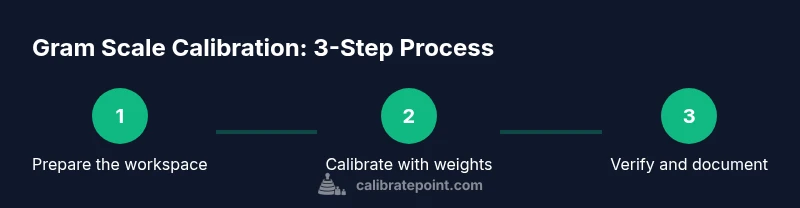
This section outlines the core workflow you’ll perform in the dedicated Step-by-Step block. The process starts with a no-load zero check, followed by placing known reference weights at set points across the scale’s range, recording readings, and applying adjustments for tare and offset as directed by the device. After adjustments, you validate the instrument’s response with one or more confirmation weights, ensuring readings align within the specified tolerance. Finally, you document results comprehensively for future audits and operator handoffs.
Verification: testing with multiple reference weights
Verification involves testing several masses that span the scale’s useful range (for example 1 g, 5 g, 10 g, 50 g, 100 g). For each weight, ensure the display shows the expected mass within the device’s tolerance. Repeat measurements to confirm repeatability. If discrepancies appear, revisit setup, zeroing, or calibration factors; sometimes a second warm-up or a minor adjustment yields the correct alignment. Keep the verification data organized to demonstrate compliance with internal standards or external regulations.
Documentation and record-keeping
A robust calibration procedure ends with thorough documentation. Record: date, operator, environmental conditions, scale model, serial number, weights used, observed values, calculated errors, any adjustments made, and the final conclusion. Use a standardized template so future calibrations can be compared directly. Store calibration logs securely, and consider digital backups. Regular reviews of the logs help identify drift trends, schedule maintenance, and support audits.
Troubleshooting common issues
If readings drift after calibration, check for air currents, verify zero and tare operations, and confirm that the weights are clean and correctly placed. Inspect the weighing pan for deformation, check the scale’s level, and ensure the enclosure is properly sealed if used. Some scales require a full re-zero or a factory re-calibration after a component has moved or been replaced. When in doubt, consult the manufacturer guide or seek assistance from a qualified technician.
Next steps: maintaining accuracy over time
Calibration is not a one-off task; it’s a continuous practice. Schedule regular re-checks and update your calibration logs. Train operators to handle weights consistently, use the same calibration sequence, and re-certify weights periodically. By maintaining a documented routine, you ensure ongoing confidence in every gram you measure and support consistent results across teams and projects.
Tools & Materials
- Calibration weights set (traceable)(Include 1 g, 5 g, 10 g, 50 g, 100 g, 200 g with certificate)
- Flat, rigid calibration surface(Level bench or lab-grade table; avoid soft mats)
- Lint-free cloth and cleaning solution(Wipe weighing pan and weights to remove oils)
- Calibration log or software(Document readings, adjustments, and conclusions)
- Scale manual or manufacturer guide(Model-specific steps, tare functions, zeroing)
- Tweezers or gloves(Handle weights to avoid skin oils)
Steps
Estimated time: 60-90 minutes
- 1
Prepare the workspace
Clear the area, ensure a stable, vibration-free surface, and place the scale on a level pad or bench. Remove any debris from the weighing pan and keep weights within arm's reach. This reduces random drift and helps the scale settle quickly.
Tip: Use a dedicated, dust-free area to minimize contamination. - 2
Warm up the scale
Power the device and allow it to warm up for the time recommended in the manual. This ensures the internal electronics reach a stable state and improves repeatability across measurements.
Tip: Avoid touching the weighing pan during warm-up to prevent temperature changes. - 3
Zero and tare check
With no load, verify the display reads zero. Place the tare object (if used) and confirm the tare reading is accurate. This establishes a valid baseline before introducing reference weights.
Tip: If zero is unstable, recalibrate or check for air currents. - 4
Select calibration weights
Choose a set of certified weights that cover the lower to mid-range of the scale (e.g., 1 g, 5 g, 10 g, 50 g, 100 g). Ensure weights are clean and dry before use.
Tip: Handle weights with tweezers to avoid skin oils affecting mass. - 5
Record baseline readings
Place each reference weight on the pan and record the displayed mass. Do this in triplicate to assess repeatability before any adjustment.
Tip: Keep a clean, organized log with weight and reading data. - 6
Make adjustments
If the readings consistently deviate, adjust the scale’s calibration factors or offset as per the manufacturer’s method. For digital scales, update the internal calibration; for mechanical devices, follow the adjustment screws or dials guidance.
Tip: Make small adjustments; test again after each change. - 7
Re-test with the same weights
Repeat measurements after adjustments to confirm the readings align with the true weights within tolerance. Document any remaining bias.
Tip: Allow the scale to settle between measurements. - 8
Cross-check with additional weights
Add another weight (e.g., 200 g) to verify linearity across the range. If the scale can’t accurately read this weight, revisit steps 5–7.
Tip: Use a wider weight spread to test linearity. - 9
Calculate and record error
Compute the error for each weight (measured minus true value) and compare against the tolerance specified by the manufacturer. Document all results clearly.
Tip: Include a summary table for quick audits. - 10
Verify stability over time
Run a short post-calibration check after a period (e.g., 15–30 minutes) to confirm readings stay stable without drift start-to-finish.
Tip: If drift appears, re-calibrate and re-test under controlled conditions. - 11
Finalize documentation
Complete the calibration log with date, operator, environment, weights used, readings, and conclusions. Sign or timestamp the entry.
Tip: Store logs in a centralized, retrievable location. - 12
Plan for future calibration
Set a recurring calibration interval based on usage, environment, and regulatory requirements. Schedule the next check to maintain accuracy.
Tip: Revisit the interval if you notice recurring drift.
Questions & Answers
What is the purpose of calibrating a scale for grams?
Calibration aligns readings with known weights, ensuring accuracy and repeatability across measurements. It reduces bias and drift and provides traceable data for audits.
Calibration makes your gram readings accurate and repeatable, with a traceable record for audits.
How often should I calibrate my gram scale?
Calibration frequency depends on use and environment. Start with monthly checks, and increase frequency if you handle high-precision tasks or experience drift.
Calibrate monthly or sooner if you notice drift or after moving the scale.
What weights should I use for calibration?
Use a traceable weight set that covers the scale’s working range, including several standard masses (e.g., 1 g, 5 g, 10 g, 50 g, 100 g).
Use traceable weights across the scale’s range for calibration.
What if the scale reads high or low after calibration?
Recheck zero and tare, ensure a stable environment, and confirm the correct weights. If discrepancy persists, repeat calibration or consult the manual.
If readings drift, recheck setup and try calibrating again; seek help if needed.
Can I calibrate without calibration weights?
Calibration requires known masses to verify absolute accuracy. Without weights, you cannot confirm true mass values.
No, you need certified weights to verify accuracy.
Watch Video
Key Takeaways
- Use traceable calibration weights for accuracy
- Record results to support traceability
- Verify readings across multiple weights
- Keep a clean, stable workspace
- Document every calibration for audits