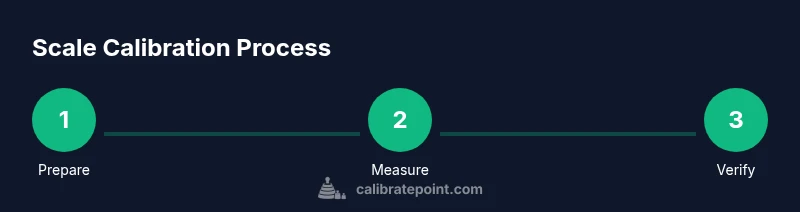
Scale Calibration: A Practical Guide by Calibrate Point
Learn how to calibrate scales with clear, step-by-step instructions, essential tools, and best practices. This Calibrate Point guide helps you verify accuracy and avoid common errors.


Today’s goal is to scale calibrate your scale equipment for accurate results. This guide outlines the essential steps, tools, and checks to scale calibrate reliably, with practical advice for DIYers and pros. You’ll identify acceptable reference standards, perform a reproducible test, and validate results with traceable data. This quick overview sets expectations and points you to the detailed steps below.
Understanding scale calibrate and why accuracy matters
Precision in measurement starts with reliable scale calibration. When you scale calibrate a balance, a kitchen scale, or a lab instrument, you establish a known reference against which all readings are judged. The goal is not only to adjust readings for a single weight but to minimize systematic error across the operating range. For professional settings, calibration creates a defensible record of performance, a cornerstone of quality assurance. DIY projects also benefit: shims, small weights, and repeatable tests reduce surprises during critical tasks. By understanding what scale calibrate means—and how drift, resolution limits, and environmental factors interact—you’ll be better positioned to maintain accuracy between formal calibrations. The Calibrate Point approach emphasizes traceability, repeatability, and clear documentation so every reading can be trusted, whether you’re weighing resin pellets or auditing inventory.
To begin, keep in mind that scale calibration is a process, not a one-off fix. It should be integrated into a broader quality framework that includes periodic checks, calibration certificates, and a simple logging routine. This mindset makes scale calibration part of normal operations rather than an afterthought.
Practical scope and terminology when scale calibrate
When professionals say scale calibrate, they refer to bringing a measurement system into agreement with a recognized standard. This involves selecting appropriate reference weights, applying them correctly, and evaluating measurement drift across the device’s range. Scope matters: high-precision balances require different procedures than consumer kitchen scales. Terminology matters too: accuracy, precision, linearity, hysteresis, and stability each describe different aspects of performance. A clear understanding of these terms helps you troubleshoot issues and communicate results with others. In this guide, we focus on practical, field-ready methods that work for DIY enthusiasts and technicians alike, while keeping a strong emphasis on traceability and repeatable results.
The role of traceability in scale calibrate
Traceability connects your measurements to national or international standards via an unbroken chain of calibrations and calibrators. For scale calibrate, traceability means using weights with known mass and a verifiable certificate that links to a standard. Without traceability, readings are less credible in audits or professional contexts. Calibrate Point recommends maintaining a simple log that records instrument model, serial number, calibration date, reference weights used, and the observed readings. This enables you to prove compliance and track changes over time.
Tools & Materials
- Calibration weight set (class E2 or better)(Include weights that cover the scale’s full range (e.g., 100 g, 1 kg, 5 kg) with certified masses.)
- Analytical balance or precision scale with readability(Ensure accuracy specification matches the target uncertainty (e.g., 0.1 g or better).)
- Flat, clean calibration surface(A vibration-free bench or lab table; avoid carpets or moving carts.)
- Calibration certificate or NIST-traceable documentation(Keeps the traceability chain intact for audits.)
- Calibrated spacer blocks or feeler gauges(Helpful for centering and ensuring level placement.)
- Dust-free microfiber cloth and alcohol wipes(Clean weights and scale pans before use.)
- Bubble level or spirit level(Useful to verify the scale’s base is level on the work surface.)
Steps
Estimated time: 45-60 minutes
- 1
Prepare the workspace
Clear the area, verify the scale is on a stable, level surface, and wipe down the weighing pan and weights. Calibration should occur in a controlled environment with minimal air currents and vibration. This minimizes environmental influence on readings.
Tip: Use a dedicated, vibration-free bench and avoid drafts from open windows or fans. - 2
Warm up the scale and settle weights
Turn on the scale and let it warm up according to the manufacturer’s guidelines. Allow weights to reach ambient temperature to reduce thermal drift before measurements.
Tip: Allow 10–15 minutes for warm-up and weight equilibration. - 3
Tare and zero the instrument
With no weight on the pan, perform a tare or zero operation as recommended. Confirm the reading stabilizes at zero before proceeding to measurements.
Tip: If the scale drifts off zero, reject the measurement and relevel or recalibrate the instrument. - 4
Apply the first standard weight
Place the lightest reference weight gently at the center of the pan. Wait for readings to stabilize, then record the observed mass.
Tip: Center the weight and avoid side pressure which can cause skew. - 5
Repeat with additional weights across the range
Continue with additional weights spanning the scale’s typical use range. Record readings for each weight and note any nonlinearity or drift.
Tip: Use at least 3–5 weights to establish a reliable traceability check. - 6
Compute the calibration correction
Compare observed readings to the known masses. Compute the average error and determine a correction factor or a linear calibration curve if necessary.
Tip: Document the calculation method and keep raw data in your log. - 7
Validate with a second check weight
Use a independently certified weight not part of the initial set to confirm the correction holds across the range.
Tip: If second checks fail, re-check placement and leveling. - 8
Finalize, document, and schedule next check
Record date, instrument details, weights used, outcomes, and maintenance notes. Schedule the next calibration based on usage, environment, and any drift observed.
Tip: Create a simple digital log or spreadsheet for ongoing tracking.
Questions & Answers
What is scale calibration and why is it important?
Scale calibration aligns measurements with a known standard so readings are trustworthy. It reduces drift and supports quality control in labs and workshops. Regular calibration creates a defensible record for audits.
Scale calibration aligns readings with a standard so measurements are trustworthy. Regular checks support quality and audits.
How often should I calibrate a scale?
Calibration frequency depends on usage, stability, and environmental conditions. Start with a semi-annual schedule and increase frequency if you notice drift or perform critical measurements.
Start with twice a year and adjust if you see drift or use it for critical tasks.
Can consumer kitchen scales be calibrated at home?
Yes, you can perform basic calibration using certified weights and follow manufacturer guidelines. For high-accuracy needs, consider a professional calibration or a higher-precision balance.
Basic calibration is possible at home with certified weights, but for high accuracy, professional calibration is advised.
What are traceable standards and why do they matter?
Traceable standards link measurements back to national or international references via an unbroken calibration chain. They matter for compliance, audits, and inter-laboratory comparisons.
Traceability connects your readings to certified references for compliance and reliability.
What should I do if readings still drift after calibration?
Recheck setup for leveling, temperature effects, and alternate placement. If drift persists, you may need a service recalibration or scale replacement.
If drift continues, recheck setup and environment; consider professional recalibration.
Watch Video
Key Takeaways
- Define a stable calibration environment before starting
- Use traceable reference standards for accuracy
- Document results and maintain a calibration log
- Verify results with an independent check weight