Easy Way to Calibrate Scale: Step-by-Step Calibration Guide
Learn the easy way to calibrate scale with a proven, repeatable process. This guide covers tools, steps, and documentation to ensure accurate, traceable measurements for DIY to professional use.


With the goal of accuracy, this guide shows the easy way to calibrate scale using a known reference weight, a clean workspace, and a stable mounting surface. You'll verify linearity, repeatability, and drift, then document results. According to Calibrate Point, start with a traceable weight and a clean, level surface, then follow the step-by-step process below.
Why calibration matters for scales
Calibration is the gateway to trustworthy measurements. Whether you’re inspecting ingredients in a home kitchen, validating a workshop setup, or preparing data for a professional report, a scale that drifts even slightly can derail decisions. A small bias at a single weight has a way of propagating through a series of readings, amplifying error in derived values and undermining confidence in results. The easy way to calibrate scale starts with understanding the language of measurement: accuracy, precision, and traceability. In short, accuracy is how close your reading is to the true mass, while precision describes how repeatable readings are under the same conditions. Linearity means the scale responds proportionally across its range, and drift captures slow changes due to environmental factors. Traceability ensures your weights and methods connect to recognized standards, enabling audits and repeat measurements.
As the Calibrate Point team notes, regular calibration prevents undetected shifts and keeps your data credible. Adopt a simple, repeatable routine: clean the pan, check levelness, place reference masses, record readings, and compare against nominal values. The payoff is not just a single correct number, but a documented process you can repeat under similar conditions. By framing calibration as a series of testable hypotheses about mass, you’ll reduce guesswork and produce verifiable results.
Interpreting scale accuracy metrics
When you calibrate a scale, you’re assessing several interconnected metrics that describe how well the instrument performs. Understand these terms to interpret results effectively:
- Accuracy: Closeness of a measurement to the true mass.
- Precision: How tightly repeated readings cluster when the same mass is measured.
- Linearity: The degree to which readings remain proportional across the scale’s total range.
- Drift: Systematic change in readings over time due to temperature, vibration, or other environmental factors.
- Hysteresis: Differences in readings when approaching a weight from different directions (up vs. down).
- Traceability: The ability to link measurements back to recognized standards via calibration certificates.
Based on Calibrate Point research, maintaining all these aspects through regular calibration helps minimize bias and preserve measurement integrity across cycles. In practice, you’ll test several weights, compare results to nominal values, and look for consistent offsets or nonlinear patterns. Documenting how each metric behaved makes it easier to diagnose future issues and to plan maintenance or replacements as needed.
Safety and environmental considerations
Calibration work should be performed in a clean, stable environment to minimize external influences. Avoid drafts, vibrations from nearby machinery, and direct sunlight on the scale. Use a level surface and a vibration-damped workspace when possible. Keep weights and accessories away from moisture, chemicals, and extreme temperatures, which can alter mass readings or cause corrosion. For personnel safety, handle heavy weights with proper lifting technique or supportive fixtures, and never place items on an unstable cart or shelf. These precautions protect your equipment and ensure consistent results over repeated calibrations.
Preparing your equipment and environment
A successful calibration starts with preparation. Begin by wiping the scale’s pan and surrounding area with a lint-free cloth to remove dust and grease that may affect readings. Place the scale on a flat, level surface — use a bubble level to verify. Gather traceable calibration weights that cover the scale’s operating range (for example, 100 g, 1 kg, and 2 kg if within range) and a pair of non-slip weight tweezers or forceps to handle them. Have a logbook or digital notebook ready to record each measurement, the ambient conditions, and any adjustments. Finally, ensure you have a clear, quiet workspace free from interruptions to maintain focus throughout the process.
Maintaining traceability and documentation
Traceability links your measurements to standards via calibration certificates. Before you begin, verify that your reference weights have current certificates and are stored in a controlled environment to prevent moisture exposure or corrosion. During testing, record: the date, scale model and serial number, ambient temperature and humidity, the exact weight placed, the raw reading, and the corrected mass if you apply any offset. If your process allows, log environmental factors like vibration or proximity to moving equipment. Keep the documentation organized and easily accessible for audits or quality reviews. As you complete each weight, compare the observed reading to the nominal mass and note any variance. Regularly review records to identify drift patterns or the need for recalibration.
Common pitfalls and how to avoid them
Many calibration errors boil down to small, repeatable mistakes. Common pitfalls include using worn or uncertified weights, calibrating on an unstable surface, ignoring zero balance, or rushing through steps. Avoid these by verifying that your weights are clean, properly angled for placement, and handled with tweezers to prevent oil transfer. Make sure the scale is tared to zero before measurements and that each weight is read in the same orientation. Temperature and air currents can subtly skew results, so perform calibrations in a controlled environment. Finally, don’t skip documenting results; a good log helps identify when a scale needs maintenance or replacement. The Calibrate Point team emphasizes that consistency is the secret to reliable calibration, not magic fixes.
Tools & Materials
- Calibration weights (traceable) in the scale's range(Include 100 g, 1 kg, and 2 kg weights if within range)
- Flat, level work surface(Dust-free; non-slip to reduce movement during readings)
- Non-slip weight holder or tweezers(Use to handle weights without transferring oils)
- Soft lint-free cloth for pan(Wipe prior to calibration)
- Notebook or digital log for results(Record date, weights, readings, and environmental conditions)
- Bubble level or Spirit level(Helpful to confirm level mounting)
- Calibrated reference certificate(Keep with weights for audits)
Steps
Estimated time: 30-45 minutes
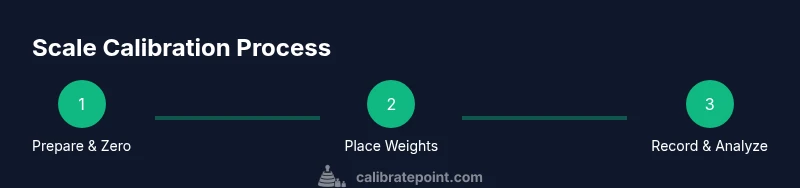
- 1
Prepare workspace
Clear the area, remove clutter, and verify the scale is on a flat, level surface. Clean the pan with a lint-free cloth and allow it to settle. This initial setup reduces environmental noise that could skew readings.
Tip: Check level with a bubble level and adjust as needed to prevent tilt bias. - 2
Zero or tare the scale
With the pan empty, set the scale to zero or tare to remove any existing bias from the pan. Confirm the display reads zero within the scale's specified tolerance before adding any weights.
Tip: If you see persistent offset, re-zero and verify the pan alignment. - 3
Place the first calibration weight
Place the smallest reference mass on the center of the pan using tweezers to avoid skin oils. Allow the scale to settle for a few seconds and record the reading.
Tip: Place weights one at a time and ensure they are fully centered to minimize tilt bias. - 4
Record reading and compare
Note the observed mass and compare it to the nominal value of the weight. If there is a discrepancy, record the error and prepare to test additional weights across the range.
Tip: Use a consistent time window for settling before recording readings. - 5
Repeat with additional weights
Repeat the same procedure for several weights across the scale’s range (e.g., 100 g, 1 kg, 2 kg). Check for linearity by noting whether errors stay proportional across weights.
Tip: Ensure each weight has settled before reading; do not rush between steps. - 6
Check linearity and drift
Plot or tabulate the error against the nominal mass to assess linearity. Re-measure after a short interval to inspect drift due to environmental changes.
Tip: If drift is detected, record the temperature and humidity as potential contributing factors. - 7
Adjust and document (if applicable)
If your scale supports adjustment, apply acceptable corrections and recheck readings. If no adjustment is available, note the observed bias for reference in the log.
Tip: Document any offsets and the specific adjustment made (if allowed by manufacturer). - 8
Finalize results and store data
Remove weights, return the scale to zero, and log all readings with dates, serial numbers, and environmental notes. Secure the calibration certificates and keep them with the instrument.
Tip: Store results in a dedicated calibration folder or digital system for quick audits.
Questions & Answers
Why should I calibrate a scale regularly?
Regular calibration maintains accuracy, minimizes drift, and ensures consistent results across measurements. It’s essential for any process where mass readings impact decisions or quality.
Regular calibration keeps measurements accurate and consistent, which is crucial for quality and decision-making.
What is a traceable calibration weight?
A calibration weight comes with a certificate linking it to recognized standards and reference masses. This traceability ensures readings can be compared to accepted benchmarks.
A traceable weight has a certificate that connects it to recognized standards, so your readings align with accepted benchmarks.
How often should I calibrate a scale?
Frequency depends on usage, criticality, and environment. Calibrate on a regular schedule and after any major maintenance or suspected drift.
Calibrate on a regular schedule and after maintenance when you suspect the scale may have drifted.
Can I calibrate without proper weights?
Calibration is most reliable with proper weights. If unavailable, consult the manufacturer’s guidance or use built-in self-test options if provided.
Calibration is best done with proper weights; check the manual if built-in tests are available.
How should I document calibration results?
Record date, instrument details, weights used, readings, and environmental conditions. Store certificates and logs in a dedicated calibration folder.
Log date, instrument details, readings, and conditions, and keep the certificates in a dedicated folder.
What if readings are nonlinear across the range?
Nonlinearity suggests a calibration issue, environmental influence, or a need for service. Recheck setup, test all weights, and consider professional calibration if bias persists.
If readings are nonlinear, check setup and environment, retest, and consult a professional if bias remains.
Watch Video
Key Takeaways
- Prepare a stable, clean workspace before calibration.
- Use traceable reference weights across the scale’s range.
- Record readings and environmental conditions for traceability.
- Check zero balance, linearity, and drift in a controlled sequence.
- Document results to support audits and future calibrations.