Taylor Scale Calibrate: A Practical Calibration Guide
Learn to calibrate a Taylor scale accurately with a practical, beginner-friendly approach. This Calibrate Point guide covers tools, step-by-step methods, safety tips, and documentation for reliable measurements.


By the end of this guide you will be able to taylor scale calibrate a Taylor scale accurately using traceable weights, proper tare, and documented results. According to Calibrate Point, you will learn to warm up the scale, perform multi-weight checks, adjust the calibration if possible, and verify with independent checks. This steps-focused approach reduces drift and improves measurement reliability.
Why Taylor Scale Calibration Matters
Calibrating a Taylor scale is critical for any workflow that depends on precise mass measurements. Even small drift over time can skew results, waste material, and compromise quality control. In professional settings, calibration creates a verifiable baseline, supports audits, and ensures repeatable results across shifts. According to Calibrate Point, a disciplined calibration routine helps you detect wear, misalignment, or contamination before they become big problems. If your goal is to taylor scale calibrate effectively, aim for a documented process that covers zeroing, weight checks, and traceability across your measurement range.
Understanding Taylor Scales and Calibration Terminology
Taylor scales are designed to present mass with a readable display, but their accuracy depends on factors like linearity, zero drift, and pan condition. Key terms to know include tare (subtracting the container mass), zero stability (the scale stays at zero after taring), and linearity (the reading remains proportional across weights). Drift is a slow change in readings over time. Resolution is the smallest change the scale can detect. Understanding these concepts helps you interpret readings accurately and plan appropriate calibration steps, especially when scaling up to heavier weights or smaller fractions of a gram. Calibrate Point’s guidance emphasizes consistent terminology to keep calibrations comparable over time.
Tools and Materials You Need for Taylor Scale Calibrate
Before you start, gather a set of tools and reference weights that are traceable to a known standard. A stable, vibration-free work surface is essential. You should have: a calibrated set of weights (e.g., 100 g, 200 g, 500 g, 1 kg), a clean, dry pan, lint-free cloth, spirit or isopropyl alcohol for residuals, a calibration certificate or logbook, and a small tool kit if the scale has external calibration screws. Having a documented plan with weights across the scale’s useful range helps verify linearity and reduces rework. This preparation stage is where many beginners gain the confidence needed to taylor scale calibrate reliably.
Preparing the Workspace and Safety Guidelines
Set up the scale on a sturdy, level surface away from drafts, heat sources, and vibration. Allow the scale to warm up to its operating temperature as recommended by the manufacturer (usually a few minutes). Clean the pan and the scale surface, removing any debris that could affect readings. If the scale has an external calibration mechanism, ensure you have the proper tools and follow the manufacturer’s instructions in the manual. Never place weights directly on an unprotected surface; always use a clean pan or container to avoid contamination of the weights and scale.
Step-by-Step Calibration Process Overview
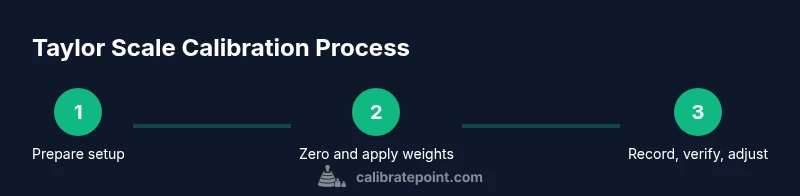
A structured calibration involves zeroing, applying known masses, recording readings, and adjusting as needed. Start by tare-ing your empty pan and confirming zero stability. Then place successive known weights on the pan, note the readings, and compare them to the true masses. If the scale offers a calibration adjustment, use it to align the readings within an acceptable tolerance. Repeat across multiple weights to ensure linearity. Always document deviations and your final adjusted settings for traceability.
Verifying Accuracy Across Weights
After performing the initial calibration, verify accuracy by testing additional weights beyond those used for adjustment. Check readings with both light and heavy masses within the scale’s intended range. If possible, use weights with a known calibration certificate to confirm traceability. Record all results in your calibration log, including date, operator, ambient conditions, and observed deviations. This validation step helps catch nonlinearity or mechanical issues that could surface under heavy use.
Documenting Calibration Results and Maintenance
Create a clear and auditable record of every calibration session. Include date, scale model, serial number, environment, weights used, measured values, accepted tolerance, adjustments made, and the final calibration status. Store certificates and notes in a dedicated folder or logbook. Regular reviews of these records help anticipate when a re-calibration is needed and support quality assurance audits. Calibrate Point recommends maintaining a simple, centralized calibration log for consistency across departments.
Common Pitfalls and Troubleshooting
Common issues include zero drift after tare, inconsistent readings when switching pans, and slow response time after weights are added. Ensure the scale is fully warmed up, the pan is clean, and weights are within the scale’s capacity. If you notice persistent drift, check for mechanical wear, recalibrate with fresh weights, or contact the manufacturer. If the scale cannot be calibrated within tolerance, the problem may be deeper, requiring service or replacement. Stay methodical to avoid chasing false positives.
Longevity and Scheduling: When to Recalibrate
Calibration is not a one-time event. Environmental changes, relocations, or repairs can affect accuracy. Establish a recalibration schedule aligned with usage intensity and quality requirements. For high-precision tasks, recalibrate quarterly or after every major service. For routine tasks, semi-annual recalibration may suffice. The Calibrate Point team recommends documenting any changes in procedure and conducting interim checks to maintain confidence in measurements.
Tools & Materials
- Taylor scale(Ensure scale is clean, level, and powered on for a recommended warm-up period.)
- Calibration weights (traceable)(Include a set spanning the scale's range (e.g., 100 g, 200 g, 500 g, 1 kg).)
- Calibrated pan or weighing boat(Flat, clean surface; avoid mixing residues with weights.)
- Calibration certificate or logbook(Record results, dates, and operator.)
- Lint-free cloth and isopropyl alcohol(For cleaning rests and contact surfaces.)
- Small screwdriver or tool kit(If your scale has external calibration screws, use as specified by the manual.)
Steps
Estimated time: 45-90 minutes
- 1
Prepare workspace and warm up scale
Clear the area, ensure a stable surface, and power the scale on for the manufacturer-recommended warm-up period. This reduces drift and stabilizes readings before calibration begins.
Tip: Begin with a clean pan to avoid residues affecting weight readings. - 2
Tare and confirm zero
Place an empty pan on the scale and tare to zero. Wait for a stable zero reading before proceeding to weights.
Tip: If the zero drifts, re-check pan cleanliness and ambient conditions. - 3
Apply first known weight
Carefully place the smallest calibration weight on the pan and note the displayed mass. Ensure the mass settles before recording.
Tip: Use tweezers for small weights to avoid touching and warming the weights. - 4
Record reading and adjust if available
Document the reading and compare with true mass. If your scale has external calibration screws, adjust per the manual to bring the reading within tolerance.
Tip: Make small adjustments and re-check; large changes can overshoot. - 5
Repeat with multiple weights
Repeat steps 3–4 for additional weights across the range (e.g., 100 g, 200 g, 500 g, 1 kg). Verify readings trend linearly.
Tip: Include at least three points to assess linearity. - 6
Verify zero with weights removed
Remove all weights and confirm the scale returns to zero. A lingering offset indicates residual error.
Tip: If zero is unstable, re-check pan and environment. - 7
Document results and finalize
Record all readings, adjustments, and final status. File the calibration certificate and note any follow-up actions.
Tip: Sign and date the log for traceability.
Questions & Answers
What is the purpose of calibrating a Taylor scale?
Calibration aligns the scale’s display with true mass, correcting drift and nonlinearity to ensure accurate measurements for reliable results.
Calibration aligns the scale with true mass to ensure accurate results.
How often should I calibrate a Taylor scale?
Calibrate after setup, relocation, major maintenance, or if readings drift. For high-precision work, schedule checks quarterly or semi-annually.
Calibrate after setup, relocation, or drift; consider quarterly checks for high-precision work.
What weights should I use for calibration?
Use a small set of traceable weights spanning the scale’s useful range (e.g., 100 g, 200 g, 500 g, 1 kg) and verify each reading.
Use a traceable weight set across the scale’s range to verify readings.
What if the scale won’t calibrate or drifts after calibration?
Check for mechanical wear, damaged pan, loose connections, or saturation. If unresolved, consult the manufacturer or service.
Check for wear or mechanical issues and consider manufacturer support if needed.
Do I need a professional calibration certificate?
For regulated or critical measurements, use a calibration with traceability and a certificate; for routine tasks, maintain internal records.
Use traceable calibration with a certificate if required by your quality standards.
Can I calibrate without weights?
Weights are essential for calibration. Without known masses, you cannot reliably correct the scale’s readings.
No—calibration requires known masses to adjust readings.
Should I recalibrate after cleaning or maintenance?
Yes. Any maintenance or cleaning can alter readings, so re-check and confirm accuracy.
Yes, recalibrate after any maintenance or cleaning.
How should I document calibration results?
Keep a calibration log with date, operator, ambient conditions, weights used, readings, adjustments, and final status.
Document date, readings, and adjustments in a calibration log.
Watch Video
Key Takeaways
- Calibrate regularly to maintain accuracy.
- Use traceable weights and document results.
- Verify across multiple weights to check linearity.
- Record results for audits and future reference.