Calibrate Speedometer for Tire Size: A Practical How-To
Learn how to calibrate your speedometer when changing tire sizes. This comprehensive guide covers data gathering, calculation methods, step-by-step calibration, safety, verification, and maintenance tips for accurate readings in 2026.


You will learn how to adjust your speedometer to reflect your tire size, ensuring accurate speed and distance readings. Before you start, confirm your current tire size and the target sizes, gather the required tools, and follow safety steps. Proper calibration improves accuracy for legal speeds and fuel economy. This quick guide keeps you compliant and confident.
Why calibrating speedometer for tire size matters
When you install tires with a different diameter, your speedometer reading can become unreliable. An oversized tire will cause the speedo to read too slowly or fast, depending on the diameter change, leading to inaccurate speed display, odometer drift, and potential legal issues if you rely on it for speed enforcement. The Calibrate Point team emphasizes that calibration is not optional when changing tire size; it's a safety and accuracy practice. According to Calibrate Point, even small changes can accumulate into noticeable errors at highway speeds. By calibrating, you align the displayed speed with reality, which improves fuel economy planning, maintenance scheduling, and overall driving confidence. This guide is designed for DIY enthusiasts and technicians who want a practical, repeatable approach to speedometer calibration that you can perform without professional tools, with results you can trust in 2026.
How tire size affects speedometer readings
Tire diameter directly affects the number of wheel rotations per mile. When you substitute tires with larger or smaller circumferences, the wheel speed sensor will report speeds that are biased away from the true road speed. The math is simple: the speedometer is calibrated to a reference circumference; changing circumference by a ratio changes indicated speed by the same ratio. This means a larger-diameter tire will make the speedometer read lower than actual, while smaller tires cause a higher indicated speed. Calibrate Point analysis shows that mis-match between tire size and calibration data is the primary cause of inaccurate readings after a tire swap. Understanding this relationship gives you a clear target for your calibration procedure and helps you plan the data you need to collect before starting.
When to recalibrate after changing tires
Whenever you install tires that differ in diameter from the factory spec, you should plan a recalibration. This includes switching from stock wheels to aftermarket rims, or running winter vs summer tires with different sidewall height. If you rotate tires front-to-back or install run-flat tires with lower or higher sidewall, you should re-check calibration. If your vehicle supports ECU-based calibration, you may need to update the ECU with the correct circumference data via OBD-II or dealer tools. Recalibration is particularly important for high-speed driving or long trips at consistent road speeds. The goal is to ensure the speedometer, odometer, and trip computer all reflect the same real-world distance and speed measurement.
Legal and safety considerations
Accurate speed measurement is not just a convenience; it's a safety and legal requirement in many jurisdictions. Driving with a significantly inaccurate speedometer can lead to tickets, unsafe driving under wrong speed assumptions, and misinformed maintenance intervals. Check your local regulations before performing manual calibrations and consult your vehicle's service manual for recommended methods. If your vehicle relies on dealer-specific software to adjust tire size, weigh the costs and benefits before deciding to DIY. Always perform calibrations in a controlled setting, secure the vehicle, and test with a GPS-enabled device to verify accuracy across a range of speeds.
Data you need before calibration
Before you begin, collect the following data: the current tire size (sidewall height and diameter) and the target size, the stock wheel diameter, and the rim width if it affects circumference. Measure or confirm the sidewall height with a tape measure and convert it to the approximate overall diameter. You'll also want the vehicle's official tire size specification from the owner's manual. Document the circumference ratio (new vs old) and prepare to enter that data into whatever calibration method you choose. Keeping a calibration log helps you track progress and ensures repeatability for future tire swaps.
Tools and setup overview
Gather tools such as an OBD-II scanner, a digital scale or calipers for precision measurements, a reliable GPS-based speed verification, a notebook, and a calculator. The goal is to collect the right data and adjust the vehicle's calibration setting (ECU, tire size table, or programming module) as applicable. If you're unsure about your car's calibration method, consult the owner's manual or a service professional. Ensure you have a safe, flat surface to perform tests, and set the brake hold when needed. Document the starting conditions (tire size, speed, and GPS reading).
Step-by-step overview and approach
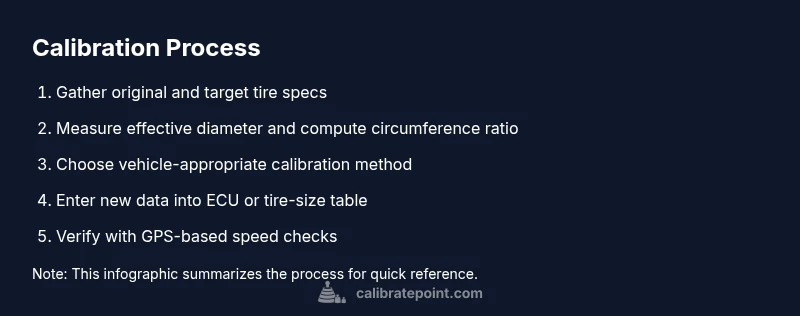
Note: The following are high-level steps; the detailed steps appear in the STEP-BY-STEP section below. The approach is to calculate the circumference ratio, determine the target calibration data, and verify accuracy with real-world testing. Start by confirming both the original and new tires’ dimensions, then compute the necessary adjustment factor. The exact method to apply this factor varies by vehicle; some cars expose a dedicated calibration setting, others require ECU-level changes. Regardless of method, the objective is consistent: the displayed speed matches the road speed and the odometer remains aligned with actual distance.
Verification methods and final checks
Once calibration data is applied, verify accuracy using multiple methods: drive at steady speeds on a known route with GPS speed readings, compare to road signs or a GPS app, and repeat at different speeds. If available, use a drag or test track for controlled testing. A secondary check is to ensure odometer distance aligns with independent trip meters. If significant discrepancy remains, recheck measurements and repeat the calibration cycle. The goal is to have an acceptable error margin across common highway speeds and city speeds.
Practical tips for ongoing accuracy
Keep a calibration log, re-check after seasonal tire changes, and share findings with your workshop if you collaborate with others. Regularly verify your speedometer against GPS measurements on at least two separate drives. Store your tire size data in your vehicle maintenance folder and note any factors that could affect circumference, such as low tire pressure or wear. Remember that calibrating speedometer for tire size is part of reliable vehicle maintenance, not a one-off project.
Tools & Materials
- Owner's manual(Reference tire size specs and calibration guidance from the factory)
- Current tire size specification(Document diameter and width in inches/mm for old tires)
- Target tire size specification(Document diameter and width in inches/mm for new tires)
- Torque wrench(Used when adjusting any hardware during calibration changes)
- OBD-II scanner(Read/modify calibration data if vehicle supports ECU updates)
- GPS-based speed verification device(To validate accuracy during testing)
- Calibration log or notebook(Record measurements, offsets, and test results)
- Measuring tools (tape measure/calipers)(Accurate circumference data requires precise measurements)
Steps
Estimated time: 60-90 minutes
- 1
Prepare and verify tire sizes
Collect both the original and target tire sizes from the vehicle and tire manufacturers. Confirm wheel diameter and sidewall height, then write them down clearly. This preparatory data is the foundation for the entire calibration process.
Tip: Double-check sizes against the manufacturer specs to avoid incorrect inputs later. - 2
Measure effective diameter and circumference
Measure sidewall height and confirm the overall diameter. Use the formula for circumference C = π × D (where D is the tire diameter). If you have access to precise measuring tools, record multiple measurements to reduce error.
Tip: Use calibrated tools or a known reference to improve measurement accuracy. - 3
Compute the circumference ratio
Calculate the ratio of the target circumference to the original circumference. This ratio determines the calibration offset you will apply in the vehicle’s speedometer system. Document the ratio for future reference.
Tip: Even small ratio changes can materially affect speed readings at highway speeds. - 4
Choose your calibration method by vehicle type
Some vehicles allow ECU-level changes, others use wheel-speed tables or dealer software. Consult the owner’s manual to choose the appropriate method for your car. If unsure, plan for a professional consultation.
Tip: Starting with the manufacturer-recommended method reduces risk. - 5
Access calibration controls
Open the calibration interface required by your method (ECU, wheel-speed offset, or tire-size table). Ensure the ignition is off when you begin and follow safety procedures for your toolchain.
Tip: Never modify while the vehicle is in operation. - 6
Enter new circumference data or offset
Input the calculated ratio or offsets into the calibration system as specified by your method. Save changes and note the exact inputs in your calibration log.
Tip: Take a screenshot or note the exact values for future reference. - 7
Perform a controlled test with GPS verification
Drive a known distance at a steady speed and compare your speedometer reading to a GPS speed readout. Record readings at multiple speeds (e.g., 30, 50, 70 mph or km/h equivalents).
Tip: Prefer a flat, safe route with minimal traffic for accuracy. - 8
Refine and repeat if needed
If discrepancies exceed an acceptable tolerance, revisit measurements and inputs. Adjust offsets and re-test until readings align closely with GPS data.
Tip: Document each iteration for a transparent calibration history. - 9
Document results and schedule future checks
Log the final calibration values, date, vehicle, tire sizes, and test results. Schedule future checks for seasonal tire changes or wear-related circumference shifts.
Tip: Keep the log in your vehicle maintenance folder for quick reference.
Questions & Answers
Will recalibrating the speedometer affect odometer readings?
Recalibration can influence how the odometer reports mileage if circumference data changes. After inputting a new circumference, verify the odometer against GPS-tracked distance. If needed, re-align both readings through the same calibration data.
Recalibration can affect the odometer; verify both readings with GPS and adjust as needed.
Can I calibrate the speedometer myself without professional tools?
Yes, you can perform calibration with data you collected and tools like an OBD-II scanner and GPS verification. However, some vehicles require dealer tools or dealership software for ECU-level changes. Always consult the manual and proceed with caution.
You can DIY using the right data and tools, but some cars need professional tools.
How do I calculate the new tire circumference for calibration?
Use the standard formula C = π × D, where D is the overall tire diameter. Determine the original and new diameters from tire specs and compute the ratio. This ratio guides input into the calibration method.
Use the circumference formula with the old and new diameters to get the ratio.
Is it legal to drive with a miscalibrated speedometer?
Laws vary by region. In many places, significant miscalibration can be illegal or lead to enforcement issues. Always check local regulations and ensure your measurements are accurate before driving extensively.
Legal rules vary; check local laws and ensure accuracy before long drives.
Do I need to recalibrate if I rotate tires with the same diameter?
If the overall circumference remains the same, a recalibration may not be necessary. Still, verify speedometer accuracy after any rotation and keep records in your calibration log.
If circumference stays the same, recalibration may not be required, but verify anyway.
Watch Video
Key Takeaways
- Verify old and new tire sizes before calibration
- Calculate circumference ratio accurately before updates
- Test with GPS at multiple speeds for robust verification
- Document all changes for future maintenance
- Regularly re-check calibration after seasonal tire changes