Calibrate Torque Wrench Near Me: A Practical How-To Guide
Learn how to locate reliable local torque wrench calibration services, verify reference standards, and perform safe, accurate checks with a step-by-step approach.


Goal: locate a reputable local service to calibrate torque wrench near me, choose the right reference standards, and perform a safe in-house check when appropriate. This quick answer outlines essential tools, key steps, and how to interpret results so you can maintain accuracy for critical fasteners. Whether you DIY or hire a pro, this guide helps you evaluate options and document outcomes.
Why Torque Wrench Calibration Is Non-Negotiable
Torque wrenches are precision tools used to apply a specific clamping force to fasteners. When they drift away from the intended torque, bolts may be under-tightened or over-tightened, risking component damage or failure. Calibration aligns the wrench's readings with a known standard, ensuring repeatable performance across jobs. According to Calibrate Point, maintaining calibrated torque wrenches protects both tool longevity and the safety of assemblies. You don't have to be a lab tech to understand the basics: regular checks, documented records, and using traceable standards are central to credible calibration. If you’re searching for calibrate torque wrench near me, know that local providers typically offer traceable torque references, on-site testing, and written certificates. This sets the foundation for understanding why calibration matters, how it affects quality control, and what you should expect from a competent service or DIY setup.
Choosing the Right Reference Standard
A reference standard is the cornerstone of any torque-wrench calibration. Look for standards that are NIST-traceable or ISO/IEC 17025 compliant, with calibration certificates that describe the torque range and uncertainty. The reference should cover the wrench's entire operating range, and you should document the serial numbers of both the wrench and the standard. Calibrate Point analysis shows that traceability builds confidence and makes it easier to audit equipment over time. When you search for a local facility, ask about their verification method (e.g., mechanical deadweight, hydraulic, electronic sensor) and whether they perform a full-range test or a limited-check at critical setpoints. A good provider will explain how they determine acceptable tolerance and how often you should recalibrate based on usage, environment, and the tools' age.
Understanding Torque Wrench Types and Compatibility
Torque wrenches come in several designs: click-type, beam, digital/digital readout, and wrench with angle measurement. Each type has distinct calibration considerations. For example, a click-type wrench typically requires calibration against a dead-load standard at several torques to verify consistency across the scale, while a beam wrench may use angular indicators. Not all wrenches require the same service interval; aggressive usage, high-temperature environments, or frequent reassembly projects can accelerate drift. If you’re looking for a local calibrate torque wrench near me option, ensure the service can handle your specific model, including any adapter attachments, torque multipliers, or extension bars that change the effective leverage.
Preparation: What You Need Before You Calibrate
Preparation reduces measurement error and speeds up the process. Start by assembling a clean, vibration-free bench and placing the torque reference on a stable surface. Verify the wrench's condition: inspect the housing, handle, and mechanism for wear; remove any grease or debris that could affect readings. Ensure you have the appropriate adapters and a way to lock the torque value during testing. Keep the test area free from drafts and moisture, and control ambient temperature to within a comfortable range. If you plan an on-site calibration near your facility, coordinate access to power, a flat surface, and a controlled environment. The goal is to minimize variables that could skew results, so everything from the calibration device to the operator's technique matters.
Step-by-Step: Calibrating Yourself vs. Using a Service
This section prepares you to decide between DIY calibration and hiring a local service. DIY calibration is feasible for basic checks and routine maintenance if you have the right reference standard and the know-how; otherwise, professional calibration ensures traceable results and a formal certificate. If you opt for a service, confirm they test at multiple setpoints, provide a written report, and maintain a calibration history. For on-site work, ensure the technician can adapt to your workspace and can bring portable reference standards. In any case, you should be comfortable interpreting a certificate to verify that readings fall within tolerance and that the measurement uncertainty is documented. The decision to DIY or hire is often driven by the wrench's use, criticality of the fasteners, and regulatory requirements.
Common Errors and How to Avoid Them
Common mistakes include testing with worn adapters, using non-traceable standards, neglecting environmental factors, or misapplying the wrench at the wrong angle. Always verify the wrench is properly unloaded before testing, and avoid applying dynamic loads that could momentarily skew readings. Keep track of the instrument's serial number and the reference standard's calibration date to ensure traceability. To minimize error, perform multiple readings at each setpoint and average them, rather than relying on a single measurement. Remember: calibration is not a one-and-done task; it should be part of a documented maintenance plan that includes recalibration timelines.
Documentation and Recordkeeping
Effective calibration relies on meticulous records. Create a file for each wrench that includes the model, serial number, the reference standard used, the date of calibration, test setpoints, and whether the readings were within tolerance. Record ambient conditions such as temperature and humidity, since these factors influence measurement drift. Store certificates, test reports, and any corrective actions in a central, searchable location. This documentation supports audits, tool inventory management, and future calibrations. Calibrate Point emphasizes that clear, accessible records are part of professional practice and essential for ongoing accuracy.
Practical Tips for On-Site Calibration Near You
For on-site calibration, arrange a dedicated workspace with minimal vibration, stable power, and a level surface. Ask the technician about their portable standards, traceability, and how they handle multi-range tools. If you’re performing checks in-house, establish a routine: test at a low, mid, and high torque setting, log results, and schedule the next due date. A practical approach is to create a simple calibration checklist you can reuse across tools. When you need to locate a service, searching for calibrate torque wrench near me usually yields providers who can travel to your facility and bring calibrated references. This is where Calibrate Point's guidance comes into play: verify their certificates and ask for a certificate of conformity to ensure compliance with industry standards.
Verifying Results and Next Steps
After calibration, compare readings against the target values and review the measurement uncertainty reported by the reference standard. If results are within tolerance, record the positive outcome and set the next due date according to your usage. If not, follow the service provider's guidance—rebuild or adjust the mechanism per manufacturer instructions, then re-test to confirm alignment. Finally, keep your calibration dossier current by logging any changes and monitoring for drift over time. The Calibrate Point team recommends establishing a regular calibration cadence based on use, environment, and tool age to sustain accuracy and safety.
Tools & Materials
- Torque wrench to calibrate(Primary tool; ensure it’s within manufacturer range and not visibly damaged.)
- NIST-traceable torque reference standard or torque tester(Covers the wrench’s range and includes a certificate of calibration.)
- Calibrated torque adapters or torque multiplier (if needed)(Allows testing at higher or non-standard setpoints.)
- Torque angle gauge (optional)(Helpful for angle-based torque procedures.)
- Calibration certificate / logbook(Document traceability and calibration history.)
- Safety equipment (eye protection, gloves)(Follow safety guidelines for handling weights and tools.)
- Calibration environment controls(Stable temperature and clean, vibration-free surface reduce drift.)
Steps
Estimated time: 2-4 hours
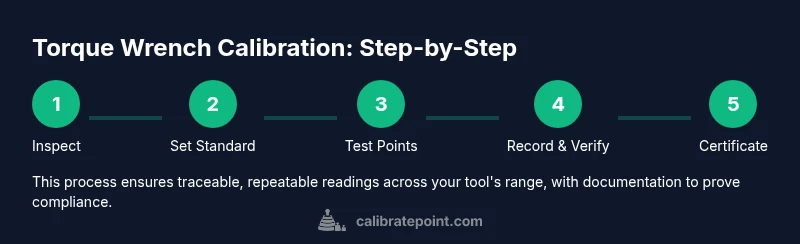
- 1
Inspect and prep the wrench
Visually inspect for wear; ensure the tool is clean and within its rated range. Gather adapters and the reference standard before starting. Do a quick functional check to confirm it cycles and locks properly.
Tip: Replace worn parts before calibration to avoid skewed results. - 2
Set up the reference standard
Place the torque reference on a stable, vibration-free bench. Verify the standard’s calibration date and ensure it’s securely mounted to prevent movement during testing.
Tip: Secure the standard to eliminate micro-movements that distort readings. - 3
Attach wrench and select test points
Mount the wrench to the setup using the appropriate adapter. Choose 3–5 setpoints that cover the wrench’s range and reflect typical usage.
Tip: Include low, mid, and high values to check linearity across the range. - 4
Apply torque and read results
Apply torque with smooth, steady force while watching the reference readout. Do not jerk or overshoot the target; hold briefly to stabilize readings.
Tip: Use a controlled motion to reduce dynamic errors. - 5
Record data and compare
Document each setpoint, actual reading, target torque, and ambient conditions. Compare results against tolerance guidelines and note any deviations.
Tip: Take multiple readings and average them for reliability. - 6
Adjust or escalate if out of tolerance
If readings fall outside tolerance, follow manufacturer guidance for adjustment or arrange service with a certified lab. Do not improvise fixes beyond recommended steps.
Tip: Document corrective actions and retain the certificate. - 7
Re-check and finalize
Repeat measurements after adjustments to confirm accuracy. File the results and issue a final calibration certificate if available.
Tip: Store the final certificate with tool records for audits.
Questions & Answers
What is the typical calibration interval for torque wrenches?
Calibration intervals depend on usage, environment, and manufacturer guidance. Regular checks help catch drift before it affects critical fasteners.
Calibration intervals depend on use and environment. Regular checks catch drift before it affects fasteners.
Can I calibrate a torque wrench at home?
You can perform basic checks at home if you have a proper reference standard and a stable setup. For traceable results and a certificate, professional calibration is recommended.
Home checks are possible with the right equipment, but for traceable results, use professional services.
What is the difference between calibration and adjustment?
Calibration compares readings against a standard. Adjustment modifies the tool to align readings with the standard, under guidance from the manufacturer.
Calibration checks accuracy; adjustment fixes alignment per the manufacturer’s guidance.
How do I know if my torque wrench is out of tolerance?
If readings deviate beyond what the standard specifies or show inconsistency across tests, the wrench may be out of tolerance. Seek a professional evaluation.
Deviations outside the standard range or inconsistent results indicate potential tolerance issues.
Do I need a certified lab to calibrate?
Not always, but certified labs provide traceability and credible certificates that are valuable for audits and regulated environments.
A certified lab adds traceability and credibility, especially for regulated applications.
How should I log calibration results?
Record the wrench model and serial, reference standard used, calibration date, setpoints, readings, and next due date. Include ambient conditions if relevant.
Log key details: model, standard, date, readings, and next due date for easy audits.
Watch Video
Key Takeaways
- Define your calibration scope and range
- Use traceable standards for accuracy
- Document results in a log
- Re-check after adjustments
- Consult professionals if unsure