How to Calibrate a Torque Wrench in Newton Meters
Learn how to calibrate a torque wrench to Newton meters with a practical, safety-focused guide from Calibrate Point. Tools, steps, and FAQs for accurate, traceable results.


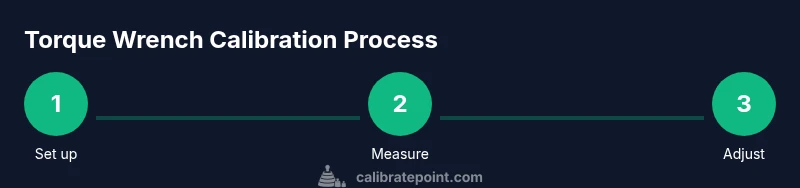
Calibrating a torque wrench to Newton meters ensures accurate fastener tension for critical assemblies. You’ll need a certified torque tester or torque calibration adapter, reference weights, and a stable workspace. Follow a precise, step-by-step process to verify drift, adjust the calibration screw or micrometer, and record results for traceability.
Why calibrate torque wrench to Newton meters
According to Calibrate Point, calibrating a torque wrench to Newton meters is essential for achieving consistent clamping forces and preventing under- or over-torquing on fasteners that impact safety and performance. Newton meters provide a standardized measure of rotational force, aligning with SI units and ensuring your torque wrench reads correctly across its entire range. When calibration is performed to this unit, technicians can compare results against certified references, maintain traceability, and reduce the risk of over-tightening or under-tightening critical components. In professional settings—from automotive repair bays to aerospace assemblies—calibration to Newton meters is a baseline practice that supports quality control, product longevity, and safety compliance. The right calibration protocol also helps technicians build confidence in every assembly, knowing the tool reports accurate values under load.
Key ideas you’ll see here
- The significance of Newton meters as the target unit for many tools
- How drift occurs and why tolerance matters
- The role of traceability and calibration records
About traceability and risk management
- Traceability links your wrench to reference standards and a documented calibration history.
- Regular checks catch drift early, reducing the chance of field failures.
- A well-maintained calibration log supports audits and warranties.
Tools & Materials
- Calibrated torque tester or torque transducer(NIST-traceable preferred; capable of absorbing the torque range of your wrench)
- Torque weights or a calibration adapter(Range that covers nominal and peak torque values)
- Calibration torque wrench under test(The same wrench you will use in daily work)
- Adjustment tool compatible with wrench (e.g., hex key or screwdriver)(Model-specific; used to set calibration screw or micrometer)
- Rigid calibration bench or vibration-free surface(Anti-slip mat recommended for stability)
- Calibration logbook or digital record system(Date, lot, reference standard, results)
Steps
Estimated time: 60-90 minutes
- 1
Prepare the calibration workspace
Set up a stable, vibration-free bench. Place the torque tester in a fixed position and verify the environment is at a comfortable, consistent temperature. Gather your wrench, adapter, and reference standards before you begin.
Tip: Use anti-slip mats and clamp the tester to the bench to prevent movement during measurement. - 2
Attach the wrench to the tester
Mount the torque wrench onto the tester or transducer according to the device’s manual. Ensure you’re using the correct adapter and that the handle is free of oil or debris that could affect grip or reading.
Tip: Tighten connections snugly but avoid over-tightening; misfits at the interface create measurement error. - 3
Zero and verify baseline reading
Set the tester to zero or the lowest reference point. Confirm there is no residual load or torque present when the wrench is not engaged. Record the baseline reading for reference.
Tip: If the baseline shows drift, clean interfaces and re-zero before proceeding. - 4
Test at a low torque point
Position the wrench and apply torque up to a low test value (e.g., 20 N·m). Read the instrument and compare to the target. Document any deviation and prepare for adjustment if necessary.
Tip: Use smooth, continuous motion—jerky pulling introduces reading errors. - 5
Adjust the wrench to align with target
If readings are off, adjust the calibration screw or micrometer per the manufacturer’s procedure. Make small adjustments and re-check at the same torque point.
Tip: Make gradual changes; overshooting can require backtracking and prolong calibration. - 6
Re-test at the same torque value
Re-apply torque to the low point and confirm the reading matches the target within tolerance. Repeat if necessary until consistent.
Tip: Use the same technique to avoid introducing new errors between attempts. - 7
Expand testing to mid and high torque points
Test at mid-range and high-range values (e.g., 60 N·m and 100 N·m). Verify readings are within tolerance at each point and adjust as needed.
Tip: Record multiple trials at each point to assess repeatability. - 8
Document results and finalize
Compile readings, adjustments, and uncertainty estimates into a calibration certificate. Schedule the next calibration according to policy or usage.
Tip: Include device serial numbers and reference standard certificates for full traceability.
Questions & Answers
What is a Newton meter in torque measurement and why use it?
Newton meters measure rotational force; calibrating to this unit ensures consistent clamping force across fasteners. It aligns with SI standards and supports traceability and safety.
Newton meters measure rotational force. Calibrating to this unit ensures consistent, traceable torque for safe fastener applications.
How often should a torque wrench be calibrated?
Calibration frequency depends on usage and producer guidelines, but a common practice is every 6 to 12 months or after a known drop or impact. For critical assemblies, more frequent checks are advised.
Most users calibrate every 6 to 12 months, or after a drop or heavy use, especially for critical work.
What equipment do I need for a home calibration?
You need a calibrated torque tester or transducer, torque reference weights or adapters, the wrench under test, an adjustment tool, and a stable work surface with a log for records.
You’ll need a calibrated tester, reference weights, your wrench, an adjustment tool, and a stable workspace.
Can I calibrate a torque wrench without a lab?
Yes, with proper equipment and adherence to procedure, you can calibrate at home. For critical applications, use a certified lab or service provider to ensure traceability and documentation.
You can calibrate at home if you have the right gear and follow the procedure, but labs provide stronger traceability.
How do I verify calibration results after adjustments?
Re-test at the same torque values and ensure readings fall within tolerance across the range. Record results and compare against the reference standards.
Re-test at the same torques and confirm they are within tolerance; document everything.
Watch Video
Key Takeaways
- Calibrate at multiple torque points for accuracy.
- Maintain traceability with certified standards.
- Document everything for future audits.
- Schedule regular recalibrations according to use.
- Follow manufacturer instructions for adjustments.