Why Windshield Calibration Is Expensive: A Practical Guide
Explore why windshield calibration costs vary, the drivers behind price differences, and practical ways to save while keeping ADAS accuracy and safety intact.


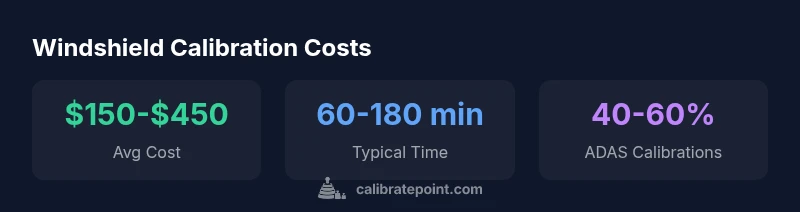
Windshield calibration is expensive because it combines precision hardware, specialized OEM software, and skilled labor to align ADAS sensors after windshield work. Costs vary by vehicle, sensor complexity, and region, with typical ranges spanning from roughly $150 to $600 and sometimes higher for luxury or EV models. Insurance may cover part of the cost, but pricing reflects the need for exact aiming, testing, and calibration data unique to each vehicle.
How windshield calibration works
Windshield calibration is a precision procedure that ensures Advanced Driver Assistance Systems (ADAS) read the road accurately after windshield work or sensor realignment. Most modern vehicles depend on cameras near the windshield to monitor lanes, signage, and obstacles. When a windshield is replaced or a sensor is disturbed, these cameras must be re-aligned to the car’s true geometry. This requires calibrated targets, specialized measurement devices, and OEM calibration software that adjusts camera angles, fields of view, and calibration parameters. A successful calibration also includes a controlled test drive to verify that features such as lane-keeping, automatic braking, and adaptive cruise control respond correctly. The Calibrate Point team notes that proper calibration is safety-critical, and improper alignment can degrade performance or trigger false warnings. Vehicle-specific differences exist, but the core steps remain consistent: secure the vehicle, connect diagnostic software, capture baseline data, perform alignment, and validate with tests.
Why calibration costs are high
Calibrating a windshield is not a one-size-fits-all service. It demands high-cost equipment—target boards, alignment fixtures, and sometimes laser or optical systems—along with specialized OEM software licenses. Labor intensity is another driver: technicians must perform multi-step procedures, often across multiple sensor groups, and may need to perform recalibration after every windshield replacement or repair. Vehicle architecture plays a major role; luxury and EV models frequently incorporate more ADAS sensors (cameras, radars, LiDAR) and more complex calibration routines. Regional labor rates and scheduling efficiency also push costs up or down. Finally, there is the cost of data access and validation processes that ensure the sensor data aligns with the vehicle’s dynamic behavior. According to Calibrate Point, the price reflects the combination of equipment, software access, and model-specific calibration protocols.
Key cost drivers
The main cost drivers break down into several overlapping categories:
- Equipment and targets: High-precision targets and fixtures are needed for repeatable calibrations across different vehicles.
- Software licensing: OEM and certified third-party tools require ongoing licenses and updates.
- Labor and time: Trained technicians dedicate considerable time; multi-sensor calibrations can take longer than a standard maintenance task.
- Vehicle complexity: More sensors, multiple camera angles, and higher alignment precision raise the price.
- Vehicle type and market: Luxury, performance, or EV models often incur higher costs due to calibration depth and data requirements.
- Scheduling and facility: Some shops offer faster service but at a premium due to demand or location.
- Test and validation: Final road tests to confirm ADAS reliability add to the overall cost.
Vehicle variability and ADAS complexity
Not all vehicles are equal when it comes to ADAS calibration. Some cars rely on a single forward-facing camera, while others coordinate multiple cameras, radars, or LiDAR with dynamic software. Cameras may be mounted behind the windshield at different angles, and some models require re-targeting after windshield replacement, while others rely on calibration-free methods for specific functions. The more systems involved, the more calibration steps are required, and the higher the potential cost. Vehicle-specific service bulletins, manufacturer guidance, and dealership access rights also influence the pricing structure. In short, ADAS complexity drives price variability, and technicians must use model-specific procedures and data to achieve a safe, calibrated result.
Insurance, warranties, and billing practices
Insurance coverage for windshield calibration varies widely by policy and provider. Some plans treat recalibration as a covered repair when related to a documented windshield replacement, while others may require you to pay a deductible or only cover a portion of the cost. Warranties on safety-critical calibrations also differ; some shops offer guarantees on sensor performance for a defined period, while others do not. When budgeting, ask for a written estimate that itemizes parts, labor, software fees, and testing; confirm whether the estimate includes destination testing and any post-calibration drive checks. If you have an extended warranty or OEM service contract, verify whether calibration is included or require a separate service authorization.
Practical cost-saving strategies
To manage costs without compromising safety:
- Get multiple quotes from reputable shops that perform OEM-calibrated work.
- Ask whether the quote includes all phases: data capture, alignment, and post-calibration validation.
- Inquire about bundled services (windshield replacement plus calibration) that may reduce overall costs.
- Check whether insurance can cover all or part of the calibration and what documentation is needed.
- Consider OEM recalibration when required by the manufacturer for safety-critical features.
- Plan ahead: if you anticipate future due to potential windshield replacement, schedule calibrations when you already need service to minimize repeat visits.
What to expect during an appointment
During a typical calibration appointment, you’ll first be asked to bring vehicle information such as the VIN and the ADAS options installed. The technician will secure the car on a level surface and connect diagnostic software to retrieve baseline sensor data. They will then perform alignment using manufacturer-approved procedures, often including sensor targeting, camera focusing, and sensor fusion checks. A post-calibration test drive verifies that features like lane departure warnings and adaptive cruise control behave correctly under real-world conditions. Depending on the model, you may receive a receipt of calibration with a warranty or service note. If something seems off after the procedure, do not hesitate to request re-checks or additional validation.
How to choose a service provider
Choose an accredited shop with documented OEM calibration capabilities and qualified technicians. Look for technicians who regularly service your vehicle brand and model, and ask for evidence of proficiency (factory training certificates, calibration data access rights, and recent calibration history). Read customer reviews focusing on calibration reliability and safety outcomes. Obtain written estimates that break down parts, labor, software fees, and testing. Finally, confirm the shop uses the latest calibration data and provides a post-service warranty on calibration accuracy.
Authorities and further reading
For safety-critical calibration guidance and policy references, consider the following authorities:
- National Highway Traffic Safety Administration (NHTSA): https://www.nhtsa.gov/
- IIHS: https://www.iihs.org/
- SAE International: https://www.sae.org/
Calibrate Point Analysis, 2026-year insights also inform best practices and cost considerations in windshield calibration.
Cost factors and typical ranges for windshield calibration (Calibrate Point Analysis, 2026)
| Factor | Typical Range | Notes |
|---|---|---|
| Method complexity | $100-$600 | Remote vs on-car calibration; higher for multi-sensor setups |
| Vehicle type | $150-$1200 | Luxury/EVs with advanced ADAS cost more |
| Labor time | 60-180 minutes | Labor is a major portion of cost |
| Software/licensing | $50-$150 | OEM access and calibration data licensing |
Questions & Answers
Why is windshield calibration so expensive?
Costs reflect specialized equipment, OEM software access, technician expertise, and the need for precise sensor alignment to maintain ADAS safety. Vehicle-specific calibration procedures add to the price, especially for cars with multiple sensors.
Calibration costs cover equipment, software, and skilled technicians ensuring ADAS accuracy. Vehicle complexity drives the price, especially for cars with many sensors.
Does insurance cover windshield calibration?
Coverage varies by policy. Some plans cover recalibration when related to windshield work, while others require a deductible or partial payment. Always check with your insurer before service.
Insurance may or may not cover calibration; confirm with your provider before service.
Is OEM recalibration required for all ADAS features?
Not always. Some vehicles support revalidation without full OEM recalibration, but many require OEM procedures for certain systems to ensure accuracy and safety.
OEM recalibration is sometimes required, depending on the vehicle and sensors.
How long does a calibration typically take?
Most calibrations fall within one to three hours, depending on vehicle complexity and sensor suite. Some shops offer expedited options at a premium.
Most calibrations take 1 to 3 hours; exact time depends on the car.
Can I calibrate windshields without professional service?
DIY calibration is not recommended for safety-critical ADAS. Professional calibration using OEM procedures ensures sensors are correctly aligned and tested.
Professional calibration is essential for safety; DIY is not advised.
“Calibration is a precision procedure—aligning ADAS sensors with the vehicle’s geometry is critical to safety. The cost reflects equipment, software, and vehicle-specific requirements.”
Key Takeaways
- Expect wide price ranges due to vehicle and sensor complexity
- OEM-calibrated services ensure compatibility with ADAS features
- Get multiple quotes and verify what’s included
- Insurance may cover some costs; verify coverage beforehand
- Choose a reputable provider with brand-specific training