Calibrate Car Compass: A Practical Step-by-Step Guide
Learn how to calibrate your car compass with a clear, step-by-step method to improve heading accuracy and safer navigation in diverse driving conditions.


Calibrating your car compass ensures accurate heading readings and safer navigation, especially in new or magnetically disturbed areas. This quick guide outlines when calibration is needed, the essential tools, and the step-by-step process to perform it safely. You’ll need a stable vehicle for testing, a built-in compass or phone app, and a few minutes to complete the procedure.
Why calibrate car compass matters
According to Calibrate Point, a properly calibrated car compass improves heading accuracy, reduces drift, and enhances route confidence during navigation. In modern vehicles, even small misalignments can lead to noticeable deviations on digital maps or heads-up displays. This section explains why compass calibration matters for DIY enthusiasts, technicians, and professionals alike, and what real-world benefits you can expect after a successful calibration. When your compass is aligned with true north, you’ll notice more reliable turn-by-turn guidance, particularly in urban canyons or rural roads where magnetic interference from nearby structures is variable. Calibration is not a one-off task; it should become part of routine vehicle maintenance, especially if you frequently travel in areas with strong magnetic disturbances or after major repairs. By understanding the theory behind compass alignment, you’ll perform calibrations confidently, avoiding common mistakes that can worsen heading errors.
Key takeaway: Regular calibration keeps your vehicle’s navigation tools trustworthy and easier to rely on.
How magnetic fields affect car compass readings
A car’s compass is sensitive to nearby magnetic sources—ferrous metals in the vehicle, electronic devices, even road magnets used for traffic control. When these sources shift or when you refuel near large steel structures, the indicated heading may drift. Calibrate Point emphasizes that awareness of the surrounding environment is the first step in reliable calibration. The aim is to minimize interference during the calibration sequence and to verify the result with a secondary reference if possible. In practice, many drivers notice small heading discrepancies only after long trips, in parking garages, or after maintenance that alters the dashboard layout. Recognizing these patterns helps you plan a more effective calibration routine.
Step alignment overview and what to expect
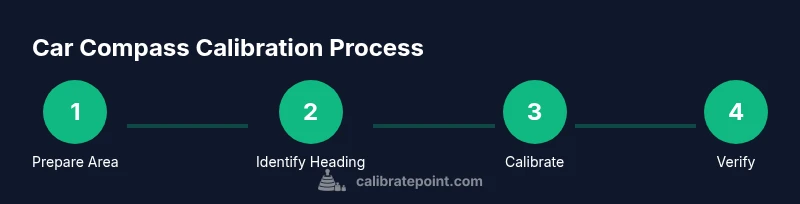
Calibration is a process that realigns the compass reference with true north. The steps vary slightly by vehicle make and model, but the core concepts are consistent: establish a stable testing area, start from a known heading, perform the calibration sequence, and verify the outcome. Expect a calm, methodical procedure that takes a few minutes in a parked, open area with a clear view of the sky for reference tools. If your car displays heading in a digital gauge, use that as the primary readout and cross-check with a secondary reference like a smartphone compass. This block sets the stage for practical, repeatable results and helps you avoid common pitfalls that lead to inaccurate calibrations.
Common sources of heading drift and how to mitigate them
Certain activities and environments are notorious for inducing compass drift. Prolonged exposure to magnetized tools or equipment, proximity to large metal objects, and even the presence of a magnetic personal device can skew readings. Move away from such sources for the calibration sequence, and if possible, perform calibration near an open area with minimal magnetic interference. Calibrate Point recommends documenting any persistent drift and rechecking after a few trips to confirm the stability of the heading reference.
Declination, true north, and why it matters for calibration
Magnetic declination is the angle between magnetic north (what a compass points to) and true north (geographic north). Depending on your location, a small declination can significantly affect heading accuracy on maps and navigation systems. For calibration, you are aligning the compass reference to the local declination context so that the displayed heading matches what you expect on a map. NOAA provides tools and references to determine local declination, which can be helpful if you travel across regions with different declination values. Understanding these concepts helps you interpret calibration results more accurately.
Practical testing after calibration
After completing the calibration sequence, validate the heading in multiple directions: north, east, south, and west. Compare the mobile phone compass or a secondary navigation app to confirm consistency. If discrepancies appear, repeat the calibration in a controlled way and re-check. A successful calibration should display stable headings within a small tolerance range across different orientations. If you regularly drive in magnetically disturbed environments, plan periodic recalibration as part of routine vehicle checks.
Safety, maintenance, and reliability
Calibrating the car compass is a simple maintenance task that should be performed when the vehicle is stationary and in a safe, distraction-free environment. Avoid calibrating while driving to prevent accidents or misinterpretation of readings. Store a simple checklist for calibration timing, environmental conditions, and verification results so you can reproduce the procedure consistently. The Calibrate Point team recommends treating compass calibration as a standard maintenance item, especially for vehicles used in urban canyons or near large metallic structures. Regular checks help maintain navigation reliability and reduce the chance of misrouting due to compass drift.
Tools & Materials
- Vehicle in a flat, open testing area(Choose a level surface away from magnetic interference (e.g., large steel structures).)
- Built-in car compass or external compass app(Ensure you can view heading readings clearly during the procedure.)
- Smartphone with compass app (optional backup)(Useful for cross-checking headings against the car system.)
- Local declination data reference (NOAA calculator or equivalent)(Helpful for understanding declination context if drifting persists.)
Steps
Estimated time: 15-25 minutes
- 1
Prepare testing area
Park the car in a flat, open space with the engine off and parking brake engaged. Turn off nearby devices that could emit magnetic interference. Allow the vehicle to stabilize for a couple of minutes before taking readings.
Tip: Do a quick visual check for magnetic sources around the car (tools, signs, or equipment). - 2
Identify a heading reference
Turn on the car’s heading indicator or compass display. If available, enable a secondary reference (e.g., smartphone compass) to compare readings from the outset.
Tip: Record the initial heading as a baseline before calibration. - 3
Enter calibration mode
Activate your vehicle’s calibration sequence per the owner’s manual. This often involves a series of clockwise and counterclockwise rotations or a digital confirmation step.
Tip: Ensure you understand the model-specific steps; consult the manual if needed. - 4
Align with true north
If possible, reference true north using a visual cue (sun position when safe) or cross-check with a smartphone compass. Adjust readings as directed by your vehicle’s system until the heading stabilizes.
Tip: Make slow, deliberate movements to avoid overshooting the target heading. - 5
Wait for stabilization
After alignment, wait 30–60 seconds to let readings settle. Take multiple readings to confirm consistency.
Tip: If readings fluctuate, repeat the calibration in a few minutes to a slightly different orientation. - 6
Verify results and record
Document the final heading, observed drift (if any), and declination context. Cross-check with a secondary device and confirm stability across orientations.
Tip: Keep a calibration log so you can repeat the process reliably in the future.
Questions & Answers
What is the car compass and why calibrate it?
A car compass is the instrument or display that indicates heading relative to magnetic north. Calibrating it ensures the heading shown aligns with true navigation references, improving route accuracy and reducing misdirection, especially in magnetically disturbed areas.
A car compass shows the heading; calibrating it helps ensure it points in the right direction, so your maps and navigation are reliable.
When should I calibrate my car compass?
Calibrate when you notice drift in headings, after magnetic disturbances near the vehicle, or after major maintenance that could affect the instrument cluster. Regular checks can prevent gradual drift from going unchecked.
Calibrate whenever you notice heading drift or after work on the car that might affect the compass readings.
Is it safe to calibrate while parked or stationary?
Yes. Calibration should be performed while the vehicle is parked in a safe, level spot with the engine off and the parking brake engaged to prevent movement.
Calibrate only when the car is parked and secured to stay safe.
How do I know if the calibration worked?
Verify by checking headings in multiple directions, and cross-check with a smartphone compass or another reference. Consistent readings across orientations indicate a successful calibration.
Check the heading in several directions and compare with a phone compass to confirm stability.
What if I still see drift after calibration?
If drift persists, re-run the calibration sequence, remove nearby magnetic sources, or consult the vehicle’s manual for model-specific guidance. Persistent issues may indicate a hardware fault.
If drift stays after recalibration, repeat the process and check for nearby magnets or consult the manual.
Does declination affect car compass calibration?
Yes. Local magnetic declination affects how magnetic north relates to true north. Understanding declination helps interpret calibration results and align displays with map data.
Declination tells you how magnetic north differs from true north; knowing it helps interpret heading readings better.
Watch Video
Key Takeaways
- Prepare a distraction-free testing area and environment.
- Use both built-in and independent compass references for verification.
- Document heading results and any drift observed.
- Repeat calibration after major repairs or exposure to strong magnetic fields.
- Incorporate compass calibration into regular vehicle maintenance.