How to Calibrate a Compass: A Practical Field Guide
Learn how to calibrate a compass accurately with a structured, step-by-step approach. Includes setup, verification, safety, and maintenance tips for reliable navigation in the field.


This guide shows you how to calibrate a compass to improve navigation accuracy in the field. You’ll learn the core concepts, required setup, and two proven calibration methods, followed by field verification steps. The process is designed for DIY enthusiasts, technicians, and professionals who want reliable, repeatable results. Safety and environmental considerations are covered to protect you and your instruments.
Why calibrate a compass matters
According to Calibrate Point, calibrating a compass is essential for accurate navigation, especially in unfamiliar terrain. The act of calibration aligns your local magnetic field readings with true north, reducing errors caused by nearby metal, magnetic tools, or vehicle iron. Whether you’re hiking, surveying, or performing field calibration for equipment, a well-calibrated compass minimizes decision errors and improves safety. This guide emphasizes practical, repeatable procedures you can perform with common tools. By learning how to calibrate compass readings and verify them in the field, you’ll gain confidence in your readings and reduce downtime due to drift. The Calibrate Point team believes in actionable steps, not guesswork, so you can trust your results when you’re far from help.
In this section, you’ll find the why behind calibration, the distinction between magnetic north and true north, and the mindset needed to conduct reliable tests in varied environments. The goal is to provide a repeatable workflow that works for DIY enthusiasts, technicians, and professionals who want robust, testable results. Remember that consistency is the backbone of good navigation, and calibration is the key that unlocks it.
Basic concepts: magnetic north vs true north
A compass aligns with magnetic north, which is not the same as true north. Geographic or true north is the direction toward the Earth's rotational axis. The difference between these two directions, called magnetic declination, varies by location and changes slowly over time. When you calibrate compass readings, you translate magnetic readings into a frame that matches your maps and GPS tools. Calibrate Point analysis shows that neglecting declination can lead to systematic errors that accumulate during longer trips. For precision work, you’ll want to apply local declination values or use a map-based method to reconcile readings with true north.
Understanding this distinction helps you decide when a simple orientation check is enough and when a formal calibration is required. In practice, you’ll use declination data to convert the compass reading to true north for navigation, surveying, or land-use planning. This keeps your bearings consistent with your reference materials and reduces misdirection in complex environments.
When to calibrate: signs you need recalibration
Calibration shouldn’t be a guess. Look for signs that your compass needs recalibration, such as persistent deviation from known landmarks, readings that don’t align with a trusted map, or noticeable wobble in the needle when moved slowly. Other indicators include metallic interference in the surroundings (vehicles, tools, or tools with strong magnets) and a sudden change in readings after transporting the instrument. If you’re using a digital compass, verify that the device’s firmware is current and that magnetic interference warnings aren’t triggered. Calibrate Point suggests performing a baseline check after any impact, near large ferrous structures, or when you switch locations radically from urban to rural settings.
Document your observations, noting the magnitude and direction of any offsets. This record helps you decide which calibration method suits your needs and whether additional checks are warranted before critical work. Regular checks are especially important for field crews who rely on multiple instruments; consistency across devices reduces cross-reading errors and improves overall project quality.
Setting up a calibration environment
Choose an open outdoor area free from metal objects, vehicles, or construction debris. A flat, level surface helps you stabilize the instrument and reduces parallax errors during readings. Avoid areas with strong magnetic disturbances, such as near power lines or rail yards. If you must calibrate indoors, ensure the room is free of electronic devices that emit magnetic fields and place the compass on a non-magnetic surface. Calibrate Point emphasizes using declination charts or GPS-apps in parallel to ensure you’re aligning to true north. Always perform calibration away from metal tools, knapsacks with metal frames, or any gear stored close to the compass.
Record environmental conditions (wind, temperature, and altitude) as these factors can influence readings indirectly by affecting your ability to remain still and focused during the process. A calm, controlled environment yields the most repeatable results, which is why many professionals stage calibration outdoors but still document conditions for reproducibility.
Step-by-step overview of methods
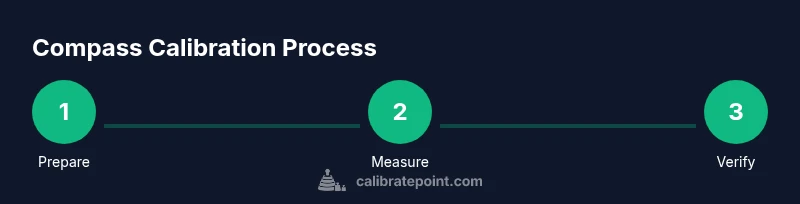
There isn’t a single universal method for compass calibration; instead, you’ll apply a method that matches your instrument type, whether a traditional magnetic compass or a modern digital/magnetometer-enabled device. Broadly, calibration involves establishing a known reference direction, taking readings, and applying corrections to align the instrument’s output with true bearings. In this guide, you’ll learn two practical approaches: a field-based deviation testing method and a declination-adjusted calibration method using known landmarks. Both methods require careful documentation, repeatable procedures, and verification before you trust readings in the field. The sections that follow break down each method into actionable steps you can execute with standard tools and minimal risk.
Method A: Field-based magnetic deviation testing
This approach tests the compass against a known reference direction in your local environment. Start by identifying a streak of true north in the landscape (such as a distant landmark aligned with true north on your map). Take multiple readings at different orientations, noting any consistent offsets. The goal is to quantify the deviation between magnetic north (the compass reading) and true north. If your instrument has adjustment screws, you may apply a minor correction to the housing alignment. Always document every reading, including the orientation, time, and environmental factors. This method is powerful when you need to quantify local magnetic interference and create a correction table for field use.
A practical pro tip is to perform a 360-degree sweep in a stable stance, keeping the compass level to reduce parallax and ensure readings are not biased by tilt. If you observe inconsistent results between readings, pause, re-check anchor points, and re-evaluate safety considerations in your environment.
Method B: Declination-adjusted calibration using known landmarks
This method uses local declination data to translate magnetic readings into true bearings. Begin by locating a landmark that lines up with true north on your map, then align the compass to the declination-adjusted bearing. Use the declination value from a current chart for your region and apply it to the compass reading to derive true bearings. Repeat the alignment from several directions to verify consistency. This approach is especially useful in areas with stable declination values and minimal interference from nearby metal objects. Keep a log of the declination used and any changes you apply to the compass housing or scale to ensure you can reproduce results later.
A pro tip is to cross-check with a digital compass or a compass app to validate that the declination adjustment yields concordant readings across devices.
Verifying the calibration with field tests
After performing calibration, test the instrument in real-world navigation tasks. Use a known trail or a marked course, and compare your bearings with a trusted map or GPS reading. If you see consistent discrepancies beyond an acceptable tolerance, revisit the calibration steps, re-check declination data, and assess whether nearby metal or electrical devices are influencing readings. Field verification should be repeatable and quick enough to perform multiple times in a single session. Maintain a calibration log with dates, conditions, and results to detect drift over time and guide future recalibrations.
In practice, a successful calibration yields bearings that match your reference route within a small margin of error and remain consistent across successive measurements.
Common mistakes and how to avoid them
Mistakes include calibrating in a magnetically rich environment, tilting the compass during readings, or neglecting to document declination values. Another frequent error is assuming a single reading represents truth; instead, take multiple readings in different orientations and average the results. Avoid adjusting the device without a clear, repeatable method and a documented tolerance. Also, never calibrate near ferrous objects (maps, weaponry, or metallic clamps) that can distort magnetic readings. Finally, verify calibration after any impact or relocation to ensure drift hasn’t reappeared.
Maintenance and long-term care for accuracy
Calibration is not a one-time event. Keep your compass clean, dry, and free of moisture that can corrode moving parts. Regularly inspect the needle balance and housing alignment, especially in field environments where vibration and jostling occur. Update declination data as regional changes are published and re-check your calibration whenever you suspect drift or after traveling long distances. Storing your instrument away from metal surfaces and metal-containing gear helps reduce cumulative interference. Consistent maintenance practices extend the reliability of your compass for years.
Tools & Materials
- Magnetic compass(Primary instrument for testing; ensure no obvious damage)
- Declination chart or GPS with true-north reference(Use up-to-date data for your region)
- Non-magnetic alignment tool (optional)(Helps align scale or housing without affecting readings)
- Notebook and pen(Record readings, conditions, and corrections)
- Open outdoor calibration area(Choose a flat, level surface away from metal objects)
- Smartphone or tablet with compass app (optional for cross-checks)(Use as a secondary reference when available)
Steps
Estimated time: 45-90 minutes
- 1
Prepare a safe calibration area
Select a calm outdoor space, free from metal objects. Clear the area of vehicles, tools, and gear that could distort readings. This reduces interference and helps stabilize measurements.
Tip: Use a level surface and keep your stance steady to minimize parallax error. - 2
Set up reference and baseline
Identify a true-north reference point or landmark. Position the compass so it sits flat and level, then take an initial reading to establish a baseline bearing.
Tip: Document the landmark alignment and baseline bearing in your notebook. - 3
Record multiple readings for accuracy
Rotate the compass slowly through 360 degrees and record readings at several midpoints. Use an average to reduce random errors and identify consistent deviations.
Tip: Avoid rushing; precision matters more than speed. - 4
Apply declination where appropriate
If you’re translating to true bearings, apply the local declination value from an up‑to‑date chart. Note the value and method used for traceability.
Tip: Cross-check with a secondary device to confirm the adjustment aligns with true north. - 5
Check alignment screws or housing (if present)
If your instrument has adjustable screws, perform a minor correction only after confirming a reproducible offset. Record any adjustments.
Tip: Make small, documented changes and re-test immediately. - 6
Perform a 360-degree verification sweep
With the compass level, sweep through all azimuths to confirm the final offset remains consistent across directions.
Tip: If a single orientation shows a large error, re-check setup and repeating steps 1–5. - 7
Cross-check with a secondary reference
Use a map-based or digital compass reference to validate readings. Compare results and take a consensus reading.
Tip: A second reference increases confidence and reduces bias. - 8
Document the calibration outcome
Record the final bearing, declination used, environmental conditions, and any corrections applied. This ensures repeatability.
Tip: Maintain a calibration log per instrument for audits. - 9
Test in field conditions
Test bearings on a known route or course under typical field conditions to confirm real-world performance.
Tip: Choose a route with distinct landmarks for easy verification. - 10
Store and re-check regularly
Store the compass away from ferrous items and re-check periodically or after transport and impact.
Tip: Schedule a routine check before critical tasks.
Questions & Answers
Why should I calibrate a compass?
Calibration reduces magnetic drift and aligns compass readings with true north. This improves navigation accuracy, especially in unfamiliar terrain or when using maps with declination data.
Calibration reduces drift and keeps your bearings aligned with true north, improving navigation accuracy.
Can a digital compass replace a magnetic compass?
Digital compasses can be convenient, but they can also be affected by device-specific magnetometers or software. It’s best to calibrate both devices and use a traditional compass as a cross-check in the field.
Digital compasses are useful, but you should calibrate them and cross-check with a traditional compass when possible.
How long does calibration take?
A thorough calibration typically takes 30 to 90 minutes, depending on the instrument and environment. Allow extra time for verification in the field.
Plan about 30 to 90 minutes for calibration and verification, depending on conditions.
What environmental factors affect compass accuracy?
Metal objects, electrical devices, and ferromagnetic materials in the vicinity can distort readings. Temperature and vibration can also influence stability during measurements.
Metal and electrical interference are the main culprits, with temperature and vibration affecting stability.
How often should I recalibrate my compass?
Calibrate after any significant impact, relocation to a different environment, or whenever readings show drift. For field teams, schedule periodic checks to maintain consistency.
Recalibrate after impacts, environment changes, or drift, and perform periodic checks.
What’s the difference between declination and deviation?
Declination is the angular difference between true north and magnetic north used for map alignment. Deviation refers to local magnetic distortions affecting a compass reading and may require adjustments.
Declination relates to true vs magnetic north; deviation is local magnetic distortion needing corrections.
Watch Video
Key Takeaways
- Calibrate compass in a metal-free outdoor space.
- Record multiple readings for accuracy and repeatability.
- Apply declination thoughtfully and verify with a secondary reference.
- Document results to enable consistent future calibrations.
- Regular maintenance preserves long-term accuracy.