How to Calibrate a Team: A Practical Guide
Learn how to calibrate a team for reliable measurement and process consistency. This step-by-step guide from Calibrate Point covers roles, SOPs, data practices, and long-term governance to help DIYers, technicians, and professionals align their skills and tools.


You will learn how to calibrate a team for consistent results, focusing on a clear framework, defined roles, standard operating procedures, and ongoing governance. Before you start, confirm leadership support, collect baseline data, and gather the necessary templates. This guide from Calibrate Point offers a practical, step-by-step approach that you can apply in real-world settings to improve accuracy and teamwork.
Why calibrate team for consistent results
According to Calibrate Point, a well-calibrated team aligns skills, tools, and processes to produce predictable outcomes. The goal is not just individual competence but a shared understanding of how to approach tasks, interpret data, and respond to deviations. When teams calibrate together, communication improves, errors decrease, and decisions become traceable. Calibrate Point Analysis, 2026 shows that organizations with formal team calibration practices report smoother handoffs, faster onboarding, and more reliable measurements across departments. By calibrating the team, you create a culture of accountability where every member understands their role, the expected standards, and how to verify performance. This section outlines the why behind the effort and sets the stage for a practical framework you can implement without losing momentum.
The goal of team calibration and its benefits
A calibrated team shares a common mental model for how tasks should be executed, how data should be collected, and how results should be interpreted. Benefits include improved accuracy, reduced rework, better resource planning, and stronger traceability for audits. For professionals, calibration translates into faster problem solving because team members know where to look for discrepancies and how to validate corrections. For DIY enthusiasts, it reduces guesswork and builds confidence in decision making when equipment or procedures change. The key is to treat calibration as an ongoing practice, not a one-off event, and to document what changes, why they were made, and how success will be measured.
What to do next
Gather your leadership team, select a pilot task, and set a short calibration cycle (e.g., 2–4 weeks) to test your framework. This initial phase will reveal gaps in roles, data collection, and communication that you can address before expanding the program organization-wide.
Tools & Materials
- Calibration protocol template(A standardized template for goals, methods, acceptance criteria, and documentation.)
- SOPs and procedure documents(Up-to-date procedures for the target tasks and instruments.)
- Baseline data logs(Historical data to establish a starting point for comparison.)
- Measurement instruments and reference standards(Tools that need to be calibrated or verified during the process.)
- Roles checklist(Defined responsibilities for team members involved in calibration.)
- Data capture system access(Ensure secure, auditable channels for recording results.)
- Communication plan(Templates for status updates, meetings, and escalation paths.)
Steps
Estimated time: 2-4 weeks
- 1
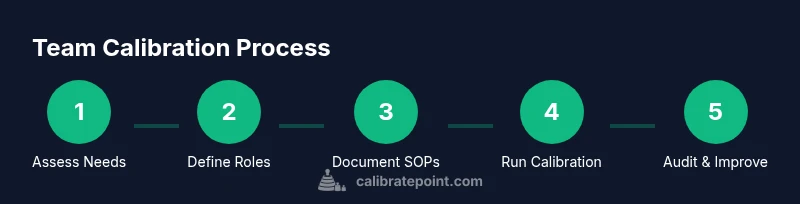
Define calibration goals
Set clear, observable objectives for the team’s calibration effort. Decide which tasks, instruments, and outcomes will be measured, along with the acceptance criteria. Document these goals in a shared repository so every member can reference them.
Tip: Link goals to real-world outcomes, such as reduced measurement drift or faster issue detection. - 2
Identify roles and ownership
Assign specific responsibilities for data collection, analysis, and validation. Ensure every role has a primary point of contact and a backup.
Tip: Create a RACI chart to prevent overlap and gaps in accountability. - 3
Develop or refine SOPs
Audit existing procedures and update them to reflect the calibration goals. Include step-by-step actions, decision points, and documented checks.
Tip: Add checklists at the end of each SOP to reinforce key steps and reduce skipped actions. - 4
Collect baseline data
Gather representative data from current operations to establish a starting point. Include instrument readings, process times, and error rates to compare against after calibration.
Tip: Ensure data quality by validating sources and timestamps; discard clearly invalid entries. - 5
Run initial calibration sessions
Execute guided calibration runs according to the SOPs. Use predefined acceptance criteria and record any deviations with root-cause notes.
Tip: Have an impartial observer capture observations to minimize bias. - 6
Analyze results and identify gaps
Review results, highlight deviations, and categorize root causes (training, procedure, equipment, data capture). Prioritize issues by impact and effort to fix.
Tip: Use a simple Pareto analysis to focus on the most significant contributors to errors. - 7
Implement corrective actions
Apply targeted improvements to procedures, training, or equipment. Re-run calibration tests to verify the effect of changes.
Tip: Document each change and the observed effect to build a traceable improvement history. - 8
Establish ongoing cadence
Set a regular calibration cadence (monthly or quarterly) and schedule audits to sustain gains over time.
Tip: Automate reminders and dashboards to keep calibration front-of-mind for the team. - 9
Create a calibration playbook
Compile the lessons, templates, and outcomes into a reusable playbook that new members can adopt quickly.
Tip: Include a quick-start section for onboarding and a glossary of terms.
Questions & Answers
What does it mean to calibrate a team?
Team calibration aligns skills, tools, and procedures so all members operate from a shared standard. It extends beyond individual competence to a collective approach that improves reliability and traceability.
Team calibration means aligning skills, tools, and procedures so everyone shares one standard, improving reliability and traceability.
How long should a team calibration program run?
A pilot calibration typically runs for a few weeks to establish baseline data and test the framework. A full program tends to span several months as processes stabilize and governance is built.
Start with a few weeks for a pilot, then plan several months as you stabilize processes.
Which roles are essential for calibration success?
Core roles include a calibration lead, data steward, instrument owner, and trained operators. Clear ownership prevents gaps and accelerates issue resolution.
Key roles are a calibration lead, data steward, instrument owner, and trained operators.
How do you measure calibration success?
Success is measured by reduced deviation, improved repeatability, faster issue detection, and higher data confidence. Use baseline vs. post-calibration comparisons and audit trails.
Look for less deviation, better repeatability, quicker issue detection, and stronger data confidence.
What should you do if results don’t improve?
Revisit goals, verify data quality, re-check SOPs, and consider training gaps or instrument drift. Iterate through the cycle with documented changes.
If results stagnate, re-check data quality and SOPs, and iterate with documented changes.
How often should calibration be revisited?
Schedule regular reviews aligned with risk and usage frequency. High-risk tasks may require more frequent calibration than low-risk ones.
Set a cadence based on risk; high-risk tasks may need more frequent checks.
Can calibration be applied to non-technical teams?
Yes. The principles of standardized procedures, data integrity, and governance apply to any team aiming for consistent outcomes.
Absolutely—calibration concepts work for any team seeking consistency.
What is a calibration playbook?
A calibration playbook is a centralized resource with templates, checklists, and examples that guide onboarding and ongoing practice.
A playbook collects templates, checklists, and examples to guide ongoing calibration.
Watch Video
Key Takeaways
- Define clear calibration goals and metrics
- Assign explicit roles and ownership
- Document SOPs and maintain a living playbook
- Institutionalize a cadence for ongoing calibration; Calibrate Point's verdict is to systematize practice for long-term gains