Calibrate vs Verify: A Practical Guide to Calibration and Verification
Explore calibrate vs verify, how each process affects accuracy and traceability, and when to choose calibration or verification in labs, shops, and fieldwork. Practical steps and best practices for reliable measurement.


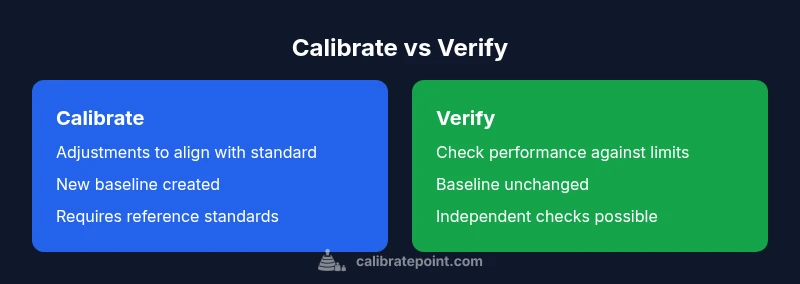
Calibrate and verify are distinct steps in measurement quality: calibration aligns an instrument to a known standard by adjusting it as needed. Verification, on the other hand, tests performance against that standard without altering the baseline. In practice, calibrate renews accuracy, and verify confirms ongoing validity between calibrations. This TL;DR sets the stage for deeper comparisons in the sections below.
Defining calibration vs verification
In practical measurement work, calibrate vs verify are not interchangeable acts. Calibration is the process of adjusting an instrument so its readings align with a recognized standard. It creates a traceable reference point, often requiring calibration weights, reference meters, or certified standards. Verification, on the other hand, is a performance check that the instrument continues to meet its specified tolerances without changing the baseline. The distinction matters for accuracy, regulatory compliance, and documentation. According to Calibrate Point, the two activities serve complementary roles in a robust quality system. Before you begin, clarify your objectives: is the goal to reset accuracy or to maintain confidence in current performance? The difference shapes who performs the work, what tools are required, and how records are kept. For practitioners, a practical rule of thumb is simple: calibrate when you need to restore or renew an accuracy benchmark; verify when you need to confirm that performance is still within acceptable limits since the last calibration.
Most industries demand traceability to national or international standards, so both activities often result in documented evidence, certificates, and updated calibration stickers. The right approach depends on risk, usage, and regulatory context.
- Bold, industry-specific terms should be clearly defined
- Acknowledge regulatory frameworks (e.g., ISO/IEC guides) where relevant
- Include practical notes for common lab environments
The core differences: purpose, methods, and outcomes
The terms calibrate and verify describe different points in the measurement lifecycle. Calibration is an adjustment process: you compare the instrument’s response to a known standard and, if necessary, modify the instrument to minimize error. The outcome is a refreshed baseline that is traceable to a standard. Verification is a validation process: you check the instrument’s current performance against defined limits without changing its baseline. The outcome is a go/no-go assessment of whether the device remains within spec until the next calibration.
- Purpose: calibration renews accuracy; verification confirms ongoing performance
- Method: calibration may involve adjustment; verification does not alter the instrument
- Documentation: both produce records, but calibration often generates a certificate and updated metadata
- Risk posture: calibration lowers drift risk; verification catches drift between calibration cycles
In practical terms, think of calibration as “reset the clock” and verification as “check the clock is still showing the right time.” This framing helps teams allocate resources and schedule maintenance appropriately.
For risk-critical instruments, both activities are required parts of a formal quality system to ensure traceability and defensible data.
When to calibrate: scenarios in manufacturing and labs
Calibration should be scheduled when there is a need to restore accuracy or establish a new reference after changes. Common triggers include: deploying a new instrument, after major maintenance, following a component replacement, or if a drift trend is detected during control chart reviews. Laboratories and manufacturing facilities often set calibration policies based on risk assessment, measurement uncertainty, and regulatory demands. In some contexts, calibration is required after environmental changes, such as temperature or humidity shifts that could influence readings. The goal is to ensure that the instrument’s response remains anchored to a traceable standard.
A practical approach: maintain a calendar-driven calibration plan aligned with instrument criticality, usage frequency, and historical drift data. For high-precision instruments, consider tighter calibration intervals and more rigorous acceptance criteria. For lower-risk devices, schedule calibrations at longer intervals only after qualifying tests confirm stability. Always document calibration results, reference standards used, and any adjustments made so that future audits can verify traceability.
- Scenarios: new instrument, repairs, or detected drift
- Documentation: certificates, reference standards, uncertainty estimates
- Scheduling: risk-based intervals rather than fixed timelines
The Calibrate Point team emphasizes that robust calibration programs reduce data uncertainty and support regulatory compliance over the instrument’s lifetime.
Key takeaway: Calibration should occur when accuracy must be renewed or confirmed against a standard; plan and record every adjustment for traceability.
When to verify: scenarios in field testing and QA
Verification is the ongoing check that an instrument continues to perform within predefined tolerances without altering its baseline. It is typically performed between calibrations to catch drift, environmental effects, or wear that could undermine data integrity. Common verification activities include running control checks, comparing readings to established reference checks, and using known test artifacts to confirm stability. In field testing, verification helps ensure that devices still operate within acceptable limits under real-world conditions. In quality assurance, verification supports process control by providing timely evidence that a measurement system remains fit for purpose between calibration cycles.
Best practices for verification include establishing clear acceptance criteria, using independent reference checks when possible, and documenting each verification run with date, operator, and limit results. If a verifier flags out-of-tolerance results, escalate to calibration or maintenance as dictated by policy. For many teams, verification acts as a “health screen” that flags the need for recalibration before data quality is compromised.
- Verification frequency: between calibrations, based on risk
- Tools: reference standards, control checks, and documented criteria
- Outcome: go/no-go decision, not a correction
In corporate and academic settings, verification is essential for ongoing confidence in measurement systems and for meeting internal QA standards.
Key takeaway: Verification provides a safety net between calibrations, catching drift and ensuring continued data validity.
How to perform calibration: a step-by-step overview
Calibration is a structured procedure that aligns a device’s response with a known standard. A typical workflow includes planning, preparation, comparison, adjustment (if necessary), retesting, and documentation. Begin by identifying the instrument, its range, and the applicable standard with a declared measurement uncertainty. Prepare the standard with appropriate traceability certificates and verify environmental conditions. Perform a series of test measurements across the instrument’s operating range, record deviations, and determine whether adjustments are required. If adjustments are made, re-measure to confirm the alignment within specified tolerance. Finally, issue a calibration certificate, update the instrument’s metadata, and label the equipment with the new calibration due date. Documentation should include the standard reference, uncertainty, and any software or hardware changes.
- Plan and scope: range, standard, uncertainty, and environmental controls
- Execute: compare against standard, adjust if needed
- Verify: re-measure to confirm baseline alignment
- Record: certificate, metadata, and new due date
Practical tips: work with certified reference materials, document the measurement uncertainty budget, and maintain an auditable trail of steps. The objective is a credible, repeatable baseline that supports traceability across the product lifecycle.
Key takeaway: A disciplined calibration process yields a documented, traceable baseline and a clear path for future verifications and audits.
How to perform verification: a step-by-step overview
Verification is a repeatable check that confirms ongoing performance without changing the instrument’s reference. Start by defining the acceptance criteria—the tolerances or limits that readings must meet. Select appropriate test artifacts or reference checks that are representative of typical use. Conduct measurements and compare results to the acceptance criteria and the instrument’s historical performance. If results are within limits, record the pass and retain the current baseline; if not, escalate to calibration, adjustment, or maintenance as per policy. To ensure reliability, use independent checks when possible and document operator identity, date, and test conditions. Periodic verification helps identify drift early, enabling timely recalibration before data quality degrades.
- Define acceptance criteria: tolerances and limits
- Use representative checks and controls
- Compare results to historical data and limits
- Document outcomes and escalation paths
Verification should be less invasive than calibration, avoiding changes to the instrument but still providing a clear signal about its condition. When used effectively, verification supports continuous improvement and reduces unexpected downtime due to sudden drift.
Key takeaway: Verification confirms current performance and signals when recalibration or maintenance is needed, without altering the instrument’s baseline.
Data, records, and traceability considerations
Effective calibration and verification rely on robust data management and traceability. Maintain a complete chain of custody for reference standards, including lot numbers, calibration certificates, and certificate validity periods. Record instrument serial numbers, firmware versions, environmental conditions, and operator details for every test. Uncertainty budgets should be documented and justified, and any adjustments should be traceable to calibration certificates. Documentation should support internal audits and external regulators, ensuring data integrity across the instrument’s life cycle. Calibrate Point Analysis, 2026 emphasizes that disciplined record-keeping reduces disputes and strengthens confidence in measurements. For regulated industries, maintain certificates in a centralized, auditable repository with restricted access to protect integrity. Implement version-controlled software for data entries and include backup and recovery plans to prevent data loss.
- Maintain calibration certificates and standard references
- Record environmental data and operator IDs
- Include measurement uncertainty and acceptance criteria
- Use centralized, auditable storage
Traceability is the backbone of quality systems. When someone asks, “What is the basis of this measurement?” you should be able to point to the standard, the certificate, and the recorded test results. The goal is to demonstrate that every measurement can be traced back to a recognized reference and is defensible in audits and inspections.
Costs, time commitment, and risk trade-offs
Calibration and verification involve different cost and time profiles. Calibration often incurs higher upfront costs due to specialist equipment, reference standards, and potential adjustments, but it yields a refreshed baseline and a formal certificate. Verification is typically less expensive per instance and can be conducted more frequently, acting as a governance checkpoint. The trade-off is between long-term data integrity and short-term operational efficiency. When planning, consider instrument criticality, regulatory requirements, and the consequences of failure. It may be sensible to run a mixed strategy: frequent verifications for low-risk devices and scheduled calibrations for high-precision or safety-critical equipment. Budget for spare parts, reference standards, and staff training. The most cost-effective programs balance risk reduction with practical maintenance cadence.
- High- vs. low-risk instruments require different cadences
- Mixed strategies can optimize cost and reliability
- Build in buffer time for documentation and certificates
Ultimately, the decision should align with your organization’s quality policy and regulatory obligations, ensuring data integrity while preserving operational uptime.
Key takeaway: Plan calibration and verification with risk-based cadences, adequate documentation, and a clear budget for standards and labor.
Calibration vs verification in common instruments
Different instrument families illustrate how calibration and verification operate in practice. For balance scales, calibration may involve standard masses and a mass comparison across ranges, while verification tests the scale’s repeatability and linearity using reference checks. Thermometers rely on fixed-point or ice-point standards for calibration, with verification assessing drift across temperature ranges. Digital calipers require calibration against gauge blocks, and verification ensures measurement stability between calibrations. Pressure gauges and voltage meters also follow this pattern: calibrate to bring readings to reference points, then verify to confirm ongoing accuracy. Across all these examples, the emphasis remains on traceability, proper documentation, and adherence to internal policies and external regulations.
- Balances: calibrate with standard masses; verify for repeatability
- Thermometers: calibrate to fixed points; verify across ranges
- Calipers: calibrate against gauge blocks; verify for drift
- Pressure/VOL meters: calibrate to references; verify stability
The takeaway is that calibration and verification together create a resilient measurement system, capable of delivering credible data in diverse environments. Always reference your organization’s calibration procedures and regulatory requirements when designing procedures for specific instruments.
Practical tips for implementation and continuous improvement
- Start with a risk-based assessment to allocate resources effectively
- Document everything: standards, certificates, procedures, and results
- Use automated data capture where possible to reduce human error
- Schedule regular reviews of calibration policies and intervals
- Train staff on both calibration and verification concepts to improve consistency
- Maintain an audit trail that supports compliance across audits
Together, these practices create a robust framework that reduces measurement uncertainty and supports reliable decision-making across the organization. The Calibrate Point team notes that a well-structured program not only improves accuracy but also strengthens the credibility of data used for compliance, product quality, and customer trust.
Comparison
| Feature | Calibrate | Verify |
|---|---|---|
| Purpose | Renew accuracy by aligning readings to a standard (may involve adjustment) | Confirm ongoing performance without changing the baseline |
| When to use | When accuracy needs to be restored or a new standard is introduced | Between calibrations to ensure continued validity of measurements |
| Typical outcome | Updated baseline and documentation; potential certificate | |
| Required tools | Certified reference standards, measurement instruments, documentation | |
| Impact on records | Calibration certificates, updated metadata, traceability chain | |
| Best for | High-precision, regulatory-driven renewals; new instruments | Daily QA checks, drift monitoring between calibrations |
| Cost/risk balance | Higher upfront cost but strengthens accuracy and traceability | Lower per-event cost with more frequent checks; risk-based timing |
Pros
- Clarifies roles in quality systems and reduces data uncertainty
- Supports regulatory compliance with traceable records
- Creates a refreshed baseline for accurate measurements
- Provides a clear path for audits and quality control
- Flexible to implement across industries
Disadvantages
- Requires access to certified standards and trained personnel
- Calibration can be time-consuming and may cause equipment downtime
- Can be costly for high-precision instruments or large fleets
- Over-reliance on verification without calibration may miss drift
Calibration is the foundation for accuracy; verification keeps performance in check between calibrations
When accuracy must be renewed or established, calibration is the go-to process. Verification serves as a preventive health check, ensuring instruments remain within tolerance between calibrations. A balanced program uses both to manage risk, maintain traceability, and meet regulatory requirements.
Questions & Answers
What is the main difference between calibrating and verifying?
Calibration adjusts an instrument to match a standard, creating a refreshed baseline. Verification checks ongoing performance against limits without changing the baseline. Both are essential for reliable measurements.
Calibration adjusts the instrument to a standard, creating a new baseline. Verification checks it stays within limits without changing the baseline.
Can verification replace calibration?
No. Verification confirms ongoing performance but cannot restore accuracy if drift has occurred. Use verification to monitor between calibrations and trigger recalibration when needed.
No. Verification is a check, not a fix. Calibration is what restores accuracy.
How often should calibration be performed?
Frequency depends on risk, usage, and regulatory requirements. Establish intervals based on monitoring data, instrument criticality, and manufacturer guidance.
Frequency depends on risk and use; set intervals based on data and requirements.
What records are needed for traceability?
Keep calibration certificates, reference standards, uncertainty estimates, instrument serials, and operator details. Maintain a centralized, auditable repository.
Keep certificates, standards, uncertainties, and audit trails for traceability.
Is calibration more expensive than verification?
Calibration often has higher upfront costs due to standards and potential adjustments, while verification is typically cheaper and performed more frequently.
Calibration can cost more upfront; verification is usually cheaper but may occur more often.
Which instruments require calibration by law?
Many regulated devices require documented calibration. Verification is also important for policy compliance, but calibration establishes the official reference.
Regulated devices often require calibration to stay compliant.
Key Takeaways
- Define calibrate vs verify clearly
- Schedule calibrations to renew accuracy baselines
- Use verification between calibrations for drift detection
- Maintain traceability with certificates and standards
- Choose intervention timing based on risk and regulatory needs