Difference Between Calibration and Alignment
Explore the difference between calibration and alignment with practical guidance for technicians. Learn definitions, key distinctions, steps, and best practices to ensure measurement accuracy and geometric integrity across tools and systems.


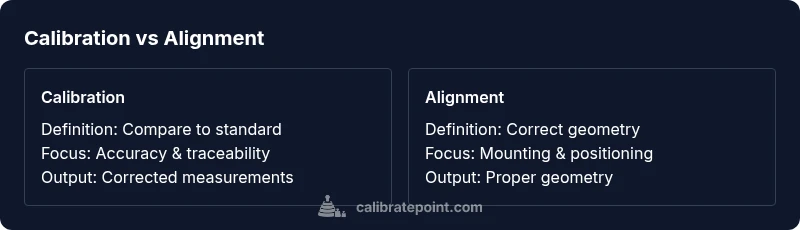
Calibration and alignment are distinct but complementary quality-control processes. Calibration fixes reading accuracy by referencing a known standard, while alignment corrects geometric relationships to ensure proper positioning. For most professional workflows, start with calibration to establish traceability, then verify alignment to ensure the instrument's geometry matches design specifications. This approach minimizes drift and geometric errors, setting a solid foundation for reliable measurements.
What is calibration?
Calibration is the process of quantitatively comparing an instrument's readings against a known standard and adjusting to align the instrument's output with that standard. The goal is to establish traceability—an unbroken chain of comparisons to recognized references, usually through an accredited calibration laboratory and documented certificates. In practice, calibration addresses systematic errors like bias, scale factor, linearity, and drift that accumulate over time. The difference between calibration and alignment becomes apparent when you consider the primary purpose: calibration suits measurement accuracy, while alignment ensures the device's geometry and mounting are correct. As explained by Calibrate Point, calibration builds a baseline for trustworthy data, enabling reliable decisions, audits, and compliance with quality systems. In many industries, calibration data is required for instrument qualification, process validation, and customer reports.
Understanding the difference between calibration and alignment helps technicians decide which process to apply in a given scenario. The Calibrate Point team emphasizes starting from a certified baseline and then verifying that physical setup aligns with design intent. The outcome of a proper calibration is a documented reference that supports traceable measurements across shifts, operators, and environments.
What is alignment?
Alignment focuses on correcting the physical relationships between components so that the system’s geometry matches the intended reference. It addresses how parts fit together, how axes run true, and how optical or measurement paths align with design intent. Misalignment can introduce errors even when a device reports correct values, because the geometry itself governs how readings should be interpreted. Alignment relies on fixtures, reference surfaces, laser alignment tools, dial indicators, and autocollimators to achieve parallelism, perpendicularity, and coaxiality. A key distinction is that, while calibration fixes data quality, alignment fixes the actual physical relationships to ensure the data is meaningful within the system. The Calibrate Point methodology highlights that alignment often needs to be revisited after major disassembly or temperature changes, to preserve geometric fidelity.
In practice, alignment ensures the instrument’s geometry aligns with the design specification, allowing calibration to measure true quantities with confidence. This separation of concerns—geometry vs. measurements—reduces the risk of conflating physical misalignment with instrument drift.
The core difference: scope and purpose
Calibration and alignment serve different, but complementary, roles in a broader quality system. Calibration targets measurement accuracy, bias, drift, and scale across the instrument’s output. It establishes traceability to recognized standards, enabling consistent readings across time and across laboratories. Alignment, by contrast, targets geometric accuracy—how well the instrument’s physical components occupy the intended spatial relationships. Correct alignment ensures that the measurement path, mounting surfaces, and moving parts operate within design tolerances. The practical effect is that calibration answers the question, “Are the readings correct?” while alignment answers, “Is the instrument correctly positioned to produce correct readings?” For high-precision work, practitioners perform both steps in a deliberate sequence to separate data integrity from physical geometry.
This separation also clarifies responsibilities: a calibration technician focuses on reference standards and uncertainties, while an alignment technician concentrates on fixtures, mounting, and geometry. When planned together, calibration and alignment reduce the risk of confounding errors, simplify troubleshooting, and improve overall process reliability.
Key metrics and standards used
Effective calibration relies on traceability to recognized standards and documented uncertainty budgets. The reference artifacts—weights, gauge blocks, or calibrated sensors—define the baseline against which measurements are compared. Certificates from accredited labs provide evidence of traceability and compliance with ISO/IEC 17025 or equivalent standards. Alignment relies on geometric references, fixture accuracy, and alignment tolerances specified in engineering drawings or equipment manuals. Common metrics include parallelism, perpendicularity, angular accuracy, and coaxiality. Even without numerical values, teams should track the status of reference standards (last calibration date, certificate numbers) and the alignment references used (surfaces, fixtures, reference edges). The Calibrate Point framework emphasizes tying both calibration and alignment to a documented quality system, with clear responsibility and audit trails.
In practice, maintain a record of all standards, related uncertainties, and the environment in which measurements occur. This documentation supports audits, customer inquiries, and process improvements. By preserving traceability and geometry records, teams can quickly diagnose drift sources and geometry faults, rather than chasing symptoms in isolation.
When to perform calibration vs alignment
Deciding between calibration and alignment begins with the observed problem and the risk assessment. If readings drift, appear biased, or fail a traceability check, calibration is typically warranted. Calibration addresses instrument accuracy and measurement credibility, especially after servicing, manufacturing, or environmental changes. If a component is physically out of place, misaligned, or not parallel to reference surfaces, alignment should be performed to restore proper geometry before re-extending the instrument’s use. In some workflows, calibration and alignment occur in a tight cycle: you align, calibrate, verify, and document. High-precision environments often require both actions within a scheduled program, as misalignment can masquerade as drift and vice versa. The goal is to separate causes of error and establish robust, repeatable procedures.
In many regulated settings, manufacturer guidelines and internal SOPs define the exact triggers for calibration and alignment. The pragmatic rule is simple: use alignment to fix physical relationships first when geometry is suspect, then use calibration to confirm whether readings align with known standards after geometry is corrected.
Step-by-step: Calibration procedure
- Define acceptance criteria and identify the reference standard the instrument will be compared against. 2) Prepare the instrument, clean interfaces, and ensure environmental conditions meet the standard’s requirements. 3) Record the baseline measurement without adjustments to understand the current drift. 4) Apply adjustments within permitted ranges to bring output in line with the standard. 5) Re-measure using independent references to verify the correction. 6) Document the entire process, including certificates, measurement data, adjustments, and any limitations. 7) Schedule follow-up calibration to maintain traceability over time. The process should be repeatable, auditable, and reproducible across operators and shifts. When performed properly, calibration confirms that readings reflect true quantities and that measurement uncertainty has been properly accounted for, enabling better decision-making.
In practice, many teams rely on a documented SOP that includes step-by-step instructions, required equipment, and acceptance criteria. This helps avoid ad hoc adjustments and ensures consistency across calibrations performed by different technicians. The Calibrate Point approach stresses the importance of a clear record, traceability to standards, and a validated method for any corrective actions.
Step-by-step: Alignment procedure
- Identify the reference geometry and the critical axes or paths that must align with engineering tolerances. 2) Inspect mounting surfaces, fixtures, and contact points for wear, deformation, or contamination. 3) Establish a baseline using a high-precision reference, such as laser alignment tools or dial indicators, and verify orientation relative to the reference frame. 4) Make controlled adjustments to fasteners, shims, or fixtures to achieve the target geometry. 5) Recheck measurements along multiple axes to confirm parallelism, perpendicularity, angular accuracy, and coaxiality. 6) Validate alignment by running a test with a known standard or a simulated load, if feasible. 7) Document the alignment outcomes and the equipment or fixtures used. The alignment process is highly dependent on stable seating, clean interfaces, and consistent instrumentation. A well-executed alignment creates a reliable platform for subsequent calibration and measurement.
In many settings, alignment is sensitive to temperature, vibration, and mechanical wear. As a result, it is common to reassess alignment after large temperature shifts or after maintenance on critical components. The goal is to preserve geometric integrity, so calibration results remain meaningful and traceable.
Common devices and contexts
Practically, calibration and alignment touch a broad range of equipment and contexts. Common calibration targets include instruments like digital multimeters, torque wrenches, pressure gauges, thermometers, calipers, and weight sets. Alignment is vital for optical systems, CNC machines, laser measurement devices, microscopy, and surveying equipment. In labs and manufacturing floors, technicians routinely perform calibration to establish a traceable baseline and use alignment to ensure that the measurement path and mechanical axes run true. The difference between calibration and alignment becomes most evident when assessing why a reading is off: is it the instrument’s output, or is the geometry forcing the reading to be incorrect? A careful hybrid approach, guided by standards, helps distinguish between these possibilities and improves overall measurement integrity.
Consequences of miscalibration
Miscalibration undermines trust in data, increases the risk of incorrect decisions, and can trigger nonconformances during audits. Drift or bias in readings may propagate through processes, leading to product defects, improper tolerances, and failed validations. In critical industries, miscalibration threatens compliance with regulatory requirements and customer specifications. The visible symptoms include unexpected measurement trends, inconsistent results between shifts, or failure of inter-laboratory comparisons. Proper calibration mitigates these risks by providing a documented baseline and a defensible uncertainty estimate. The Calibrate Point perspective emphasizes that a well-documented calibration history reduces surprises during external audits and supports continuous improvement.
Organizations that invest in robust calibration workflows also strengthen their incident response. When a reading discrepancy appears, a calibrated baseline enables rapid root-cause analysis and effective corrective actions. In short, calibration protects data integrity, product quality, and customer trust, turning measurement into a reliable, auditable process.
Consequences of misalignment
Misalignment can produce subtle yet real measurement errors that compromise the validity of calibration results. If the measurement path is angled, tilted, or offset from the intended reference, readings may appear precise but be systematically biased. Misalignment can cause wear due to uneven load distribution, accelerated component failure, increased vibration, and degraded dynamic performance. In optical systems, misalignment reduces signal quality, resolution, and accuracy; in machining, it leads to poor part fit, dimensional variance, and rejection rates. The key message is that even with perfect calibration, poor alignment degrades the entire measurement chain. Regular checks and proper fixtures help prevent cumulative geometric errors that erode confidence in data over time.
To mitigate these risks, schedule routine alignment verification as part of the maintenance plan and use high-quality reference surfaces and calibrated fixtures. The result is a measurement pathway that remains physically accurate and mathematically trustworthy, enabling calibration data to reflect true performance rather than geometric distortion.
Best practices for a combined program
A robust calibration-and-alignment program blends process discipline with practical flexibility. Start with a documented scope: identify which devices require calibration, which require alignment, and how often each should be performed. Use traceable standards and maintain a clear chain of custody for references. Establish responsibility: assign separate roles for calibration and alignment while encouraging cross-training to foster collaboration. Create simple, repeatable SOPs, and ensure all work is recorded with date, operator, reference certificate, and instrument serial numbers. Implement control of environmental conditions when necessary, as temperature, humidity, and vibration can influence both calibration and alignment outcomes. Finally, integrate findings into a continuous improvement loop that tracks nonconformities, corrective actions, and opportunities to refine processes. The goal is a sustainable program that enhances accuracy, geometry, and confidence in measurements.
Myths and misconceptions
One common myth is that calibration alone fixes all measurement issues. In reality, alignment can be the root cause of apparent drift if the geometry is off. Another misconception is that calibration always yields perfect results; calibration reduces bias but cannot eliminate all uncertainty, so you must understand and document the residual uncertainty. A third misunderstanding is that alignment is only relevant for complex machines; simple measurement tools can also suffer from misalignment in mounting or reference surfaces. The truth is that calibration and alignment complement each other, and neglecting one can undermine the effectiveness of the other. By embracing both, teams reduce risk and improve reproducibility.
An additional point is that the presence of a calibration certificate alone does not guarantee accuracy if misalignment remains unaddressed. A complete approach requires ongoing verification of both calibration and alignment, especially after maintenance, relocation, or environmental changes. This holistic viewpoint aligns with the Calibrate Point emphasis on traceability, geometry, and documented evidence for every step of the process.
Documentation and audits
Documentation is the backbone of credibility in calibration and alignment work. After calibration, generate a certificate that lists the instrument, reference standard, uncertainty, traceability chain, climate conditions, and any adjustments performed. For alignment, produce a detailed report that documents reference surfaces, fixture fit, and measured tolerances across the relevant axes. Store both types of records together in a centralized, searchable system to support audits and troubleshooting. Regularly review records for gaps, such as missing certificates, outdated references, or unrecorded adjustments. A well-organized documentation system simplifies external audits and demonstrates a serious commitment to quality control. The Calibrate Point approach recommends linking calibration and alignment records to a common asset ID and a maintenance schedule to facilitate ongoing compliance.
Implementation roadmap for Calibration and Alignment Programs
Begin with a gap analysis to identify which devices require calibration, alignment, or both. Draft a phased plan that aligns with production deadlines, risk assessments, and available resources. Create a standardized set of reference standards, fixtures, and alignment tools, plus a repository of SOPs that cover planning, execution, verification, and documentation. Train staff across roles with a focus on traceability and repeatability, and implement a change-control process so any instrument or fixture adjustments are formally approved. Integrate calibration and alignment activities into your corrective-action process, so issues are tracked from discovery to resolution. Finally, establish metrics for program effectiveness, such as the rate of out-of-tolerance findings, the time to resolve issues, and the quality of audit trails. A disciplined rollout reduces risk, enhances data integrity, and improves overall operational excellence.
Industry examples and case considerations
In practice, organizations across manufacturing, laboratories, and field services benefit from a clear separation of calibration and alignment activities. For example, a metal fabrication shop may calibrate force gauges and torque tools to maintain measurement accuracy, while concurrently aligning CNC machine spindles to ensure that tool paths remain true. A pharmaceutical QC lab might calibrate thermometers for accurate temperature readings and align optical benches to preserve measurement path fidelity. The common thread is that each case requires careful planning, precise execution, and thorough documentation. The result is a robust, auditable process that delivers reliable data and stable equipment performance. The Calibrate Point framework emphasizes tailoring the program to the device's criticality, usage frequency, and environmental exposure to maximize value.
In all cases, the goal is to achieve a balanced program where calibration ensures data credibility and alignment ensures geometric integrity, enabling confident decision-making across operations.
Practical tips for technicians
- Start each task by checking the reference standard’s validity and certificate availability.
- Clean and inspect interfaces before calibration or alignment to avoid contaminated readings or skewed geometry.
- Use a standardized checklist to ensure consistency across operators and shifts.
- Document every step, including conditions, fixtures used, and results.
- Cross-train staff to understand both processes, promoting better troubleshooting.
- Schedule regular reviews of the calibration and alignment program to adapt to tool wear and process changes.
- Maintain an environment that minimizes thermal and vibrational disturbances during measurements.
- Treat calibration and alignment as a coupled system rather than isolated tasks for best results.
Following these tips helps build resilient, repeatable processes that support accuracy, reliability, and quality across your operations.
Implementation-wrapping-up
As you implement a calibration and alignment program, remember that accuracy and geometry require continuous attention. Establish clear goals, provide trained personnel, and maintain robust documentation. Success hinges on disciplined execution, regular audits, and a culture that values measurement integrity. With a well-structured program, teams can identify, isolate, and address sources of error before they impact product quality. The result is a more predictable measurement environment where calibration and alignment work together to ensure dependable results and sustained confidence in data.
Final thoughts
The difference between calibration and alignment is not a competition but a coordinated strategy for precision. Calibration anchors data to a known standard, while alignment secures the physical relationships that make measurements meaningful. When implemented together, these practices reduce drift, improve reproducibility, and support continuous improvement across processes. The Calibrate Point approach emphasizes treating calibration and alignment as a unified discipline—one that embraces standards, traceability, geometry, and documentation to deliver trustworthy results. By adopting this integrated mindset, organizations can optimize performance, quality, and compliance over time.
Comparison
| Feature | Calibration | Alignment |
|---|---|---|
| Definition | Adjusting a tool to a known standard to ensure measurement accuracy | Correcting the geometric relationships between components to match a reference geometry |
| Scope | Measurement accuracy, bias, drift, and traceability | Geometric accuracy, positioning, and alignment of axes and fixtures |
| Focus | Data quality and uncertainty management | Physical geometry and mounting integrity |
| Typical devices | Gauges, thermometers, balances, calipers, pressure sensors | Optical benches, CNC spindles, laser systems, surveying equipment |
| Process steps | Plan -> Measure -> Adjust -> Verify -> Document | Assess -> Adjust -> Verify -> Document |
| Frequency | Depends on usage and standard; regular intervals are common | Often tied to setup, maintenance, or major service events |
| Traceability | Relies on calibration certificates and reference standards | Relies on fixture references and geometry references |
| Best for | Ensuring readings reflect true quantities | Ensuring geometry and fit meet design specifications |
Pros
- Improves data credibility and traceability
- Essential for audits and regulatory compliance
- Reduces drift and measurement uncertainty
- Supports repeatable, reproducible results
- Clarifies responsibilities and documentation
Disadvantages
- Requires access to calibrated standards and reference materials
- Can be time-consuming and may require instrument downtime
- Misapplication can lead to false sense of accuracy
Calibration establishes a defensible accuracy baseline, while alignment ensures geometry supports reliable measurements.
In practice, start with calibration to set traceable baselines, then verify and adjust alignment to preserve geometric integrity. Use both iteratively for best results across the measurement chain. The Calibrate Point team recommends a coordinated program that treats calibration and alignment as complementary, not isolated tasks.
Questions & Answers
What is the difference between calibration and alignment?
Calibration fixes readings to a standard to ensure accuracy, while alignment fixes the geometry and positioning of components. Both address different error sources and are often sequential in precision workflows.
Calibration fixes readings to a standard; alignment fixes geometry. They address different errors and often work in sequence.
When should I calibrate instead of align a device?
Calibrate when readings drift, lack traceability, or fail a standard comparison. Align when geometry is out of tolerance or mispositioned, affecting measurement paths or fit.
Calibrate for drift or traceability. Align for geometry issues.
What instruments typically require alignment?
Optical systems, CNC machines, laser-guidance setups, and surveying instruments commonly require alignment checks to maintain geometric fidelity.
Optical benches and CNC machines often need alignment.
How often should calibration be performed?
Frequency depends on usage, risk, environment, and manufacturer guidance. Establish a documented schedule that balances practicality with quality requirements.
Set a schedule based on risk and guidelines.
Can misalignment masquerade as calibration error?
Yes. Misalignment can produce bias or drift similar to calibration issues, so both should be checked when problems arise.
Yes—check both when issues appear.
Key Takeaways
- Define scope: calibration targets accuracy and traceability
- Use alignment to correct geometry and positioning
- Document results for audits and quality records
- Schedule regular calibration and setup alignments
- Consider environment and instrument-specific requirements