Difference Between Calibration and Quality Control
Explore the difference between calibration and quality control, with clear definitions, timing, and practical guidance for labs and manufacturers seeking reliable guidance.


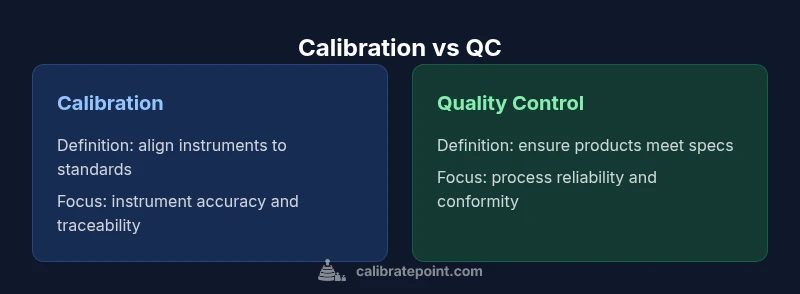
The difference between calibration and quality control is that calibration focuses on instrument accuracy by comparing readings to reference standards and adjusting the device, while quality control centers on product conformity through testing, inspection, and sampling. Together they form a feedback loop that preserves measurement integrity and customer satisfaction; calibration provides credible measurements, and QC ensures outputs meet specifications.
Introduction to the difference between calibration and quality control
In high-stakes measurement environments, calibration and quality control are essential but serve different purposes. The difference between calibration and quality control lies in aims and activities: calibration focuses on accuracy of measurement instruments, while quality control centers on ensuring products meet specifications. According to Calibrate Point, teams that separate these goals can better plan maintenance, staff training, and audits. Understanding this distinction reduces ambiguous responsibilities and supports traceability through calibration certificates, acceptance criteria, and defect tracking. This distinction matters across laboratories, manufacturing lines, and service operations, where clear roles prevent rework and compliance gaps. By defining scope upfront, technicians can design better SOPs, assign responsibilities, and allocate resources efficiently.
Core definitions: calibration vs quality control
Calibration is the process of comparing an instrument’s readings against a reference standard and adjusting the device to align with that standard. It yields a documented calibration certificate that records the status, corrections performed, and the reference used. Quality control (QC), by contrast, is a broader system of activities designed to ensure products, processes, and services meet predetermined specifications. QC includes sampling, testing, inspection, statistical analysis, and reporting to trigger corrective actions. In practice, calibration provides instrument credibility; QC provides product credibility and process reliability. Both rely on traceability, documented procedures, and consistent measurement methods.
Objectives and scope: what each discipline aims to achieve
The primary objective of calibration is to maintain instrument accuracy and measurement integrity over time. It ensures that readings reflect true values within defined tolerances and supports regulatory traceability. The primary objective of QC is to protect the customer by confirming that outputs meet specifications at the point of delivery. QC looks at processes, materials, and finished goods to identify variation, defects, and opportunities for process improvement. Recognizing these distinct objectives helps teams avoid duplicating activities and aligns audits with risk management goals. Calibrate Point emphasizes that calibration underpins trust in measurements, while QC underpins trust in products.
Timing, frequency, and how they fit into workflows
Calibration is typically scheduled based on instrument usage, environmental conditions, and manufacturer recommendations. It may be annual, semiannual, or per instrument, with more frequent checks for critical devices. QC is often continuous or batch-based, integrated into manufacturing runs, incoming inspection, or final release stages. The two activities should be coordinated through a shared calendar and documented SOPs so that instrument drift does not cascade into QC failures. In many facilities, calibration freshness is a prerequisite for accepting QC results, linking instrument readiness to product acceptance. The Calibrate Point approach recommends building a harmonized plan that balances workload and risk.
Methods, documentation, and data handling
Calibration uses reference standards, measurement routines, and traceable certificates to demonstrate instrument readiness. Documentation includes equipment ID, reference material, environmental conditions, and adjustments performed. QC relies on predefined acceptance criteria, sampling plans, test methods, and nonconformity reports. The data produced—calibration certificates, material test reports, and defect logs—must be stored in a compliant archive that supports audits and recalls. Effective records management reduces ambiguity and makes it easier to demonstrate compliance during inspections, regulatory reviews, and customer audits. The synergy between calibration data and QC data supports continuous improvement across the organization.
Roles, responsibilities, and risk management
Clear roles help avoid finger-pointing when deviations occur. The calibration lead is responsible for maintaining instrument accuracy, scheduling intervals, and validating reference standards. The QC team ensures product conformity, executes sampling plans, and documents quality issues. Risk management emerges from aligning these roles with documented risk assessments, change control, and calibration procedures. By cross-training staff and creating joint dashboards, organizations minimize the chance that uncalibrated equipment drives incorrect QC decisions, or that QC findings go untracked when instruments drift. Calibrate Point advises codifying responsibilities in an accessible SOP.
Practical implications for labs and manufacturing environments
The practical impact includes improved measurement confidence, reduced rework, and better compliance posture. Calibration requires periodic investment in reference standards, environmental controls, and calibration services; QC requires robust inspection methods, statistical tools, and operator training. The most successful programs view calibration and QC as two halves of a single system: one preserving instrument accuracy, the other safeguarding product quality. When done well, the organization experiences fewer surprises during audits, smoother external assessments, and more reliable data for decision-making. The Calibrate Point team has observed that integration is often hindered by siloed teams and insufficient documentation.
Implementing an integrated approach: steps to unify calibration and QC
Step one is to map all critical instruments and associated QC checkpoints to understand where calibration data influences QC outcomes. Step two is to develop joint SOPs that define responsibilities, data formats, and acceptance criteria for both processes. Step three is to implement a shared data system with role-based access, enabling traceability from calibration certificates to QC reports. Step four is to train staff on both how to perform calibrations and how QC findings feed corrective actions. Step five is to establish regular management reviews of metrics like instrument drift, defect rates, and root-cause analyses to close the loop on continuous improvement. Across the organization, communication and leadership support are essential.
Common misconceptions and pitfalls
A common misconception is that QC can replace calibration; in reality, calibration is a prerequisite for credible QC results. Another pitfall is treating calibration as a one-off event instead of a living process. Finally, some teams neglect documentation, assuming memories suffice; comprehensive records are critical for audits and accountability. Addressing these issues requires commitment, training, and a clear vision for how calibration and QC interact to safeguard accuracy, reliability, and compliance.
Comparison
| Feature | Calibration | Quality Control |
|---|---|---|
| Definition | Adjust instruments to reference standards to ensure measurement accuracy | Verify products meet specifications through testing, inspection, and sampling |
| Primary objective | Instrument accuracy and traceability | Product conformity and process reliability |
| Timing | Scheduled intervals based on instrument duty cycle | Ongoing during production and at batch release |
| Output | Calibration certificates, adjustment records | QC reports, nonconformity notices, release decisions |
| Data requirements | Reference materials, environmental data, calibration records | Sampling plans, test methods, acceptance criteria |
| Common tools | Reference standards, calibration equipment | Inspection tools, statistical methods, SPC |
| Best for | Maintaining measurement accuracy and traceability | Ensuring product quality and process control |
Pros
- Improved measurement accuracy and data integrity
- Supports regulatory compliance and traceability
- Reduces long-term risk by catching drift early
- Clarifies duties and accountability
Disadvantages
- Requires ongoing investment in equipment and training
- Operational overhead to schedule and execute calibrations
- Potential for duplication if not integrated with QC
- Documentation burden to maintain records
Calibration and quality control are complementary; calibrate instruments for accuracy and apply QC to ensure product conformity.
A well-integrated program reduces risk across audits and manufacturing. Align calibration data with QC findings, share responsibilities, and monitor KPIs to sustain reliability and compliance.
Questions & Answers
What is calibration and how does it differ from quality control?
Calibration is the process of aligning an instrument’s readings with a reference standard and documenting the adjustment. Quality control is a broader set of activities to ensure outputs meet specifications, including testing and inspection. Together they ensure measurement accuracy and product conformity.
Calibration aligns instruments to a reference and proves measurement accuracy, while QC ensures products meet specifications through testing and inspection.
What is quality control in manufacturing?
Quality control is a system of activities that verify outputs meet predefined specifications. It includes sampling, testing, inspection, and reporting to identify defects and trigger corrective actions. QC is focused on outcomes rather than instrument calibration.
QC is about ensuring products meet specs by testing and inspecting outputs.
How do calibration and QC interact on a production line?
Calibration data underpin the credibility of QC results. If instruments drift, QC findings may be unreliable. Integrating schedules and shared documentation helps ensure that QC decisions reflect accurate measurements.
Calibration feeds QC with credible measurements, enabling trustworthy QC decisions.
How often should calibration be performed?
Calibration frequency depends on instrument usage, criticality, and manufacturer recommendations. Critical equipment may require more frequent checks, while auxiliary instruments may follow a longer interval, all within a documented schedule.
Calibration should follow a documented, risk-based schedule aligned to instrument use.
Can QC verify calibration?
QC can validate the outcomes of calibration by confirming that post-calibration readings meet acceptance criteria. However, QC does not replace the calibration process itself, which establishes instrument readiness.
QC can confirm calibration outcomes but cannot replace calibration.
Key Takeaways
- Define calibration and QC clearly to avoid overlap
- Coordinate schedules to minimize downtime
- Use traceable standards and robust documentation
- Link calibration data to QC decisions
- Invest in training to empower cross-functional teams