How to calibrate a dial indicator: A comprehensive guide
A complete guide to calibrating a dial indicator with a structured workflow, essential tools, and clear steps to ensure accurate, repeatable readings.


Learn how to calibrate a dial indicator with accuracy and repeatability. This guide covers essential setup, reference standards, measurement techniques, and documentation steps. By following a structured workflow, you’ll reduce drift and improve trust in your readings. According to Calibrate Point, a disciplined calibration process yields more reliable results. The article includes safe handling tips, common pitfalls, and a printable checklist to maintain long-term performance.
What is a dial indicator and why calibrate it
A dial indicator is a precision instrument that translates linear movement into dial readings. It is used to measure small displacements, assess runout, and establish flatness in machine setups. Because these devices wear and drift with use, calibration ensures the readings remain linear and accurate across the travel range. In this guide on how to calibrate a dial indicator, you’ll learn how to assess contact travel, verify repeatability, and document results for traceability. The process relies on stable fixtures, clean references, and a disciplined approach to measurement. The Calibrate Point team emphasizes that consistency, not force, yields reliable results, so plan your session and protect the instrument from contamination.
Calibration principles: accuracy, repeatability, and traceability
Calibration hinges on three core concepts. Accuracy measures how close a reading is to the true value. Repeatability ensures the same measurement is obtained when the process is repeated under identical conditions. Traceability links results to recognized standards through a documented calibration chain. When calibrating a dial indicator, you should aim for a linear response across the travel range and a consistent dead-band. Adopting a formal procedure helps technicians avoid ad-hoc adjustments that degrade long-term reliability.
Reference standards and setup environment
Select reference standards that are traceable and certified, such as gauge blocks or a master block with a current calibration certificate. Use a flat, stable surface plate as the test base and keep the ambient temperature stable to minimize drift. Cleanliness matters: wipe the reference surfaces and the dial indicator contact point with lint-free cloth and isopropyl alcohol prior to measurements. Ensure the dial indicator is within its specified range and note any wear that could affect results. A controlled environment reduces measurement noise and increases repeatability.
Basic alignment checks and instrument positioning
Mount the dial indicator in a sturdy stand so the contact point travels perpendicular to the reference surface. Alignment should be checked visually and with a preliminary measurement run across known standards. The goal is to minimize angular error and parallax. Keep the instrument at a comfortable working height to reduce operator-induced variability. If the indicator does not sit squarely, small misalignments can produce apparent drift that masks true performance.
Calibration workflow overview
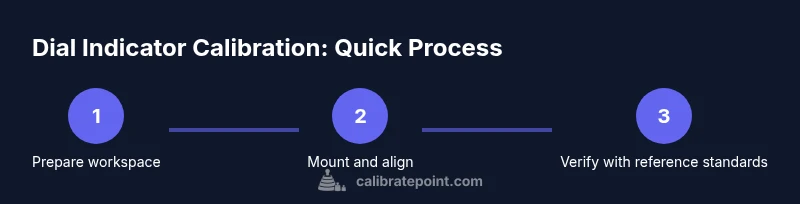
A disciplined calibration workflow typically follows: establish a stable reference, gently bring the dial into contact with the standard, zero the indicator, and record readings at multiple known offsets. Repeatability tests involve re-zeroing and re-measuring under the same setup to confirm consistent results. Finally, document all readings, reference standards, environmental conditions, and any adjustments made. This high-level workflow sets the stage for the detailed STEP-BY-STEP section.
Common errors and how to avoid them
Common mistakes include dirty contact points, misaligned stands, improper zeroing, and forcing the dial through its travel. Environmental factors like temperature shifts or vibrations can introduce noise. Parallax error can occur if the observer’s eye is not aligned with the dial face. Avoid these by using a stable fixture, zeroing carefully, and performing measurements in a clean, quiet environment. Always handle standards with clean gloves to prevent oil and dirt from affecting results.
Documentation and maintaining records
Keep a calibration log that records the instrument serial number, reference standards used, environmental conditions, and all readings. Include the date, operator, and any corrective actions taken. Documentation supports traceability and helps you track changes over time. Store certificates and blocks in a clean, organized cabinet, and re-check certificates periodically to ensure ongoing validity.
Practical tips for different dial indicators and applications
Dial indicators vary in range, resolution, and contact point geometry. For thin or delicate indicators, use lighter contact pressure and shorter travel to avoid bending the plunger. When measuring runout, use a symmetric setup to minimize bias. Consider using a dedicated master block for each indicator type to simplify cross-checks. Regularly inspect the dial face for wear and ensure the bezel remains clear and easy to read.
When to retire or re-calibrate and how often
Calibration frequency depends on usage, environment, and criticality of measurements. High-demand parts or safety-critical assemblies typically require more frequent checks. If readings drift, if the instrument has been dropped, or if environmental conditions have changed significantly, re-calibrate promptly. Establish SOP-driven schedules and review them after major maintenance or repairs.
Tools & Materials
- Dial indicator with appropriate range and resolution(Check range, resolution, and spindle travel before calibration)
- Surface plate or granite reference plate(Flatness and stability are crucial for accurate results)
- Dial indicator stand or height gauge(Secure mounting to minimize vibration)
- Gauge blocks or calibrated reference standards(Traceable to accredited standards; use blocks with certified tolerances)
- Cleanliness supplies (lint-free cloth, isopropyl alcohol)(Use to remove dust, oil, and residues from contact surfaces)
- Calibration certificate or reference standard certificate(Maintain traceability documentation for the calibration session)
- Small spacers or additional gauge blocks for travel testing(Optional for extended linearity checks)
Steps
Estimated time: 1.5-2.5 hours
- 1
Prepare workspace and gather standards
Clear the bench, place the surface plate on a stable base, and gather the dial indicator, reference standards, and cleaning supplies. Verify all items are clean and within their calibration validity. Have your calibration log ready to record readings.
Tip: Do a quick visual check for any obvious damage before starting. - 2
Mount the dial indicator and align perpendicular
Mount the dial indicator in its stand and bring it close to the reference surface. Adjust the orientation so the contact point travels perpendicular to the surface. Confirm no binding occurs as you move the plunger.
Tip: Use a test block to verify the contact point alignment from multiple angles. - 3
Place reference standards on the surface plate
Position gauge blocks or a master block on the surface plate with clean, dust-free contact faces. Ensure the blocks are stable and not slipping during measurement. Document the block reference and certificate details.
Tip: Wipe blocks with lint-free cloth just before use. - 4
Zero the indicator on the reference
Carefully bring the dial contact onto the reference block and zero the dial at the central position. Confirm zero is stable across several micro-movements. If drift is observed, recheck alignment and cleanliness.
Tip: Avoid pressing too hard on the contact point; use a light, consistent touch. - 5
Check repeatability across multiple positions
Relocate the reference block or the indicator to several known offsets and repeat the zeroing and reading. Record each position and its corresponding reading. Repeat this step to confirm consistency.
Tip: Use a fixture to maintain repeatable block placement. - 6
Assess linearity and runout
Move the contact across a calibrated block with known increments to map the indicator’s response. Look for a straight-line relationship between input displacement and dial readings. Note any deviations that exceed your tolerance.
Tip: Plot readings if possible to visualize nonlinearity. - 7
Document results and any adjustments
Capture all readings, reference standard details, environmental conditions, and operator notes. If any drift or nonlinearity is detected, record the corrective actions and the rationale. Prepare a calibration certificate.
Tip: Include a signature block for the operator and supervisor. - 8
Clean up and store equipment
Remove samples, clean all surfaces, and return items to their storage locations. Ensure the calibration log is filed and accessible for future audits.
Tip: Store standards in a controlled environment to preserve stability.
Questions & Answers
What is a dial indicator and what does calibration involve?
A dial indicator is a precision device that translates small linear movements into dial readings. Calibration involves verifying travel, zeroing, testing repeatability, and ensuring linear response within the instrument’s range.
A dial indicator converts tiny movements into dial readings. Calibration checks travel, zeros the display, and confirms repeatability and linear response.
How often should I calibrate a dial indicator?
Calibration frequency depends on usage, environment, and how critical the measurements are. Follow your internal SOPs and re-calibrate after major service or if readings drift.
Frequency depends on use and environment. Re-calibrate after service or if you notice drift.
Can I calibrate a dial indicator at home?
Yes, with proper reference standards, a clean workspace, and a documented procedure. For critical parts, consider professional calibration services for traceability.
You can calibrate at home if you have proper standards and a clear procedure.
What reference standards are acceptable?
Use traceable gauge blocks or master blocks with current certificates. Ensure they are clean, undamaged, and verified against recognized references.
Use traceable gauge blocks with current certificates and clean surfaces.
What is the difference between runout and straightness here?
Runout describes the variation as the contact point traverses the surface; straightness refers to the flatness or planarity of the reference surface. Both affect readings in different ways.
Runout is variation during travel; straightness is surface flatness. They influence readings differently.
What if measurements drift after calibration?
Check alignment, cleanliness, and reference standards. If drift persists, re-run the calibration with fresh references and verify environmental stability.
If drift occurs, re-check setup and calibrate again with clean references.
Watch Video
Key Takeaways
- Define the calibration goal before starting.
- Use traceable references and a clean environment.
- Zero carefully and test at multiple points.
- Document all data for traceability.
- Store equipment properly to preserve calibration.