How to Calibrate Meta Quest 3 Controllers
Learn how to calibrate Meta Quest 3 controllers to reduce drift and improve tracking. This expert, DIY-friendly guide covers setup, step-by-step calibration, troubleshooting, and firmware considerations for reliable VR performance.


By the end, you’ll know how to calibrate Meta Quest 3 controllers to reduce drift and improve accuracy. This guide covers quick checks, setup, and step-by-step calibration for the right and left controllers, plus when to update firmware. You’ll need a clear play space, your headset, and a USB cable for firmware updates if required.
What Calibrating Controllers Improves
Calibrating Meta Quest 3 controllers aligns the physical motions you make with the on-screen response. Proper calibration enhances aiming, menu selection, and gesture control, which translates to a smoother, more immersive VR experience. According to Calibrate Point, precise calibration reduces drift and improves input fidelity, especially in fast-paced games or precision-required experiences. This section explains why calibration is worth your time and how it can affect everyday play sessions, fitness apps, and enterprise simulations.
When hardware or environmental factors change—new accessories, newly lit rooms, or after a software update—recalibration helps restore reliable tracking. You don’t need to be a tech wizard to perform it; a calm play space and methodical steps will usually yield noticeable gains in tracking consistency and control responsiveness.
Prerequisites, Environment, and Safety
Before you start, ensure your Quest 3 headset firmware is up to date and that both controllers are charged. A tidy, clutter-free play area reduces occlusion and improves tracking; clear surfaces allow the headset’s inside-out sensors to see your hands more reliably. Avoid reflective surfaces or bright direct light that might confuse the cameras. In addition, a stable Wi‑Fi connection helps with firmware checks if you choose to update during calibration. For best results, perform calibration in a quiet, distraction-free environment where you can focus on deliberate movements rather than frantic in-game actions.
How Quest 3 Tracking Works (High-Level Overview)
Meta Quest 3 uses inside-out tracking, relying on cameras on the headset to observe your hands and controllers. The system merges visual data with inertial measurements to estimate position and orientation. Any drift or misalignment typically stems from subtle changes in lighting, occlusion, or sensor calibration. Understanding this helps you tailor your calibration steps to the root cause—whether it’s persistent drift, misalignment when pointing, or inaccurate button presses in menus.
Calibration Methods: Home Steps vs. Advanced Options
There isn’t a single “one-size-fits-all” calibration method. The basic in-headset calibration focuses on establishing a stable origin and consistent axis orientation for each controller. Advanced workflows may involve verifying the controller pose against reference patterns and performing environment-based tests to ensure that tracking remains robust across different lighting conditions. The goal is to create a repeatable baseline that you can reuse whenever tracking quality changes after updates or hardware modifications.
Quick Checks That Often Solve Most Issues
If you notice stray drift or drift only appears after a long session, start with quick checks. Verify both controllers are paired correctly in the headset, confirm battery levels are sufficient, and restart the headset to refresh sensor data. Ensure there are no protective covers or third-party accessories obstructing the cameras’ line of sight. If drift persists, a formal calibration in the settings is the next step. These pre-checks save time and reduce the chance of chasing false causes.
Step-by-Step Calibration Concepts and Patterns (No Numbers For Now)
Calibration can be thought of as three linked activities: aligning the origin, verifying axis orientation, and validating tracking through simple motion patterns. The origin ensures that your forward-facing gesture corresponds to forward movement in-game. Axis verification confirms roll, pitch, and yaw stay consistent as you rotate controllers. Finally, pattern validation tests whether the system tracks standard shapes (e.g., a steady arc) without jumping or snapping. While hardware differs, the core ideas remain the same, and the steps below will guide you through a robust process that you can adapt as needed.
Practical Testing Scenarios and Real-World Examples
After calibration, test in a familiar VR space with tasks you perform regularly—navigating menus, selecting items, and playing a rhythm or shooter game. Watch for any lingering drift when you quickly move your hands from shoulder height to waist level, or when you swing your arm in a wide arc. If you notice inconsistencies in a particular direction, that often indicates an axis misalignment rather than a global tracking failure. In such cases, revisit the calibration steps with a focus on the affected axis and re-run the basic tests in a controlled environment.
Maintenance, Firmware, and When to Recalibrate
Calibration isn’t a one-and-done action. Firmware updates, new accessories, or a change in lighting can affect tracking, so it’s wise to recheck calibration after such events. Regular, lightweight checks help you maintain accurate control without interrupting immersion for long. If drift resurges after updates, consider performing a full re-calibration and, if needed, restoring factory defaults on the headset before attempting calibration again.
Tools & Materials
- Meta Quest 3 headset(Both headset and controllers accessible and featured in the calibration flow.)
- Left and Right controllers(Charge them and ensure buttons respond normally.)
- Clear play space(Free of clutter and reflective surfaces.)
- USB-C cable(For firmware checks or updates if prompted.)
- Smart device with Oculus/Meta app(Helps with additional checks or updates if needed.)
Steps
Estimated time: 25-40 minutes
- 1
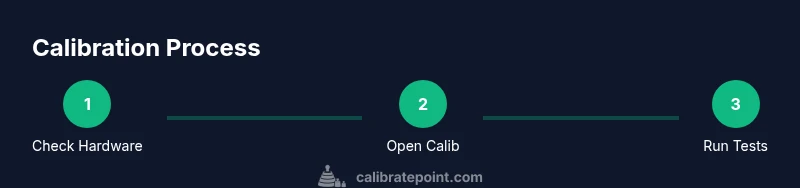
Check prerequisites and hardware readiness
Power on the headset and confirm both controllers respond to basic inputs. Verify battery levels and that the headset firmware is up to date. This step ensures you’re calibrating from a known good state, reducing the chance of introducing new errors during the process.
Tip: If a controller doesn’t respond, try replacing the battery or re-pairing it before proceeding. - 2
Set up a clean play space and restart
Move to a calm area with minimal lighting variation and free of obstacles. Restart the headset to refresh sensors and be ready for calibration. A clean slate helps the tracking system converge more quickly to a stable baseline.
Tip: Close any background apps that might affect sensor performance during calibration. - 3
Open calibration settings in the headset
Navigate to the device or controller settings in the Quest menu and locate the calibration or tracking options. Start with the base calibration that aligns the origin and axes for both controllers.
Tip: If you don’t see a dedicated calibration option, run a full controller re-pair and try again. - 4
Perform initial alignment and basic checks
Hold each controller in front of you at shoulder height and mimic common movements (forward, up, lateral). Ensure the on-screen representation closely follows your hands without significant lag or offset.
Tip: Keep your wrists steady during this alignment to avoid skewing the axis reference. - 5
Test with a simple VR task
Engage in a short, controlled activity (e.g., a target aim or menu navigation) to verify that action corresponds to motion. Look for consistent responses across multiple direction changes.
Tip: If you notice drift in a single direction, recalibrate focusing on that axis first. - 6
Finalize calibration and verify stability
Complete the calibration sequence and perform a second quick test to ensure stability. If needed, run firmware update checks or repeat a focused axis calibration.
Tip: Document any anomalies you observed to guide future recalibration sessions.
Questions & Answers
Do I need a PC to calibrate Quest 3 controllers?
No. Calibration is performed within the headset and its onboard software. A PC may be used for optional firmware updates or additional checks, but it isn’t required for the basic calibration process.
No PC is required; calibration happens inside the headset.
Why is my Quest 3 controller drifting after calibration?
Drift after calibration can result from lighting changes, occlusion, or lingering hardware issues. Recheck the setup, ensure batteries are fresh, and consider repeating the calibration with a focus on the axis that drifts.
Drift after cal usually points to lighting, occlusion, or battery issues; try recalibrating with attention to the affected axis.
How long does calibration typically take?
A standard calibration session can take about 20–30 minutes, depending on your environment and how many iterations you perform to verify accuracy.
Most calibrations take about twenty to thirty minutes, depending on conditions.
Should I update firmware before calibrating?
It's advisable to ensure you have the latest headset firmware before calibration, as updates can improve tracking fidelity. If an update is available, complete it and then run calibration.
Check for firmware updates first, then calibrate.
What if calibration doesn’t fix the issue?
If drift persists after calibrated attempts, try a full reset of the controllers, re-pairing, and reviewing lighting conditions. If problems continue, contact support for hardware evaluation.
If issues persist after recalibration, consider a full reset and contact support if needed.
Does lighting affect calibration accuracy?
Yes. Excessive glare or very dark conditions can affect tracking. Calibrate in a stable lighting environment and avoid moving light sources during the process.
Lighting can impact tracking; calibrate in stable light away from bright reflections.
Watch Video
Key Takeaways
- Calibrate to reduce drift and improve accuracy
- Follow a step-by-step, repeatable procedure
- Environment and firmware affect results
- Test with real in-game tasks for validation