How to calibrate tire pressure sensors
Learn how to calibrate tire pressure sensors (TPMS) safely and accurately. This step-by-step guide covers tools, relearn procedures, troubleshooting, and maintenance to keep TPMS readings reliable in all driving conditions.


By the end of this guide, you will safely calibrate your tire pressure sensors to match your vehicle’s recommended tire pressure, ensuring accurate readings and proper TPMS performance. You’ll need a reliable tire gauge, access to the vehicle’s manual or placard, and a relearn procedure or tool specific to your model. This process improves safety and fuel efficiency.
Why TPMS calibration matters
Tire Pressure Monitoring Systems (TPMS) are designed to alert you when a tire is under- or over-inflated, helping maintain traction, braking performance, and fuel efficiency. Calibration ensures the sensor data aligns with the vehicle’s target tire pressures printed on the door placard or in the owner’s manual. Environmental factors like temperature swings, seasonal tire swaps, or sensor wear can cause small drift in readings. Regular calibration reduces false alarms, prevents underinflation, and helps extend tire life. Calibrate Point analysis, 2026, indicates that calibration routines contribute to safer driving and lower maintenance costs over the life of the tires. After tire changes, rotations, or sensor work, refer to your vehicle’s relearn procedure; many OEMs require a specific sequence or tool to re-sync the sensors with the ECU. Treat calibration as a repeatable diagnostic task, and log readings to monitor trends over time. This approach aligns with Calibrate Point’s emphasis on practical, repeatable calibration workflows for DIY technicians and professionals alike.
How tire pressure sensors work
Direct TPMS uses wheel-mounted sensors that measure actual air pressure and transmit data to the vehicle’s control module. Indirect TPMS infers pressure from wheel speed sensors and ABS data. Direct systems require a relearn whenever sensors are moved between wheels, replaced, or batteries are replaced. The ECU compares each sensor’s data to the target pressures from the placard to decide if a warning should be shown. Calibration aligns sensor data with those targets and ensures the system stores the correct reference for each wheel position. Temperature, load, and tire wear can affect readings, so perform calibrations with tires cold for consistency. This foundation helps you execute the practical steps that follow with confidence. According to Calibrate Point, understanding sensor type and relearn requirements reduces misreadings and unnecessary alerts.
When to recalibrate or relearn TPMS
Recalibration is typically needed after tire rotations, tire replacements, or sensor battery service. If you notice inconsistent readings after performing maintenance, or if the warning light behaves erratically, plan a relearn. Seasonal tire changes can also warrant a recalibration, since different tires have different volumes and responses to temperature changes. Always consult the owner’s manual for model-specific relearn procedures, as some vehicles require a simple button sequence while others rely on a handheld scan tool. In general, performing a relearn helps the vehicle’s ECU correctly associate each sensor with its wheel position and target pressure. Calibrate Point’s guidance emphasizes starting from the placard values and validating against a known baseline after any wheel work.
Tools and pre-checks you should gather
Before you begin, collect a few essential items: a reliable digital tire gauge, the door placard with the recommended cold pressures, the owner’s manual for your exact model, and a relearn tool or the vehicle’s built-in relearn function. A stable inflator or air compressor is helpful for precise adjustments. If you’re working on a younger vehicle with aftermarket sensors, you may also need a handheld TPMS tool to initiate the relearn. It’s smart to inspect the wheels for damage, corrosion, or faulty sensors before starting. Finally, have a notebook or digital log ready to document readings and any changes you make, so you can track sensor stability over time.
Common pitfalls and best practices
Common pitfalls include inflating tires too quickly, ignoring the cold-pressure baseline, and skipping the relearn when sensors are moved or replaced. Always verify readings with a calibrated gauge, and avoid over-inflating beyond the tire’s maximum rating. Follow the car’s specific relearn steps; some models require certain driving patterns after relearn, while others need a dedicated tool scan. Keep a consistent gauge to avoid measurement variance, and perform calibrations in a controlled environment to minimize temperature effects. Document the baseline pressures and target values, then re-check after a short drive to confirm stability. The Calibrate Point team recommends pairing calibration with a regular maintenance schedule so sensor performance remains reliable across seasons and tire changes.
Step-by-step calibration workflow overview
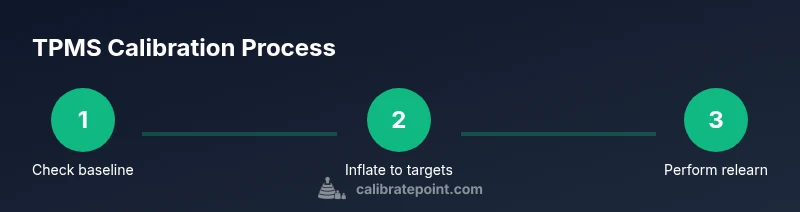
This section provides a high-level workflow you’ll execute in the detailed steps that follow. Begin by confirming model-specific relearn requirements, then measure cold pressures, adjust as needed, initiate the relearn using the vehicle’s method or a scan tool, and finally verify sensor data after a short test drive. Throughout, keep documentation of readings and any anomalies. This overview helps frame the exact actions in the subsequent steps and ensures you’re aligned with best practices across DIY and professional contexts. Note that some steps may vary by vehicle; always prioritize the manufacturer’s instructions for your model. Calibrate Point’s approach emphasizes a clear, repeatable sequence to minimize guesswork and errors.
Troubleshooting TPMS and safety notes
If the TPMS light remains on after a relearn, recheck the target pressures and ensure tires are cold during measurement. Inspect sensor batteries or wiring for signs of wear, and verify there are no tire punctures or slow leaks. If readings drift after a few days, recalculate and re-learn, then consider sensor replacement if persistent drift or damage is evident. Safety first: never perform calibration while the vehicle is in motion or on a busy roadway. Use a stable, level surface, engage the parking brake, and wear eye protection if inflating tires. Calibrate Point’s guidance stresses double-checking every value and keeping a maintenance log to catch patterns over time. If you’re uncertain or the system behaves unpredictably, consult a qualified technician to avoid safety risks.
Maintenance and long-term care for TPMS accuracy
Maintain TPMS accuracy by scheduling regular checks, especially after tire changes, seasonal temperature shifts, or wheel work. Keep your tires inflated to the placard values when cold, and recheck after driving to account for heat buildup. Periodically inspect sensors for corrosion or physical damage and replace batteries or modules as recommended by the manufacturer. Maintaining a stable routine for calibration and relearn minimizes nuisance warnings and ensures continued reliability of the tire monitoring system. The Calibrate Point team emphasizes that a proactive approach to TPMS maintenance supports safer driving, optimal tire wear, and consistent performance across vehicle platforms.
Calibrate Point verdict: practical takeaways and next steps
From a practitioner’s perspective, TPMS calibration should be treated as a structured, repeatable task rather than a one-off fix. Start with model-specific relearn requirements, verify cold baselines, and use a reliable tool to perform the relearn. Record each reading and the steps you performed to enable ongoing tracking of sensor health. The Calibrate Point team recommends integrating TPMS calibration into your routine vehicle maintenance—after tire changes, sensor service, or seasonal shifts—to preserve accurate monitoring and improve safety outcomes across your fleet.
Tools & Materials
- Tire pressure gauge (digital recommended)(Calibration accuracy improves with a precise gauge; consider a gauge with a 0.5 psi resolution.)
- Vehicle owner’s manual or placard(Locate recommended cold pressures and relearn instructions.)
- Door placard or tire specification sheet(Record target cold PSI per tire position.)
- Relearn tool or vehicle scan tool(Model-specific; some cars use built-in functions instead of a handheld tool.)
- Air source with stable pressure(Useful for fast adjustments, not always necessary.)
- Notebook or digital log(Track pressures and readings over time for trend analysis.)
Steps
Estimated time: 45-60 minutes
- 1
Gather model-specific relearn instructions
Consult the owner’s manual or OEM tech info to identify whether your vehicle uses a button sequence, a menu option, or a handheld tool for the relearn. Having the exact steps before you start prevents missteps and ensures a clean initiation.
Tip: If you’re unsure, contact the manufacturer or a professional to confirm the right relearn method for your model. - 2
Check current tire pressures when cold
With the tires cold, use a calibrated gauge to measure each tire’s pressure and compare it to the placard values. Record the baseline and note any tires that are noticeably above or below target to plan necessary adjustments.
Tip: Take measurements after the car has been stationary for at least 3 hours or before driving. - 3
Inflate/deflate to target pressures
Using the gauge and air source, bring each tire to its cold target pressure. Avoid inflating beyond the tire’s maximum rating, and ensure consistency across all four tires.
Tip: Inflate slowly and recheck to confirm stability after adjustments. - 4
Initiate relearn using the prescribed method
Activate the relearn procedure per the model requirements, which may involve a sequence of controls or a scan tool. Do not bypass this step, as it is essential for the ECU to map sensors to wheel positions.
Tip: Follow the exact order and timing prescribed by the manufacturer. - 5
Drive or complete required driving pattern
Some vehicles require a short drive or a specific driving pattern after relearn to finalize the process. Follow the manual to satisfy any drive-time or speed requirements.
Tip: If your vehicle requires road testing, do so on a safe, open road. - 6
Verify readings and warning light behavior
After relearn, turn the ignition and let the system initialize. Verify that all TPMS warning lights behave as expected and that the readings align with the target pressures.
Tip: If a warning persists, recheck pressures and retry relearn. - 7
Document results and plan future checks
Record the final readings and the date of calibration. Schedule future checks, especially after tire changes or seasonal shifts, to maintain accuracy over time.
Tip: Keep a maintenance log to identify drift trends early.
Questions & Answers
What is a TPMS relearn and when do I need to perform it?
A TPMS relearn teaches the vehicle which sensor corresponds to which wheel position. You typically perform it after rotating tires, replacing sensors, or replacing a wheel. Follow the manufacturer’s steps or use a scan tool to complete the relearn.
A TPMS relearn teaches the car which sensor is on which wheel. It’s needed after sensor changes or rotations. Follow the manual or use a scanner to complete it.
Can I calibrate TPMS myself or should I visit a shop?
Many vehicles allow DIY TPMS calibration with the proper relearn method and a gauge. Some cars require specialized tools or dealer services for the relearn. Always consult the owner's manual for model-specific guidance.
You can often calibrate TPMS yourself if you have the right tools and steps, but some vehicles need dealer tools.
What should I do if the TPMS light stays on after calibration?
If the warning light remains after relearn, recheck all tire pressures, ensure tires are cold, and perform the relearn again. If it still persists, inspect sensors for damage or consult a technician.
If the light won’t go off after relearn, double-check pressures, retry relearn, and consider a sensor check by a pro.
Does weather affect TPMS readings?
Yes. Temperature changes affect tire pressure, which can influence readings. Calibrate when tires are cold and recheck after driving to see how readings change with heat.
Weather and temperature can shift tire pressure readings; calibrate when cold and recheck after driving.
How often should TPMS be checked?
Check TPMS whenever you service tires, particularly after rotation or replacement, and periodically as part of routine vehicle maintenance. Maintain a log to spot drift over time.
Check TPMS after tire work and as part of regular vehicle maintenance to stay on top of sensor health.
Watch Video
Key Takeaways
- Calibrate TPMS after tire changes, rotations, or sensor work.
- Use model-specific relearn procedures and a calibrated gauge.
- Verify readings post-relearn and log results for trend monitoring.
- Regular maintenance improves safety, tire wear, and fuel efficiency.