How to Calibrate a Watch: A Practical Step-by-Step Guide
Learn how to calibrate a watch at home with practical steps, tools, and safety tips. This Calibrate Point guide covers quartz and mechanical movements, measurement, adjustment, and verification for reliable timekeeping.


By the end of this guide, you will be able to calibrate a watch at home with confidence. You’ll rely on a reliable timing reference, a stable workspace, and careful regulator adjustments for mechanical watches or oscillator checks for quartz models. This process covers safety, measurement, adjustment, and verification to minimize daily drift and maximize accuracy.
What is watch calibration and why it matters
Accurate timekeeping is more than a personal convenience; it affects daily schedules, time-sensitive tasks, and the reliability of timepieces as precision instruments. Watch calibration is the process of aligning a watch's rate with a reference standard, so that the reported time remains consistent across days and under typical wear conditions. According to Calibrate Point, precise calibration combines solid theory with hands-on technique, giving DIY enthusiasts and technicians a practical path to better accuracy without turning to a full-service repair. The essential idea is to measure how fast or slow the movement runs in controlled conditions, then adjust components only within safe limits. This keeps the mechanism intact while addressing systematic drift. For newcomers, the term calibration might seem intimidating, but with the right workflow and safety mindset, the task becomes a structured sequence of measurements, checks, and adjustments rather than guesswork.
Quartz vs mechanical: calibration implications
Quartz watches rely on a quartz oscillator and electronics, which respond differently to temperature and load than mechanical movements. Calibration for quartz typically centers on timing accuracy, temperature compensation, and power management, rather than regulator alignment. Mechanical watches, by contrast, depend on the balance wheel, hairspring, and escapement; calibration focuses on rate, positional variation, and consistency across crowns and positions. Understanding these differences helps you choose the right approach and avoids chasing the wrong symptoms. Throughout this guide, you’ll see practical tips that apply to both types while highlighting where the paths diverge.
Reference timing sources and accuracy concepts
A reliable reference is essential for measuring a watch's rate. In professional settings, time signals from national standards are used, but for home calibration a trustworthy public source can suffice. The goal is to quantify how many seconds per day your watch gains or loses and to compare that against acceptable tolerances for your use case. Calibrate Point analysis shows that using a stable reference reduces the risk of drifting further during adjustment, especially when working on delicate balances or tuning screws. Always note that accuracy is relative: a perfectly calibrated watch might still run slightly off in practice due to temperature, position, and wear.
Workspace setup and safety considerations
Set up a clean, well-lit workspace with a soft mat to protect the movement and a stable mounting surface. Use proper tools designed for horology and avoid improvised substitutes. Lighting should reveal small components, and a loupe or magnifier helps in inspection. Keep a parts tray to prevent losses, and wear eye protection when handling sharp screws or springs. Calibrating a watch can require delicate manipulation; never apply force or torque to a component beyond its rated limit. By maintaining a controlled environment, you improve measurement reliability and minimize the risk of accidental damage.
Baseline measurement: establish current accuracy
Begin by recording the watch's current rate before making any adjustments. Use a trusted timing source and observe over a defined period, noting how many seconds per day the watch deviates. If you’re testing mechanical watches, consider multiple positions (dial up, dial down, crown up, crown right) to map positional variance. For quartz, measure with temperature references if available. The important part is collecting repeatable data to form a baseline. This baseline becomes your reference for every adjustment and for validating post-calibration performance.
Mechanical adjustments: regulator and balance considerations
For mechanical watches, the rate is controlled by the regulator index and the balance wheel. Make very small regulator moves and recheck the rate. The goal is to shift the rate toward the reference gradually, not to overhaul the movement with large corrections. After each adjustment, allow the movement to settle for a short period and re-test accuracy in several positions. If the watch shows large positional drift, slow down and verify that the balance wheel is free of obstruction and not magnetized. Always document the direction and magnitude of each change.
Quartz watch calibration: oscillator and temperature effects
Quartz watches rely on a stable oscillator. If you observe drift, it could be related to temperature or aging components. Calibrating a quartz watch often involves software or calibration circuits in the movement, with occasional manual adjustments to the oscillator frequency within safe limits. Temperature compensation features can mitigate some drift, but you should verify performance across typical ambient temperatures. Refrain from applying any aggressive changes; small adjustments validated by measurement are safer and more reliable.
Multi-position and time-domain validation
Accuracy testing should cover multiple positions and, if possible, a range of temperatures. Record readings in each position and compare to a reference to ensure consistency. If the watch runs at a different rate depending on orientation, you may need a more detailed adjustment strategy or professional servicing. The goal is to achieve stable performance across expected wearing conditions, not just a single perfect position. If you observe inconsistent results, re-check alignment, lubrication, and any external influences such as magnetic fields.
Reassembly, documentation, and routine care
After achieving the target rate, reassemble the case carefully and run a final verification test. Document the baseline, adjustments, and final measurements for future reference. Store the calibration log with the watch model, movement type, date, and observed rates in several positions. Periodic checks are recommended to account for aging components and environmental changes. By building a concise maintenance record, you’ll know when to revisit calibration and how to reproduce good results.
Safety, common pitfalls, and best practices
Calibration work involves tiny parts, sharp springs, and delicate screws. Stay organized, avoid magnetic exposure, and work with clean hands. Common pitfalls include over-tightening, forcing components, and misinterpreting readings due to inconsistent timing sources. Always use a calibrated reference and verify results with independent measurements when possible. If a watch has complex issues or you’re unsure about the adjustment limits, seek professional guidance to prevent damage.
Tools & Materials
- Watch case opener and movement holder(Use proper tools to avoid case damage)
- Fine watchmaker screwdrivers(Sizes around 0.8mm to 1.0mm)
- Loupe or magnifier(3x–10x magnification)
- Timing reference source (atomic clock or accurate app)(Stable and repeatable readings)
- Stability mat and anti-static wrist strap(Minimize static and vibration)
- Calibrated temperature controlled environment(If possible, maintain steady ambient temperature)
- Soft watch movement holder or block(Secure the movement without damage)
- Parts tray and cleaning cloth(Prevent losses and keep parts clean)
Steps
Estimated time: 2-4 hours
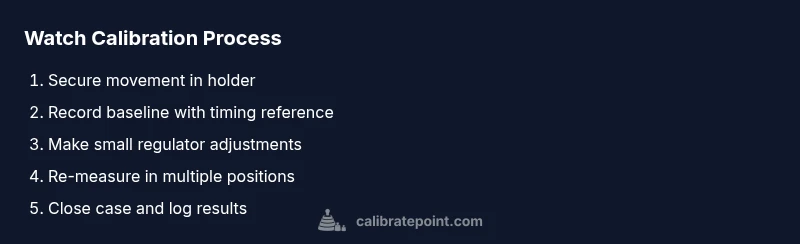
- 1
Prepare the workspace
Set up a clean, well-lit, magnetic-free area. Place a soft mat, movement holder, and a parts tray. This ensures you can work safely and see tiny components clearly.
Tip: Keep a camera or notebook handy to document each setup. - 2
Secure the watch and access movement
Open the case carefully and secure the movement in the holder. Ensure the dial is visible and the crown is accessible for position testing.
Tip: Handle screws with the correct screwdriver size to avoid slipping. - 3
Obtain a baseline reading
Connect the timing reference and record the watch rate over a defined interval. Note variations by position to build a baseline map.
Tip: Take multiple measurements in quick succession for reliability. - 4
Adjust the regulator or oscillator gradually
For mechanical watches, make very small regulator adjustments and re-measure. For quartz, check oscillator stability and temperature effects carefully.
Tip: Increment changes conservatively; small tweaks yield better control. - 5
Re-test after each adjustment
After each small adjustment, re-measure in several positions. Confirm the rate moves toward the reference and remains stable.
Tip: Allow the movement to settle before re-testing. - 6
Validate across positions and temperatures
Test in multiple orientations and, if feasible, under a controlled temperature range. This ensures the calibration holds in real wear.
Tip: Document all readings for future comparisons. - 7
Close the case and log results
Reassemble carefully and perform a final check. Record model, movement, deviations, adjustments, and date in a calibration log.
Tip: Keep a copy of the log with the watch for easy reference.
Questions & Answers
Can I calibrate a quartz watch at home, and is it safe?
Yes, you can calibrate some quartz watches at home using appropriate tooling and a stable reference. However, many quartz calibations involve factory settings or software adjustments that require specialized equipment. If in doubt, consult the watch’s manual and proceed with caution.
Yes, you can calibrate some quartz watches at home with the right tools, but certain adjustments may require professional equipment.
What tools are essential for watch calibration?
A movement holder, precision screwdrivers, a loupe, and a reliable timing reference are essential. Optional items include a temperature-controlled environment and anti-static accessories to improve measurement stability.
Essential tools include a movement holder, precision screwdrivers, a loupe, and a reliable timing reference.
How often should I calibrate a watch?
Calibration frequency depends on usage and environment. Regular checks are recommended if the watch experiences heavy wear, temperature variation, or magnetism exposure. Use a log to determine when readings drift again.
Calibration frequency depends on use and environment; log to track drift over time.
What if the watch shows large drift in one position?
Large positional drift may indicate an internal issue such as magnetism, lubrication problems, or a damaged balance. Re-check the movement and consider a professional service if drift persists after careful adjustments.
If you see large drift in a position, recheck the movement and consider professional service if it continues.
Is magnetism a common cause of timing errors?
Yes, magnetism can significantly affect a watch's rate by altering the balance spring. Keep the movement away from magnets and use antimagnetic tools when possible.
Magnetism can cause timing errors; keep the watch away from magnets.
What should I do if calibration tools are not available?
If you lack the tools for precise calibration, consider delaying adjustments until you can access proper equipment or seek a professional service. Amateur attempts can cause damage if misapplied.
If you don't have proper tools, avoid calibration and seek professional help.
Watch Video
Key Takeaways
- Establish a stable baseline before adjustments
- Make tiny regulator or oscillator changes
- Test across multiple positions for reliability
- Document results for future calibrations
- Protect the movement from damage and magnets