Calibrate Bosch Oven: A Step-by-Step Calibration Guide
Learn how to calibrate a Bosch oven with a safe, practical, step-by-step method. This guide covers tools, testing temperatures, adjusting offsets, and verifying results for reliable cooking accuracy.


Calibrate Bosch oven at home to achieve accurate temperatures and repeatable results. This guide shows a safe, step-by-step approach using a thermometer, careful preheating, and manufacturer-aligned adjustments where available. You'll learn when calibration is necessary, what tools to gather, and how to verify results with practical test bakes. That way, you minimize drift and get consistent outcomes across recipes.
Why Bosch Oven Calibration Matters
According to Calibrate Point, precise temperature control in cooking and baking starts with accurate heat. A Bosch oven is built with smart sensors and a programmable thermostat, but all ovens drift over time due to wear, door seal changes, and ambient conditions. When the oven's internal temperature does not align with the dial or the display, baked goods may come out too hot, undercooked inside, or unevenly browned. Calibration helps lock in a repeatable baseline, so a 350°F setting yields a consistent center temperature across racks and recipes. For professionals, consistent results save time and reduce waste; for DIY enthusiasts, it prevents frustration and guesswork in every project from bread to pastry. In this guide, Calibrate Point shares a practical approach that is safe for typical home kitchens and mindful of Bosch's common control layouts. You will learn to test, adjust, and verify without risking damage to the appliance.
Tools and Safety Considerations
Before any calibration, gather the right tools and observe safe practices. A digital or oven-safe thermometer lets you read the true oven temperature without guessing from the dial alone. A timer or smartphone keeps tests consistent across runs. Heat-resistant gloves or oven mitts protect hands when handling hot racks. Keep the oven's power off when connecting or removing probes, and never operate the appliance with an open door beyond the safe test position. Having Bosch's official calibration chart or the user manual on hand helps ensure you follow model-specific steps. Finally, maintain a clear log of readings, adjustments, and test temperatures so you can reproduce successful calibrations in the future.
Understanding Oven Temperature Calibration
Calibration is the process of aligning the oven's internal temperature sensor with the actual heat produced inside the cavity. The thermostat or control board sets a nominal temperature, while heat transfer from the elements may create a small offset. Over time, component wear, door gaskets, and thermal lag can cause drift. Calibration does not fix performance problems caused by door leaks, uneven rack heat, or calibration-critical faults; it simply corrects the baseline so your heat matches your setting more closely. In practice, you compare the thermometer reading at a known temperature with the display reading, calculate an offset, and apply that offset using the model's calibration controls where available. The goal is to bring the oven's center temperature to within a consistent range across tests.
Common Bosch Oven Calibration Methods
Many Bosch ovens offer two broad paths for calibration: a digital offset through the control panel and a manual offset via a service or calibration mode. Digital offset involves selecting a target temperature in Settings and adjusting upward or downward by small increments, then re-testing. Manual offset, when available, might require entering a service mode and turning a calibration screw or using a hidden menu, followed by re-testing. Because models vary, consult the Bosch manual for your specific model ID before attempting any adjustment. If your model lacks a direct calibration control, the recommended approach is to rely on a more accurate thermometer and consider professional service for substantial drift.
Troubleshooting and Maintenance
Even after calibration, temps can drift if the door seal, hinges, or venting are compromised. Check for gaps around the door, ensure the rack is not blocking vents, and verify that you are testing at the center of the oven cavity away from walls. If hot spots persist, rotate test dishes and repeat, or test at multiple rack positions to map variance. Keep the oven door closed during test runs to minimize heat loss. Use test bakes with uniform dough or batter to reduce measurement noise. If you still observe significant differences between settings and actual heat, return to the manufacturer documentation or contact service.
Maintaining Calibration Over Time
Calibration is not a one-and-done effort. Temperature drift can occur with door wear, element aging, and even voltage fluctuations. Recalibrate after service, after moving the oven, or after extended periods of non-use. Maintain consistent power sources and ensure you run the oven on standard household voltage. Log results and watch for patterns over several months; a drift trend may indicate a need for professional adjustment.
AUTHORITY SOURCES
- https://www.nist.gov/pml/calibration
- https://www.nist.gov/pml/calibration/temperature
- https://www.bosch-home.com/us/support/calibration-guide
Tools & Materials
- Digital or oven-safe thermometer(Probe capable of reading hot temperatures inside the oven)
- Timer or smartphone with alarm(For consistent test intervals during preheat and readings)
- Oven-safe gloves or mitts(Protect hands when handling hot racks)
- Bosch user manual or calibration chart(Model-specific instructions for calibration offsets)
- Notebook or digital log(Record readings, settings, and outcomes for reproducibility)
- Flat-head or Phillips screwdriver (model-dependent)(Only if your Bosch model exposes a calibration screw)
Steps
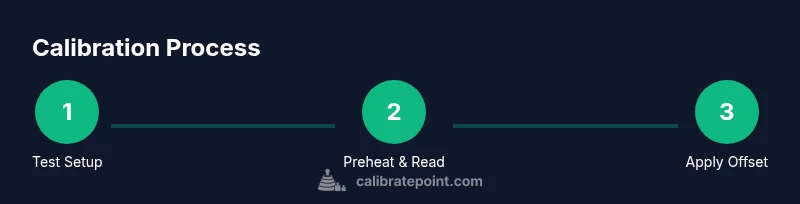
Estimated time: 60-75 minutes
- 1
Prepare and safety-check
Power off the oven and put on heat-resistant gloves. Gather the thermometer, timer, and your Bosch manual. Confirm you have a clear work area and a clean, dry rack for placement of the probe.
Tip: Don’t start tests with the oven hot; allow it to cool to a safe handling temperature. - 2
Position the thermometer properly
Place the thermometer probe in the center of the oven cavity, away from walls or racks, and ensure the probe does not touch metal surfaces. Secure the cable so it won’t snag during operation.
Tip: Center placement reduces measurement error from edge effects. - 3
Preheat to a reference temperature
Set the oven to a common reference temperature (for example, 350°F / 175°C) and allow full preheating. Wait until the preheat indicator shuts off or the over display reads that the set temperature has been reached.
Tip: Use a single, stable reference temperature for all tests to minimize variation. - 4
Read the actual temperature
As soon as the oven indicates it has reached the reference temperature, read the thermometer reading. Compare this actual interior temperature to the set temperature on the control.
Tip: Take at least two readings spaced a minute apart to account for transient fluctuations. - 5
Assess if calibration is needed
If the thermometer reading deviates from the set temperature, an offset exists. Determine whether your model supports a digital or manual offset to correct this drift.
Tip: If you’re unsure, consult the Bosch manual before attempting adjustments. - 6
Enter calibration mode (model-specific)
Access the calibration controls per your model: digitally through Settings if available, or via a service mode if your manual specifies. Do not force entries; follow the exact sequence from the manual.
Tip: Only use approved methods; improper calibration can cause unsafe operation. - 7
Apply offset in small increments
If using a digital offset, adjust in small steps (e.g., 5–10°F or the equivalent in Celsius) and retest. If a screw-based offset is available, turn slowly and test after each small adjustment.
Tip: Small steps reduce overshoot and rework. - 8
Retest across temperatures
Repeat the test at the reference temperature and at an additional temperature (e.g., 450°F / 230°C) to confirm consistency. Repeat measurements to confirm stability of the offset.
Tip: Testing at multiple temps uncovers nonlinearity in the offset. - 9
Document and return to normal use
Record the offset, settings used, and test results. Restore the oven to standard use and re-test with a familiar recipe to validate the change in practical cooking terms.
Tip: Keep the calibration record with your user manual for future reference.
Questions & Answers
How do I know if my Bosch oven is out of calibration?
If your baked goods consistently differ from the expected results or a thermometer reading diverges from the dial, your oven may be out of calibration. Use a thermometer to verify and follow the calibration steps in this guide.
If your oven bakes unevenly or the temperature seems off compared with the dial, it might be out of calibration.
Can I calibrate Bosch ovens myself or should I hire a technician?
Many models allow safe, at-home calibration when the manufacturer provides digital or manual offset options. For large drifts or unfamiliar models, consider professional service.
You can try the official calibration steps if your model supports them; for bigger issues, a technician may be safer.
What temperatures should I test at?
Test at standard reference temperatures such as 350°F (175°C) and 450°F (230°C) to map offsets and verify linearity across the range.
Testing at common reference temperatures helps reveal offsets across range.
Is calibration safe for my Bosch oven?
Calibration is generally safe when you follow the manual and power precautions. Do not calibrate while the oven is hot and always disconnect power during setup.
Yes, as long as you follow the manual and stay safe with power and heat.
What if the oven still reads differently after calibration?
If drift persists, check for door leaks or thermally isolated zones. Calibration may need professional adjustment or replacement of faulty components.
If it still reads differently after calibration, you may need professional help.
Watch Video
Key Takeaways
- Calibrate Bosch oven with safe testing and a reliable thermometer
- Use model-specific calibration steps from the Bosch manual
- Test at multiple temperatures to verify accuracy
- Document results and maintain a calibration log
- If issues persist, consider professional service