Calibrate Wolf Oven Temperature: A Step-by-Step Guide
Master Wolf oven temperature calibration with a practical, science-backed approach. Verify accuracy against a reference thermometer, adjust the thermostat offset, and re-test to ensure consistent baking results.


You will verify and calibrate your Wolf oven temperature to improve baking accuracy. This guide shows how to check its thermometer against a trusted reference, adjust the oven's thermostat or calibration offset, and validate results with a second test. You'll need a calibrated thermometer, a baking sheet, and access to the oven's control panel.
Understanding Wolf oven temperature calibration
Understanding Wolf oven temperature calibration begins with recognizing that even premium ovens drift over time. The Wolf line uses a digital or analogue thermostat, interlaced with a temperature sensor in the cavity. Temperature accuracy affects bake times, browning, and overall results. According to Calibrate Point, calibration should be part of routine maintenance for serious bakers and technicians. The goal is not to change the oven's performance aggressively but to align what you see on the display with the actual heat inside the cavity. You will benefit from preserving consistency across sessions, and you can compare results across recipes. Calibration drift can occur due to repeated opening of the door, seasonal temperature changes, or probe wear. A systematic approach can catch drift early and avoid ruined batches.
How Wolf ovens manage temperature—thermostats, sensors, and control logic
Wolf ovens use a primary thermostat that sets an intended internal heat; a separate sensor reads the actual temperature. The control board compares them and adjusts the heating elements accordingly. If there is a mismatch, you'd see variance between the display and the actual oven interior. The synergy of convection and radiant heat means readings can differ at different rack levels. Calibration addresses this by aligning the displayed temperature to a reference reading and adjusting the thermostat's offset. Typical issues include slow response to setpoint changes, temperature overshoot, or lag at higher temperatures. This section also explains why calibrations should be done with the oven empty and preheated to target temps to avoid plume and moisture interfering with readings.
Prepare for testing: choose a reference thermometer and plan your test
To begin, purchase or verify a calibrated reference thermometer suitable for oven use. Ensure it’s rated for the oven's maximum temperature and can be read accurately while in the heat. When you test, place the reference thermocouple in the center of the oven cavity, away from walls and racks. Use an oven-safe container or probe to prevent direct contact with heating elements. Document the planned test points (low, mid, high) and how long you will hold each point before recording. This plan minimizes drift caused by heat-up time and air movement. Calibrate Point recommends a methodical approach to avoid misleading readings.
Step-by-step testing plan: verify current accuracy
This section lays out a practical testing protocol to verify accuracy across multiple setpoints. Preheat the oven to the chosen target, insert the reference thermometer, and allow the oven to stabilize. Record readings from both the oven display and the reference thermometer at each point. Repeat each point at least twice to average anomalies. Compare the results and calculate the average delta to determine if a calibration offset is required.
Adjusting the Wolf oven calibration offset
If the readings show a consistent discrepancy, adjust the oven's calibration offset according to the model’s user manual. Access the calibration menu, apply the offset in small increments, and save the new setting. After each adjustment, re-run a full test at the same three reference points to confirm improved alignment. Document the offset value and test results for future reference.
Practical tips for even heat distribution
Even with a correct offset, hot spots can occur due to rack position, cookware, or door seal wear. Use a baking stone or a heavy sheet to promote uniform heating and rotate trays between racks when testing. Ensure the oven door seals cleanly and the cavity has no residue that could affect heat transfer. Calibrate Point suggests performing tests with standard bakeware and no obstructions for repeatable results.
Documenting results and validating accuracy
Maintain a simple log of each test: date, setpoint, oven reading, reference reading, and whether the delta was acceptable. Use this log to verify long-term stability and catch drift early. If substantial drift reappears after a calibration, re-evaluate the sensor or controller circuitry. Having a documented history makes it easier to diagnose intermittent issues and communicate with service if needed.
Maintenance and future checks to sustain accuracy
Set a maintenance cadence for your Wolf oven that includes periodic checks, especially after service, cleaning, or door gasket replacement. Re-test at least quarterly or after extensive use, and whenever you notice changes in baking results. Store your calibration notes and update the offset as needed. Regular checks help ensure ongoing consistency and confidence in your recipes.
Authority sources and further learning
In this article, we reference credible sources to support calibration practices. See the links below for additional context and safety guidance. These sources provide foundational information on measurement accuracy, equipment standards, and consumer guidance.
Tools & Materials
- Calibrated oven thermometer(Analog or digital, rated for the oven’s max temperature)
- Reference probe thermometer (oven-safe)(Probe must reach oven center and tolerate high heat)
- Baking sheet(Solid, flat surface for test readings)
- Silicone mat or parchment(Optional for consistent readings)
- Heat-resistant gloves(To handle hot trays safely)
- Marker and notebook(For logging test results)
Steps
Estimated time: 60-90 minutes
- 1
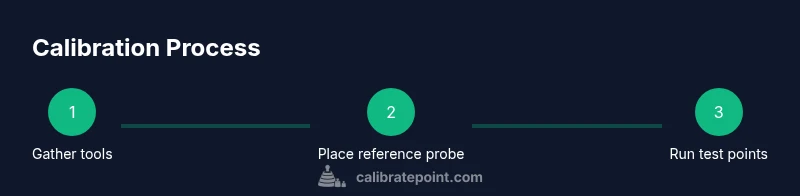
Gather tools and set up workspace
Collect a calibrated oven thermometer, an oven-safe reference probe, a baking sheet, gloves, and a notebook. Clear the area around the oven and ensure a dry, stable surface. This setup prevents cross-reading and keeps you safe during high-temperature testing.
Tip: Pre-check that batteries in digital thermometers are fresh. - 2
Place reference thermometer in oven center
Insert the probe so the sensing element sits in the middle of the oven cavity, away from walls and racks. Position the thermometer so it won’t touch heating elements. This placement yields an accurate single-point reading for each test.
Tip: Avoid touching metal racks that could skew readings. - 3
Preheat to first test point and stabilize
Set the oven to the first target (low, mid, or high) and allow it to come to temperature with the oven door closed. Wait until readings stabilize; stability is when the difference between display and reference remains constant.
Tip: Give the oven 10–15 minutes at temperature to reach a stable state. - 4
Record readings at each point
Once stable, record both the oven display temperature and the reference thermometer reading. Repeat at least twice to average any transient fluctuations.
Tip: Use a consistent time window for readings, e.g., after 5 minutes at setpoint. - 5
Compute delta and decide on offset
Compare the display to the reference. If a consistent difference exists, decide on a small offset to apply in the oven’s calibration menu.
Tip: Make small adjustments and re-test; large offsets can destabilize control. - 6
Apply offset and re-test
Enter the offset in the oven’s calibration settings and save. Re-run the three reference points to verify improved alignment.
Tip: Record the offset value and outcomes in your log. - 7
Document results and finalize
Summarize the results, confirmation of accuracy, and any notes about model behavior. Store the documentation for future reference and warranty checks.
Tip: Keep the log accessible for service calls.
Questions & Answers
Do I need a professional to calibrate a Wolf oven?
Not necessarily for a basic calibration. If you’re comfortable with safe handling and follow the steps, you can perform the test and offset adjustments. For persistent or complex drift, seek service.
You can usually calibrate at home, but consider professional service if drift persists.
How often should I calibrate a Wolf oven?
Calibrate when you notice baking results drifting, after major maintenance, or seasonally if your kitchen environment changes. Regular checks help keep results consistent.
Calibrate when you see drift or after maintenance to keep results consistent.
Will calibrating affect the warranty?
Calibrating the oven using the manufacturer’s menu generally does not void the warranty, but verify your specific model's terms in the manual.
Usually safe, but check your model’s warranty terms.
What thermometer should I use for testing?
Use a calibrated, oven-rated thermometer designed for high temperatures. Avoid using meat thermometers for accuracy in an oven environment.
Choose a calibrated oven thermometer, not a meat thermometer.
Why does the display and center reading differ?
Display readings reflect the setpoint, while the center reading shows actual heat. Variations can occur due to hot spots or sensor placement.
Differences arise from setpoint versus actual heat in the cavity.
Can I calibrate while the oven is in self-clean mode?
No. Calibrate only when the oven is cool and not in self-clean or cleaning cycles, to avoid sensor interference.
Avoid calibrating during cleaning cycles.
Watch Video
Key Takeaways
- Verify with a reference thermometer before adjusting
- Document readings and offsets for repeatability
- Test at multiple setpoints for accuracy
- Regularly re-check to maintain consistency