How to Calibrate an Oven Thermometer: Step-by-Step Guide
Learn how to calibrate an oven thermometer with practical steps and essential tools. This Calibrate Point guide helps DIY enthusiasts verify accurate oven temperatures for reliable cooking.


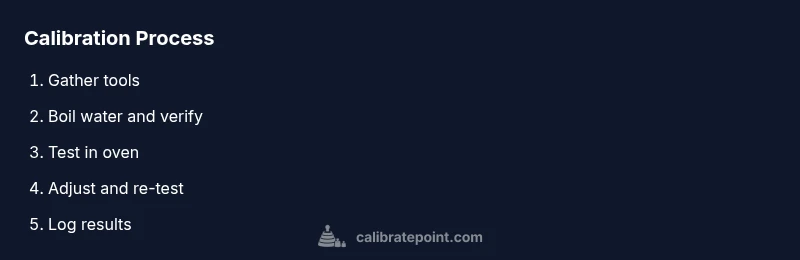
You can verify and calibrate an oven thermometer with a few simple steps. Start with a known temperature source, like boiling water at 212°F (100°C) or a preheated oven of a known setting. Compare the thermometer reading to the target temperature, then adjust if possible (dial calibration or screw). If adjustment isn’t possible, replace the thermometer and recheck to ensure accuracy.
Why Calibration Matters for Oven Thermometers
A precise oven thermometer is essential for consistent baking and safe cooking. Inaccurate readings can ruin a cake, undercook meats, or waste energy. According to Calibrate Point, a reliable thermometer helps home cooks and professionals make better decisions in real time and reduces the risk of over- or under-heating food. Calibration isn’t a one-time event; temperature probes drift over time due to aging, exposure to heat cycles, and occasional rough handling. By validating your thermometer against known reference points, you create a dependable baseline you can repeat across recipes and seasons. The goal is dependable accuracy within a practical margin, not perfection. This section lays the groundwork for a straightforward calibration process you can perform with common kitchen tools.
Understanding How Oven Thermometers Work
Oven thermometers come in different forms, but most rely on a heat-responsive element that expands or changes resistance as temperature rises. Dial models use a bi-metal coil or bimetal strip connected to a needle, while digital models rely on a thermistor and microcontroller. Response time varies; probes placed close to heat sources may react faster but also drift more under repeated cycles. Linear, evenly illuminated scales help reduce parallax error, but all thermometers benefit from periodic cross-checks. Grasping how your unit operates helps you choose appropriate calibration methods and interpret readings more accurately. This knowledge also clarifies why a thermometer can read low or high by several degrees after heavy oven use or frequent door openings.
Methods to Calibrate: Boiling Water Test and Oven Method
There are two widely used calibration methods for oven thermometers. The boiling water test uses a reference point of 212°F (100°C) at sea level. Submerge the thermometer stem and sensor in gently boiling water, avoiding contact with the pot, and compare the reading. For ovens, preheat to a known setting (for example, 350°F) and place the thermometer in the center of the oven cavity, away from walls. Allow the oven to come to temperature, then compare the thermometer reading to the set point. If your reading differs, you’ll need to adjust or replace, depending on your device’s features. Keep altitude in mind; boiling temperature drops with elevation, so reference points shift accordingly.
Adjusting Readings and Making Adjustments
Some oven thermometers include an adjustable calibration dial or screw. If yours does, use a small screwdriver to fine-tune the dial in small increments, rechecking after each adjustment. If there is no adjustment mechanism, you cannot calibrate the device in place; in that case, rely on a reference check and consider replacing the thermometer if it consistently drifts. After any adjustment, repeat the boiling water test and oven test to confirm the change. Document the baseline, adjustment, and verification results for future reference.
Maintenance, Verification, and When to Replace
Regular verification helps maintain accuracy over time. Set a reminder to recheck your oven thermometer after heavy use, temperature swings, or after moving the device to a new oven. If reference checks show persistent drift beyond an acceptable range, replacement is often the simplest path to regain reliability. Proper storage and careful handling—avoiding impacts and exposing sensors to extreme temperatures—extend life. When in doubt, compare against a trusted reference thermometer to ensure confidence in readings.
Common Mistakes to Avoid
Avoid assuming all oven thermometers read identically at all temperatures; readouts can skew at higher temperatures more than at ambient. Do not rely on a single data point; verify at multiple temperatures to establish a true offset. Never place the thermometer tip against the oven rack or heating element during tests, as this creates false readings. Finally, don’t rush the process; give sensors time to stabilize after changes before recording results.
Start a Simple Calibration Log for Your Oven Thermometer
Keeping a log helps you track stability over time. Record the model, test method, reference temperature, observed reading, adjustments, and the date of verification. Use a simple template in a notebook or a dedicated app. Regular review of the log will reveal drift patterns and remind you when it’s time to replace the device. A well-maintained log makes calibration repeatable and trustworthy.
Tools & Materials
- Oven-safe thermometer (dial or digital)(Ensure readable scale in °F or °C; place probe away from heat coils.)
- Stovetop pot or kettle for boiling water(Sturdy handle; large enough to hold water without splashing.)
- Large heatproof container or bowl(Submerge thermometer tip in water without touching sides.)
- Towel or oven mitts(Handle hot equipment safely.)
- Digital or reference thermometer (optional)(Used to independently verify the boiling point.)
- Screwdriver or small adjustment tool(Only if your model provides an adjustment screw.)
- Calibration log notebook or app(Record initial readings, adjustments, and rechecks.)
Steps
Estimated time: 25-40 minutes
- 1
Gather tools and prepare workspace
Collect the thermometer, boiling pot, container, towel, and calibration log. Clear the counter and set up away from children. This helps prevent accidents and ensures you won’t misplace components mid-test.
Tip: Lay everything out within arm’s reach before you begin. - 2
Boil water and prepare reference
Fill a pot with water and bring it to a rolling boil on a safe burner. Have a heatproof container ready to submerge the thermometer so you can take a stable reading without splashing.
Tip: Use the stove’s largest burner to maintain a steady boil. - 3
Submerge thermometer in water
Immerse the thermometer in the boiling water, making sure the sensing region is fully submerged but not touching the pot walls or bottom. Allow a few seconds for stabilization before reading.
Tip: Keep the stem and sensor fully under water for accuracy. - 4
Read and compare water temperature
Record the water temperature shown by your thermometer and compare it to 212°F (100°C) at sea level. Note any offset and determine whether an adjustment is possible.
Tip: If you’re at altitude, account for a lower boiling point. - 5
Adjust calibration if possible
If your thermometer has a calibration screw or dial, make a small adjustment and recheck. Use minimal turns and verify after each change to avoid overcorrection.
Tip: Make only tiny adjustments; small changes have big effects. - 6
Re-test in water and in oven
Repeat the boiling water test to confirm the adjustment. Then preheat the oven to a known setting and place the thermometer in the center to verify under actual cooking conditions.
Tip: Wait for stabilization before recording each reading. - 7
Document results
Record baseline readings, adjustments, and final verification in your calibration log. This creates a repeatable reference for future tests.
Tip: Note the date, model, and any anomalies observed during testing. - 8
Plan future verifications
Schedule regular checks and log reviews to ensure ongoing accuracy. If readings drift consistently, consider replacement for reliability.
Tip: Set reminders to recheck after kitchen equipment changes or new oven installations.
Questions & Answers
Do I really need to calibrate an oven thermometer?
Yes. Calibration helps ensure accurate baking temperatures, improves recipe results, and supports food safety. Regular checks catch drift caused by heat cycles or rough handling.
Yes, calibration helps ensure accurate oven temperatures and safer cooking. Regular checks catch drift.
Can I calibrate a digital thermometer the same way as a dial?
Many digital thermometers offer calibration, but some models use auto-calibration or require manufacturer instructions. Follow the user manual for model-specific steps.
Digital thermometers may have different calibration methods; check the manual for your model.
What if my thermometer doesn’t have a calibration screw?
If there’s no adjustment mechanism, calibration isn’t possible in place. Rely on reference checks and consider replacement if drift remains.
If there’s no adjustment, you can’t calibrate the device directly; replace if drift continues.
How often should I calibrate my oven thermometer?
Calibrate when you acquire the thermometer, after suspected drift, or following oven repairs or relocation. Use a quick verification routine to stay confident.
Calibrate when you get it, after drift, or after oven changes; verify regularly.
Does altitude affect boiling-point calibration?
Yes. Higher altitudes lower the boiling point, so adjust the reference point accordingly when performing the boiling water test.
Altitude lowers the boiling point; adjust your reference when testing.
Is it safe to calibrate with the oven on high heat?
Calibration tests should use safe, controlled references (boiling water or a known oven setting). Do not perform calibration while the oven is hot and in use.
Calibrate using safe references; avoid calibrating while the oven is hot.
Watch Video
Key Takeaways
- Verify readings with a known reference.
- Use proper tools and safe handling.
- Document results for repeatability.
- Calibrate regularly or when drift is suspected.