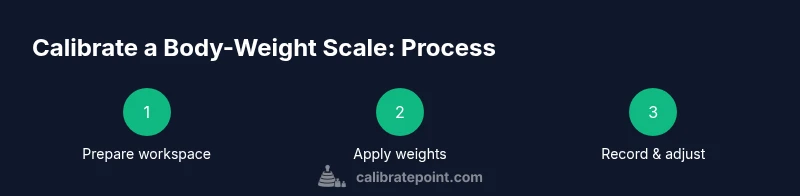
How to Calibrate a Scale for Body Weight
Learn a precise, repeatable method to calibrate a body-weight scale, with safety tips, step-by-step instructions, verification checks, and maintenance guidance to ensure accurate readings.


You will learn how to calibrate a body-weight scale for accurate readings. Begin with a hard, level surface, select certified calibration weights, and follow a controlled procedure to adjust offset or sensor readings. This quick guide highlights the essential steps you’ll replicate for consistent results.
Why accurate body-weight scale measurements matter
Precise body-weight readings are essential for fitness tracking, medical decision-making, and equipment calibration in clinics or exercise facilities. An inaccurate scale can propagate errors into diet plans, training programs, and progress tracking, undermining goals and safety. For DIYers and professionals alike, a reliable scale baseline is the foundation of repeatable measurements. According to Calibrate Point, precision starts with choosing the right platform, understanding how load distribution affects readings, and implementing a consistent calibration routine. Mild variations in floors, temperature, and user technique can introduce drift that compounds over time, especially with scales that have spring-loaded mechanisms or electronic sensors. Recognizing these factors helps you design a robust calibration plan you can repeat under similar conditions. You’ll learn how to interpret readings so you can decide when recalibration is necessary rather than chasing minor fluctuations. The goal is to establish a benchmark you can trust for every user and every session.
Why accurate measurements matter for different users
Different users place varying loads on the scale, which can reveal weaknesses in a scale’s linearity if not checked. In professional settings, repeated measurements verify that a single instrument provides consistent data across a range of body weights. This consistency is crucial for nutrition plans, medical monitoring, and performance goals. Calibrate Point’s approach emphasizes reproducibility, documentation, and periodic rechecks to maintain trust in the data you collect. By building a calibration habit now, you reduce surprises later and support safer downstream decisions.
How this guide fits into a broader calibration plan
A robust calibration routine isn’t a one-off task. It sits inside a broader maintenance cycle that includes routine checks, environmental control, and record-keeping. The exercises here align with best practices used in calibration standards and provide a repeatable workflow that can be adapted to different scales. If you manage multiple scales, you’ll appreciate having a consistent protocol that reduces drift and saves time during routine inspections.
Tools & Materials
- Certified calibration weights (e.g., 5 kg, 10 kg)(Use weights with traceable calibration certificates; ensure combinations cover the expected range of body weights.)
- Flat, level, hard surface for the scale(Carpet or uneven floors introduce tilt; verify with a spirit level.)
- Scale under calibration(The device you intend to use for body-weight readings.)
- Spirit level or level app(Helpful to verify levelness but not strictly essential.)
- Calibration log or notebook(Record baseline readings, adjustments, and environmental conditions.)
- Towel or non-slip mat(Optional protection to keep weights clean and scale surface undisturbed.)
Steps
Estimated time: 45-90 minutes
- 1
Check setup and baseline
Place the scale on a hard, level surface. Ensure there are no weights on the scale, then verify the displayed reading is near zero or in the tare range. Record the baseline as a reference before applying any weights.
Tip: If your scale shows a non-zero baseline, note the offset and plan to reset to zero after clearing the surface. - 2
Warm up and stabilize
Turn on the scale and let it stabilize for a couple of minutes. A stable reading reduces measurement noise and helps the calibration process converge.
Tip: Avoid touching the scale during stabilization to prevent introducing minor force changes. - 3
Apply first calibration weight
Gently place a certified calibration weight on the center of the scale. Ensure it lies flat and is fully supported by the weighing surface. Note the displayed value and compare it to the known weight.
Tip: Center the weight to prevent off-center loading that could skew the reading. - 4
Record reading and adjust offset
If the reading differs from the known weight, adjust the scale’s offset or calibration setting in small increments. Recheck after each adjustment to track progress.
Tip: Make small adjustments (e.g., increments of 0.5–1%) to avoid overshooting. - 5
Test with a second calibration weight
Repeat the measurement with a different known weight to verify the scale’s response across multiple points. Record both readings and ensure they align with the expected values.
Tip: Use weights that cover a representative portion of the device’s capacity. - 6
Cross-check at a typical body-weight value
If possible, test with a weight close to a common user’s body weight to confirm linearity in the middle of the scale’s range. This helps detect nonlinear behavior near the edges.
Tip: Avoid repeatedly loading near the maximum rating to preserve scale longevity. - 7
Test tare and zero function
Remove all weights and verify the scale returns to zero. Then re-apply a weight to confirm the offset remains consistent after tare operations.
Tip: Consistent tare behavior is critical for accurate live measurements during use. - 8
Document results and reset
Log the final readings, adjustments made, and environmental conditions (temperature, surface, etc.). Reset the scale to its normal operating mode.
Tip: Keep your calibration log organized for audits or future recalibration needs. - 9
Re-test after a short wait
Let the scale rest briefly, then re-check with a weight to ensure readings are stable over time. If drift reappears, repeat the process with refined increments.
Tip: In some devices, a brief cooling period helps stabilize sensor behavior.
Questions & Answers
What is a calibration weight and why is it important?
Calibration weights are known masses used to verify and adjust a scale’s accuracy. They provide a reference point to align the scale’s readings with true mass, ensuring reliable results across users and sessions.
Calibration weights are known masses used to verify a scale’s accuracy and adjust its readings to match true mass.
Can I calibrate a household scale at home?
Yes, many household scales can be calibrated at home with certified weights and the manufacturer’s instructions. Follow safety guidelines and keep a log of readings and adjustments.
Yes, you can calibrate a household scale at home using proper weights and the device’s instructions.
What safety precautions should I take during calibration?
Ensure the scale is on a stable, level surface, avoid overloading beyond capacity, and disconnect power if the manual advises it before adjustments.
Place the scale on a stable surface and avoid overloading; follow the manual’s safety steps.
How often should I calibrate a scale for body weight?
Calibration frequency depends on usage, environment, and manufacturer guidance. Recalibrate when you notice drift, after moving the scale, or when environmental conditions change notably.
Calibration frequency depends on how often you use it and changes in its environment.
Why would readings differ after calibration?
If readings still drift, recheck surface level, repeat calibration with multiple weights, and confirm weights are centered and fully supported.
If readings drift, re-check the surface and repeat calibration with proper weights.
Is there a difference between calibrating digital and mechanical scales?
Yes. Digital scales often use electronic sensors and software offsets, while mechanical scales rely on springs or balance systems that may require mechanical adjustments.
Digital scales use sensors and software offsets; mechanical scales may need springs adjusted.
Watch Video
Key Takeaways
- Verify a level, clean workspace before calibration
- Use certified weights and document conditions
- Make small offset adjustments and recheck
- Test with multiple weights to confirm linearity
- Maintain a calibration log for future reference