Calibrate Scale with Weights: A Step-by-Step Guide
Learn how to calibrate a scale with weights using traceable standards. This guide covers essential tools, step-by-step procedure, and verification for accurate measurements in DIY and professional settings.


Calibrating a scale with weights ensures readings reflect true mass across the device’s range. Collect traceable weights, use a stable, level workspace, and follow a documented procedure. Apply weights in ascending order, adjust the scale as needed, and verify results with a mid-range test for accuracy.
Why calibrate a scale with weights
Calibrating a scale with weights is a foundational practice for any measurement task, from hobby projects to professional labs. Without calibration, a scale can drift due to temperature changes, wear, or mechanical variance, leading to biased results or inconsistent data. The core idea is simple: compare the scale’s readings to known masses and adjust the device so the displayed mass matches the true mass as defined by a traceable standard. For DIYers, this still matters: a small misread can compound across multiple measurements and misinform decisions. At Calibrate Point, we emphasize documenting every run so you can audit results and reproduce successful calibrations. Ensure the environment is stable, the scale is on a level surface, and the weights you use are certified and clean. When you finish, re-check the zero setting and repeat the test with a mid-range weight to confirm the adjustment holds under typical use in 2026.
Getting the right weights and traceability
The heart of any calibration is traceable reference weights. Use a certified weight set that covers the scale’s operating range in suitably spaced increments. Weights should be clean, dry, and free of oils or corrosion. Record the weight certificate details, the lot number, and the calibration date so you can verify traceability to national standards. If the scale’s max capacity is unknown, consult the manufacturer’s specification and choose weights that span 10% to 100% of that range in safe steps. For best results, handle weights with gloves and avoid dropping or banging them, which can damage calibration integrity. In a 2026 calibration workflow, maintain this evidence so audits or customer requirements can be met with confidence. Calibrate Point recommends establishing a standard operating procedure that includes how to store weights and how to confirm their certs remain valid.
Data collection and logging practices
Accurate calibration is not just about applying weights; it’s about capturing reliable data. Before starting, record the ambient temperature, humidity, scale model, and operator. When you apply each weight, give the scale time to settle—usually 10 to 30 seconds—and then record the reading. Note any deviations, the date, and the exact mass used. Use a simple worksheet or spreadsheet to log the target mass, observed value, and the calculated offset. The goal is to have a reproducible dataset that shows the relationship between true mass and indicated mass. After the test, compute the scale’s gain and offset adjustments as documented by the scale manufacturer or your calibration standard, and document the final verification reading with a pass/fail decision. This disciplined data approach reduces ambiguity and improves the credibility of your results.
Common mistakes and how to avoid them
User error, not hardware, often drives calibration failure. Common mistakes include leaving the scale on an uneven surface, neglecting to zero before applying weights, and using uncalibrated or non-traceable weights. Temperature drift and airflow can also skew readings; ensure the test area is stable and away from fans. Do not exceed the scale’s rated capacity or apply weights in awkward sequences that cause settling issues. Always verify the tare reading at the start and end of the test. If readings drift, pause to let the equipment return to room conditions before re-testing. By avoiding these pitfalls, you’ll improve repeatability and accuracy over time.
Maintenance and recalibration cadence
Calibration is not a one-off event. Establish a cadence that matches how precisely you need measurements to be and how often your equipment is moved or serviced. For critical measurements, re-calibrate quarterly or after any major repair. If the device is used in variable environments, more frequent checks may be warranted. Create a short calibration report after each test, including the weights used, readings observed, adjustments made, and the date. Store the report with the device’s documentation. Periodic checks with a control weight help catch gradual drift before it becomes a problem. In 2026, many facilities adopt a formal schedule aligned with their quality management system to ensure ongoing reliability.
Tools & Materials
- Certified calibration weights (traceable to national standards)(Set covers 1 kg increments to the scale’s max capacity; include calibration certificates.)
- Scale under test with tare function(Should be level and placed on a stable bench.)
- Leveling tool or spirit level(Ensure the scale is perfectly level; minor tilt causes reading drift.)
- Calibration certificate or traceability documentation(Keep with the weights for audits.)
- Cleaning cloth (lint-free)(Wipe weights and pan to remove residues.)
- Notebook or spreadsheet for data logging(Record readings, dates, operators, and environment.)
- Gloves or tweezers(Handle weights to avoid oils and fingerprints.)
- Soft brush or microfiber applicator(Clean pan and weights if needed.)
Steps
Estimated time: 60-90 minutes
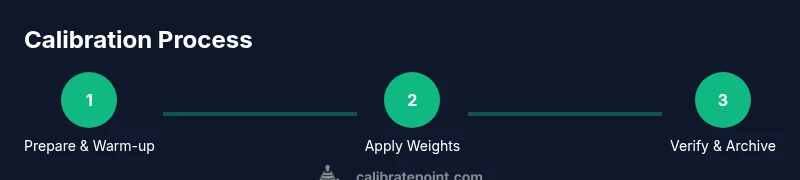
- 1
Prepare workspace and inspect the scale
Set the scale on a level, vibration-free surface. Clean any residues, ensure the display functions correctly, and verify the zero/tare control. Allow a brief warm-up if the scale was moved from a cold area to minimize temperature drift.
Tip: Place the scale away from air vents and heavy traffic to reduce drafts. - 2
Select a suitable calibration weight set
Choose weights that cover the scale’s operating range in appropriate increments. Use weights with valid calibration certificates and clean, dry surfaces. Verify the certificate details before use and record them for traceability.
Tip: Document the certificate number and date; this helps audits and future verifications. - 3
Zero the scale and record baseline
Tare the scale to zero with no mass on the pan. Confirm the reading shows zero and log baseline conditions (temperature, humidity). Take at least two baseline readings to confirm stability.
Tip: If zero drifts, re-zero and investigate potential vibration sources. - 4
Apply weights in ascending order and measure
Place each weight on the pan and allow the reading to settle (10–30 seconds). Record the indicated mass for each weight and note any anomalies. Use consistent placement to avoid skew from off-center loading.
Tip: Avoid touching the weights with bare hands to prevent oils from transferring. - 5
Compute adjustments and update calibration
Calculate the required offset (and gain if available) using the observed values. Apply adjustments per device instructions and re-check the same set of weights to confirm changes take effect.
Tip: Make small, incremental adjustments and re-test after each change. - 6
Verify with additional weights and finalize
Test additional points across the range to verify linearity and stability. If results are within tolerance, finalize the calibration and archive the data.
Tip: Keep a formal calibration record for future audits.
Questions & Answers
Why is traceability important in calibrating a scale with weights?
Traceability links weight standards to national or international references, ensuring calibration results are credible and auditable. It provides a documented trail from the weights to a recognized standard.
Traceability links your weights to recognized standards so your calibration is credible and auditable.
How often should I recalibrate my scale with weights?
Frequency depends on usage, environment, and requirements. For ongoing accuracy, many shops calibrate quarterly or after moves or repairs.
Calibrate on a regular schedule, such as quarterly, and after moving the scale or major repairs.
Can I use kitchen or household weights for calibration?
Kitchen weights are not appropriate for calibration. Use certified calibration weights with traceable certificates to ensure accuracy.
Household weights aren’t suitable; use certified calibration weights.
What should I do if readings drift after calibration?
Double-check the setup, environment, and zeroing. Recalibrate using the proper procedure and verify with multiple weights to confirm stability.
If readings drift, re-check setup and re-calibrate with the proper procedure.
Is calibration necessary for every measurement session?
Not every session, but for critical measurements or when high accuracy is required, perform a quick check or full calibration before starting.
Only calibrate when accuracy matters or after changes to the setup.
What is a pass/fail criterion for calibration?
Define acceptable tolerance ranges before testing and compare readings to those limits. If all tests fall within tolerance, your calibration passes.
Set tolerance ranges and ensure readings stay within those limits.
Watch Video
Key Takeaways
- Use traceable weights for accuracy.
- Log readings to support auditability.
- Verify across the operating range.
- Document results and set a recalibration cadence.