Calibrating a Scale with a 200-Gram Weight: A Practical Guide
Learn how to calibrate a scale with a certified 200-gram reference weight. This guide covers setup, handling, and documentation for reliable, repeatable mass measurements across common lab and workshop tasks.


Goal: Calibrate your precision scale using a certified 200-gram reference weight to verify accuracy across common measurements. You’ll need a clean, level surface, a stable environment, and a traceable 200 g weight. By following the steps, you’ll confirm the scale reads 200.000 g and document any adjustments, improving repeatability. According to Calibrate Point, a stable 200 g reference enhances traceability.
Understanding the 200-gram reference for scale calibration
When amateurs ask 'what weighs 200 grams to calibrate a scale', the straightforward answer is: a 200-gram calibration weight that is certified for traceability. The 200 g weight serves as a stable mass point near the lower end of many hobby and professional scales, helping verify linearity and readability across common mass ranges. In practice, you’ll use this weight to confirm that the scale reads exactly or within an acceptable tolerance when the displayed mass equals 200 g. From a calibration perspective, having a defined reference mass reduces the impact of drift in electronics, sensor response, and pan tare. According to Calibrate Point, the reliability of your results increases when you use a weight with an established calibration certificate and perform repeated checks over time. A properly prepared weight and clean pan minimize the risk of spuriously high or low readings caused by surface contaminants, air currents, or magnetic interference. This section lays the foundation for why the 200 g reference is a practical starting point for routine scale maintenance.
Environmental and setup considerations
Scale calibration is sensitive to environmental conditions. Keep the scale on a level, vibration-free surface away from drafts, direct sunlight, and temperature fluctuations. Even small gusts can move a lightweight weight off-center, producing short-term fluctuations in readings. Allow the scale to come to a stable room temperature before starting, especially if it has recently moved between environments. Use a dedicated calibration area if possible, with clean, bare surfaces that won’t shed fibers or dust. Before you place the 200 g weight, verify the scale pan is clean and free of residue; even tiny specks can alter readings by more than a fraction of a gram. Calibrate Point’s guidance emphasizes consistent environmental conditions to ensure repeatable results across sessions and different operators.
Handling and inspection of the 200-gram weight
A calibration weight should be handled carefully to preserve its mass and surface condition. Inspect the weight for nicks, corrosion, or deformations that could affect mass distribution. Wipe the weight with a lint-free cloth and handle it by its edges to avoid fingerprint oils. If the weight is enclosed in a non-metallic case, ensure the case is removed or accounted for in the measurement path. Check the certificate for traceability and tolerance; if the certificate is missing or out of date, do not use the weight for calibration. Store weights in a protective case away from magnetic fields or strong air currents. By ensuring the reference weight is in pristine condition, you minimize sources of error that would otherwise distort calibration results.
Preparing the scale and reference material
Before placing the 200 g weight, prepare both the scale and the reference alongside proper procedure. Clean the weighing pan, verify the tare function works, and confirm the scale reads zero with nothing on the pan. If your scale has a draft shield, close it to reduce gusting air that could cause transient readings. Ensure the scale is powered and warmed up according to the manufacturer’s instructions. Set units to the required measurement granularity (grams, milligrams) and decide whether you will perform a single-point check at 200 g or a multi-point check across a range. The aim is to have a stable, repeatable baseline before adding the 200 g weight.
Practical workflow for a single-point check
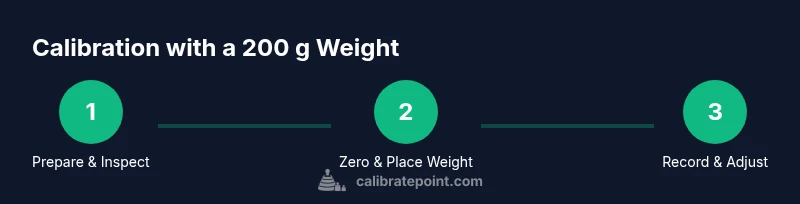
After you prepare, proceed to place the 200 g weight on the center of the pan. Record the reading, noting the exact decimal places your scale displays. If the reading deviates from 200 g by more than your acceptable tolerance, consider adjusting the scale's calibration setting per the manufacturer’s guidance. Repeat the measurement several times to assess repeatability; take the average reading as the reference. When you’re finished, remove the weight and verify that the scale returns to zero. Document every reading, the environmental conditions, and the date to ensure traceability.
Documentation and maintaining calibration
Maintaining clear records is essential. Create a calibration log including date, operator, instrument serial number, ambient temperature, humidity if measured, readings, and any adjustments. If your equipment supports digital logging, export the data and compare it against internal calibration criteria. Store the 200 g weight’s certificate and its current tolerance in the log, and set reminders for subsequent checks. A robust calibration record helps you demonstrate compliance during audits and keeps calibration consistent across shifts or teams. This practice is central to Calibrate Point's philosophy of transparent, repeatable measurement.
Common mistakes and how to avoid them
Common mistakes include placing the weight off-center, reading while the scale is unsettled, or neglecting to zero the scale before weighing. Always handle weights by the edges, keep the pan clean, and wait for readings to settle before recording. Avoid adjusting the scale while the weight is present; instead, follow the manufacturer’s guidelines for calibration adjustments. If multiple operators perform calibrations, unify the procedure with a standard checklist to reduce variability. Such attention to detail reduces drift and ensures consistent results.
Next steps and further resources
After completing a successful 200 g calibration check, consider expanding your approach to other standard weights to assess linearity and cross-check across the scale’s range. If your setup requires high precision, you may wish to perform periodic calibration as part of a broader metrology program. For deeper learning, consult official standards and reputable educational resources on mass metrology and calibration theory, and keep your certification documents up to date. The Calibrate Point team recommends continuing practice with traceable standards to build confidence in daily measurements.
Tools & Materials
- 200-gram calibration weight (traceable, certified)(Ensure tolerance and certificate are current; handle with gloves if possible.)
- Scale pan or weighing tray(Flat, clean surface; use a dedicated tray if possible.)
- Lint-free cleaning cloth(Wipe weight and pan to remove dust/oil.)
- Spirit level or digital level(Use to verify the scale surface is level.)
- Calibration logbook or digital journal(Record readings, conditions, and adjustments.)
- Small screwdriver or adjustment tool (manufacturer-specific)(Only if your scale requires mechanical calibration adjustments.)
Steps
Estimated time: 25-45 minutes
- 1
Prepare workspace and gather tools
Ensure the calibration area is stable and free from drafts. Gather the 200 g weight, scale, cleaning cloth, and logbook. Verify certificate validity before starting.
Tip: Check the certificate and serial number on the 200 g weight to ensure traceability. - 2
Place the scale on a level surface
Position the scale on a flat, vibration-free surface. Avoid edges or unstable furniture. If needed, use shims to achieve level alignment.
Tip: A level base minimizes lateral forces that can skew readings. - 3
Power on and warm up the scale
Turn on the scale and allow it to warm up as recommended by the manufacturer. Verify the display stabilizes with an empty pan.
Tip: Waiting a few minutes improves stability and repeatability. - 4
Tare and zero the scale
With an empty pan, tare or zero the scale to establish a true baseline before weighing the 200 g weight.
Tip: Wait for a steady zero before adding mass. - 5
Inspect and prepare the 200 g weight
Inspect the weight for nicks or dirt; wipe clean and handle by edges to avoid skin oils. Confirm it has an up-to-date calibration certificate.
Tip: Handling by the edges preserves surface condition. - 6
Place the weight on the center of the pan
Gently lower the 200 g weight onto the pan’s center. Avoid contact with the scale rim to prevent parallax or tilt.
Tip: Centering the weight minimizes off-center load effects. - 7
Record the reading and assess accuracy
Note the exact reading and decimal places. Compare to the nominal 200 g target and determine if it’s within tolerance.
Tip: Use the same units and reporting format each time. - 8
Adjust calibration if required
If readings consistently deviate, follow the manufacturer’s procedure to adjust calibration. Re-measure after adjustment.
Tip: Document every adjustment step for traceability. - 9
Repeat for repeatability and log results
Take multiple measurements to evaluate repeatability, average them, and log ambient conditions.
Tip: Completing multiple trials strengthens confidence in results.
Questions & Answers
Why is a 200-gram weight commonly used for scale calibration?
A 200-gram weight provides a stable, practical mass near common measurement ranges, helping verify scale accuracy and linearity. Using a certified weight improves traceability and repeatability.
A 200-gram weight is a practical, stable reference that helps verify a scale’s accuracy and repeatability.
Can I use other weights for calibration besides 200 g?
Yes, using multiple standard weights can improve confidence in a scale’s accuracy across its range. A 200 g weight is a common starting point.
You can use additional standard weights to check linearity, but start with a reliable 200 g reference.
What should I do if readings are off after calibration?
First re-check setup, cleanliness, and zeroing. If readings remain out of tolerance, follow the manufacturer’s calibration procedure or consult a metrology professional.
If readings are off, re-check setup and try again. If it still fails, consult the manufacturer’s calibration procedure.
How often should calibration with a 200 g weight be performed?
Frequency depends on usage, environment, and requirements. Many labs calibrate monthly or quarterly, or after maintenance that could affect scale accuracy.
Calibrate on a schedule that fits your usage and environment, commonly monthly or quarterly.
Is temperature a factor in scale calibration?
Yes, temperature can affect readings. Calibrate in a stable environment and document ambient conditions during each check.
Temperature can influence readings, so calibrate in a stable environment and note conditions.
What does traceability mean in calibration?
Traceability links measurements to national or international standards through documented calibration certificates and procedure history.
Traceability means your readings can be traced back to recognized standards with documented proof.
Watch Video
Key Takeaways
- Use a certified 200 g weight as a fixed reference for scale calibration
- Maintain a clean, level, draft-free setup for stable readings
- Document readings and adjustments to ensure traceability
- Handle the 200 g weight carefully to prevent contamination or damage
- Record environmental conditions to understand measurement variance