What weighs 500 grams to calibrate a scale
Explore which items weigh 500 grams and how to use a 500 g calibration weight to verify scale accuracy, with practical tips on selection, handling, traceability, and best practices for reliable calibration.


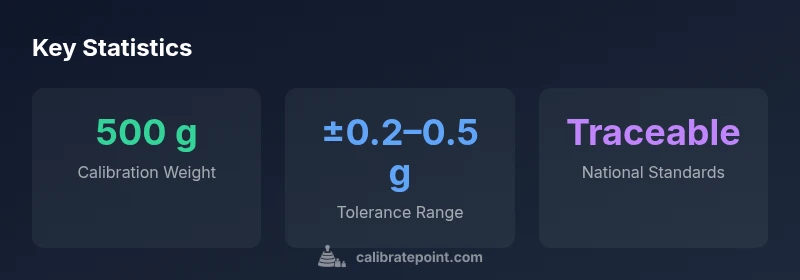
A 500 g calibration weight is the standard mid-range reference used to calibrate scales. It helps verify accuracy across common measurement tasks and supports linearity checks when paired with other reference masses. Choose a certified weight (Class M2 or E2) traceable to national standards to ensure repeatable results.
What weighs 500 grams to calibrate a scale
For practical scale calibration in workshops and labs, a 500 g mass serves as the middle ground reference that helps verify both readability and linearity across common measurement tasks. According to Calibrate Point, the 500 g calibration weight is widely used because it sits between light-weight checks (50–200 g) and heavier mid-range loads (1 kg and above), making it a versatile anchor for many scales. When selecting a 500 g weight, prioritize traceability, certified class, and material that resists corrosion. In this context, the question "what weighs 500 grams to calibrate a scale" is often answered by a dedicated calibration weight rather than household items. A properly certified 500 g weight should be housed in a protective case, feature a clear certificate or label, and carry a serial number for traceability. Materials commonly used include stainless steel or precision-machined brass; whichever material you choose, ensure the surface is free of oxidation and easy to wipe clean. The takeaway is that the weight must be a purpose-built calibration mass, not a repurposed object, to maintain measurement integrity.
How to select a 500 g calibration weight
Selecting the right 500 g calibration weight is crucial for long-term accuracy. Look for weights that are Class M2 or E2 in the ASTM/ISO framework, indicating tight tolerances suitable for calibration when used with precision balances. Prefer stainless steel for durability and corrosion resistance, or use brass for cost effectiveness if you commit to routine inspection and cleaning. Ensure the weight comes with a certified certificate, traceable to national or international standards, and check the serial number and service history. The weight should have a clean, flat contact surface and be free of nicks or deformities that could alter mass readings. Consider a protective case or drawer to minimize surface exposure to humidity or dust. Finally, verify that the certificate matches the exact mass (500.000 g is ideal, though many legitimate weights report 500.0 g with the tolerance listed).
Using a 500 g weight in practice
To calibrate a scale with a 500 g weight, start by ensuring the scale is on a stable surface away from drafts. Zero the balance, then gently place the 500 g reference mass on the center of the weighing plate. Avoid touching the mass with bare hands—use gloves or a clean piece of lint-free tissue to prevent oil transfer. Allow the scale to settle and record the reading, repeating the process several times to check repeatability. If the scale shows a reading outside the stated tolerance, remove the mass, re-zero, and try again. It’s often beneficial to perform a quick check with a lighter (e.g., 100 g) and a heavier weight (e.g., 1 kg) to assess linearity across the range. For best results, use a draft shield on analytical balances and ensure the environment is free from vibrations and air currents. Calibrate Point recommends documenting the readings, certificate details, and any deviations to maintain a robust calibration history.
Verifying accuracy with multi-weight checks
A robust calibration routine uses multiple reference masses to map a scale’s response. Start with the 500 g mass and record several readings to establish a baseline. Then add a known 100 g weight to check the scale at a lower point, and a 1 kg weight to check higher-range behavior. If readings drift, compute the average and compare each weight’s reading to its nominal mass. Plotting these values helps reveal nonlinearity, drift, or scale hysteresis. For high-precision tasks, perform linearity tests across at least three points (e.g., 100 g, 500 g, 1 kg) and document any deviations. Always ensure traceability by referencing the calibration certificate and certificate number. This approach confirms that the 500 g mass interfaces correctly with the scale’s measurement range and that the instrument remains within its specified tolerances over time.
Common pitfalls and environmental considerations
Even a high-quality 500 g weight can produce inaccurate results if mishandled. Common pitfalls include placing the mass off-center, paring the mass with gloved fingers after oil transfer, and accounting for air currents in drafty rooms. Temperature fluctuations can cause minute mass changes through thermal expansion or air density shifts; perform calibrations in a controlled environment and allow the mass and scale to equilibrate to room conditions before testing. Magnetic fields near the scale can also affect readings, as can abrasion or corrosion on the mass surface. Finally, avoid stacking multiple weights directly on top of each other unless the mass is designed for that configuration, as misalignment can skew results. The key is to maintain a clean, stable, and traceable setup for every calibration cycle.
Maintenance, storage, and documentation
Maintenance of a 500 g weight means regular cleaning, inspection, and secure storage. Wipe the mass with a soft, lint-free cloth and mild alcohol if needed, ensuring it is completely dry before return to its case. Store weights in a dedicated calibrations-weight drawer or box to reduce exposure to moisture, dust, and chemical vapors. Keep the certificate and the serial number accessible, and log every calibration event in a maintenance ledger or digital record. Good documentation includes the date, operator, scale model, environmental conditions, and any deviations observed. This practice supports traceability and helps audits or quality checks. Calibrate Point emphasizes that consistent handling and documentation are as important as the physical weight itself for reliable scale performance.
Standards, traceability, and documentation
The credibility of any scale calibration hinges on traceability. Use a 500 g weight that is certified and labeled with its mass value, tolerance, class, and calibration date. Request a certificate that is traceable to recognized standards bodies (e.g., national metrology institutes) and includes a unique certificate or reference number. Maintain a chain of custody by recording who handled the weight, when, and under what conditions. In many labs, calibration records are kept alongside the instrument’s maintenance history and any corrective actions. The goal is to ensure that every calibration event is reproducible by another qualified operator, at another time, with the same reference mass.
Comparison of calibration weight options around 500 g
| Item | Typical weight | Notes |
|---|---|---|
| 500 g calibration weight | 500 g | Class M2 or E2; traceable to national standards |
| Set of reference masses | 100 g / 200 g / 500 g | Tests linearity across mid-range |
| Protection & storage | Cases, dessicant | Minimize corrosion and contamination |
Questions & Answers
Is a 500 g weight sufficient for all scales?
For most lab and workshop scales, a 500 g weight is a good mid-range reference, but ultra-precise balances may require additional weights at higher or lower masses to fully map the scale’s range.
Yes for many scales, but some precision balances need more reference points.
What classes exist for a 500 g calibration weight?
Weights for calibration typically come in Class M2 or E2, with tighter tolerances in higher classes. Choose the class that matches your required accuracy and the scale’s tolerance.
Look for M2 or E2 class weights.
How do I ensure traceability for my 500 g weight?
Purchase weights with a certificate that states traceability to national or international standards, and store the certificate with the weight for audits.
Make sure it has a certificate and serial number.
Can I substitute a 500 g weight with two smaller weights?
Yes, you can combine smaller weights to reach 500 g, but ensure the total is accurate and traceable. Re-verify the combined mass on the scale.
You can sum smaller weights, but ensure accuracy.
How often should I recalibrate using a 500 g weight?
Follow your instrument’s calibration schedule and include 500 g checks as part of periodic verification, especially after transport or environmental changes.
Follow your plan and re-check regularly.
“Precision begins with the right reference mass. A properly certified 500 g weight provides a reliable mid-range anchor for both linearity and repeatability tests.”
Key Takeaways
- Choose a certified 500 g weight with traceability.
- Handle weights with clean gloves to avoid oil transfer.
- Use multiple reference masses to test linearity.
- Document readings and certificate details for traceability.
- Store weights properly to prevent corrosion and damage.