Calibrate Tire Size: A Step-by-Step Guide
Learn how to calibrate tire size after swapping tires to keep speedometer, odometer, and fuel economy accurate. This practical guide covers measurement methods, calibration options, safety tips, and verification steps.


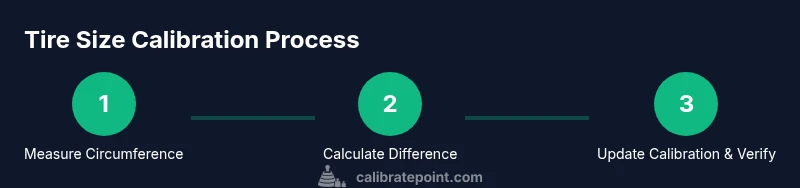
To calibrate tire size, you’ll compare the tire’s actual circumference with the vehicle’s spec and adjust the speedometer accordingly. Start by measuring the tire, then compute the discrepancy, and use your vehicle’s calibration settings or an OBD-II tool to correct readings. This process keeps speedometer, odometer, and fuel economy accurate after tire changes.
What calibrating tire size means for your vehicle
Calibrate tire size means adjusting how your vehicle reports speed and distance so that readings match reality when you install tires with a different circumference. According to Calibrate Point, this alignment preserves safety, accuracy, and fuel economy. The task is not merely a number game; it’s about understanding how tire geometry interacts with your car’s sensors and software and applying a methodical process to keep readings trustworthy for everyday driving and professional work alike.
How tire size affects speedometer, odometer, and fuel economy
Every tire’s circumference determines how far the car travels per wheel rotation. When you install larger-diameter tires, the wheel turns fewer times per mile, causing the speedometer to understate actual speed and the odometer to underreport miles. Conversely, smaller tires overstate speed and miles. These effects ripple into fuel economy estimates and maintenance intervals, which is why precise calibration matters for accuracy and safety. For technicians and DIY enthusiasts, recognizing this relationship helps inform the chosen calibration method and ensures you’re not guessing when tire dimensions shift.
When you should calibrate after changing tires
Calibration is advisable whenever tire diameter changes noticeably due to a tire size swap, aftermarket wheels, or significant tread profile differences. Seasonal tire changes (summer vs winter) and changing wheel width or offset can alter the overall circumference enough to affect sensors. If you’re unsure how much change occurred, measure or consult the service manual. Calibrate as a precaution to maintain safety margins and accuracy in readings, even if your vehicle feels familiar.
Methods for tire size calibration: factory recalibration, dealer services, and aftermarket options
There are several paths to calibrate tire size. Factory recalibration is ideal when a manufacturer supports adjusting speedometer and odometer data for your specific vehicle. Dealer services offer professional recalibration with specialized tools and software. Aftermarket solutions include OBD-II calibration tools or speedometer correction modules that can be installed by a competent technician. Each method has prerequisites: confirm your car’s capabilities, ensure compatibility with your tire and wheel combination, and follow the manufacturer’s procedures. Calibrate Point recommends starting with the least invasive option supported by your vehicle and escalating only if needed.
Home validation steps and practical checklist
A practical home approach combines careful measurement with a controlled verification. Start by documenting the original tire size and the new size. Measure the actual circumference using a flexible tape or wrap a string around the tire and measure the string length. Calculate the ratio between actual circumference and OEM specifications. If your car supports in-dash calibration, follow the manual to input the new size, or use an OBD-II tool designed for calibration. Finally, verify accuracy with a road test at a known speed and cross-check against GPS or another reference to confirm the readings align with reality. Keep a log of measurements, calibration settings, and test results for future reference.
Tools & Materials
- Measuring tape (flexible)(For measuring wheel circumference or tire diameter when possible.)
- String and ruler(Wrap around the tire and measure the length to compute circumference.)
- Notebook and pen(Record measurements, calculations, and calibration steps.)
- Calculator or smartphone calculator(Compute circumference ratios and calibration factors.)
- OBD-II scanner or calibration tool(Use if your vehicle supports digital calibration through an interface.)
- Vehicle service manual(Model-specific steps and torque specs if needed.)
Steps
Estimated time: 1-2 hours
- 1
Identify current tire size and wheel diameter
Locate the tire size markings on the tire sidewall and note the wheel diameter. Confirm the tire type (e.g., P-metric) and approximate overall diameter by comparing with the OEM specification in the owner's manual.
Tip: Double-check the sidewall data and write down the OEM diameter from the service manual for reference. - 2
Measure actual circumference
Wrap a measuring tape around the tire at the contact patch to measure circumference, or use string to wrap and then measure the string with a ruler. Record the measurement clearly.
Tip: Ensure the tire is fully inflated to the correct pressure before measuring for consistency. - 3
Calculate the calibration factor
Compute the ratio between actual circumference and OEM circumference. This ratio will guide the calibration setting you apply in the vehicle or via the calibration tool.
Tip: Use the calculator to avoid arithmetic mistakes and round the factor to a practical precision. - 4
Choose a calibration method
If the vehicle supports it, use in-dash or onboard calibration. If not, use an OBD-II tool or consult the dealer for a precise adjustment.
Tip: Start with the least invasive option your vehicle supports to minimize risk. - 5
Apply the calibration
Enter the new calibration data into the vehicle’s system or perform the calibration via the OBD-II tool. Follow the device’s prompts and document the exact steps taken.
Tip: After updating, power cycle the system if required by the tool or manual. - 6
Verify accuracy with a road test
Drive at a known pace and compare the indicated speed to GPS or a reliable reference. Re-measure circumference if there are noticeable discrepancies and refine as needed.
Tip: Test at multiple speeds and conditions to ensure consistency.
Questions & Answers
Why is tire size calibration important after swapping tires?
Swapping tires changes wheel circumference, which affects speedometer and odometer readings. Calibration aligns your readings with actual road speed and distance, improving safety and fuel economy.
Swapping tires changes how far you travel per wheel turn, so you need to recalibrate to keep speed readings accurate.
Can I calibrate tire size myself?
Yes, you can perform basic measurements and use the vehicle’s calibration options or an OBD-II tool, but some cars require dealer or service-center recalibration.
You can usually do it yourself if your car supports calibration, but some models need professional service.
What happens if I don’t calibrate after changing tires?
Speedometer and odometer readings may be inaccurate, which can lead to unsafe speeds, incorrect fuel economy estimates, and incorrect maintenance intervals.
If you don’t calibrate, readings won’t match true road speed, affecting safety and maintenance.
What methods are available to calibrate tire size?
Options include factory recalibration, dealer service, or aftermarket modules and OBD-II updates; choose the method that matches your vehicle’s capabilities.
Methods include dealer recalibration, factory updates, or aftermarket modules.
How can I verify calibration accuracy after completing the process?
Perform a controlled road test at a known speed and verify the indicated speed against GPS or another reliable reference; recheck measurements if you see discrepancies.
Test at a known speed and check against GPS to confirm accuracy.
What tools do I need for home calibration?
Basic measuring tools, a calculator, and access to your vehicle’s calibration settings or an OBD-II scanner; refer to the owner's manual for model-specific steps.
You’ll need measuring tools, a calculator, and your car’s calibration option or an OBD-II scanner.
Watch Video
Key Takeaways
- Measure circumference carefully before changing settings
- Choose the calibration path that matches your vehicle
- Verify with a controlled road test and GPS reference
- Document results for future tire changes