ecobee Calibrate: A Practical Guide to Thermostat Sensor Calibration
Learn to calibrate your ecobee thermostat to improve temperature accuracy and comfort. This guide offers practical, tested steps, reference testing, and offsets (if supported) with expert tips from Calibrate Point.


Test your ecobee readings against a calibrated reference thermometer, compute any offset, and apply it in ecobee settings if supported. Recheck after adjustments to confirm alignment and consistent comfort.
Why Calibration Matters for Ecobee Thermostats
Ecobee thermostats rely on temperature readings to manage heating and cooling cycles. Sensor drift, environmental factors, and aging equipment can cause readings to diverge from true room temperature. According to Calibrate Point, small drift is common in consumer devices and can lead to comfort complaints or unnecessary HVAC operation. The Calibrate Point team found that even a fraction of a degree difference can change when the thermostat calls for heating or cooling, affecting energy efficiency and occupant comfort. In homes with multiple sensors, differences among sensors can create hot spots or cold spots, leading to uneven comfort and energy use. Calibrating helps align the thermostat with actual conditions, ensuring setpoints are effective and efficient.
Beyond comfort, calibration supports consistent performance across seasons. If your space experiences sun exposure, drafts, or heavy occupancy changes, readings may drift. Regular checks help you catch drift early, preventing long-term energy waste and uncomfortable swings in indoor temperature. The goal is to maintain a stable baseline so the ecobee can respond accurately to weather, occupancy, and solar gain.
reasoning_notes_subheadings_tmp1_to_be_removed_nulls_placeholder_with_markdown_included
tip_note_placeholder_nulls_placeholder_with_markdown_included_placeholder
Tools & Materials
- Ecobee thermostat with latest firmware(Ensure the device is connected to Wi-Fi for firmware updates and cloud features.)
- Calibrated reference thermometer(Prefer a probe-style thermometer with a known accuracy (NIST-traceable if possible).)
- Ambient room thermometer(Place at roughly thermostat height (4–6 feet off the floor).)
- Digital notepad or app for logging(Record readings and offsets for future comparisons.)
- Measuring tape or string(Useful to ensure reference thermometer is placed at the same location as the thermostat sensor.)
Steps
Estimated time: 30-60 minutes
- 1
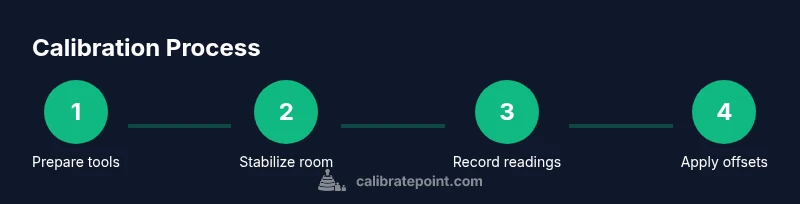
Prepare tools and environment
Gather the ecobee unit, reference thermometer, ambient thermometer, and logging method. Ensure the room is at a stable temperature for at least 15 minutes before starting. Close windows, minimize drafts, and avoid direct sunlight on the thermostat. This establishes a reliable baseline for measurements.
Tip: Verify you have all items ready and the room is not undergoing rapid temperature changes. - 2
Stabilize the room temperature
Let the space remain at a steady temperature for 15–20 minutes. A stable baseline reduces the noise in readings and makes offsets easier to interpret.
Tip: Avoid turning on heaters or AC during this stabilization window. - 3
Record Ecobee sensor readings
Note the Ecobee’s reported temperature and the time of reading. If your model has multiple sensors, record from the main unit and any relevant room sensors.
Tip: Take 3–5 readings at 1–2 minute intervals to average out short-term fluctuations. - 4
Record reference thermometer readings
Place the calibrated reference thermometer where the Ecobee sensor is located and record parallel readings. Use the same time stamps as the Ecobee measurements.
Tip: If possible, use a second reference thermometer to confirm consistency. - 5
Compute the offset
Compare Ecobee readings with reference readings. If Ecobee consistently under- or over-reads by a measurable amount, note the average offset.
Tip: Document the offset in your calibration log for future reference. - 6
Apply offset and re-test (if supported)
If your ecobee model supports a temperature offset, enter the offset value and re-test with the same procedure to confirm improvement.
Tip: If your model does not support a direct offset, adjust future setpoints by a known margin and verify through another round of measurements.
Questions & Answers
What is sensor drift and why does it matter for ecobee calibrate?
Sensor drift is the gradual deviation of a sensor's reported temperature from the true ambient temperature. It can affect comfort and energy use by causing the thermostat to over- or under-cycle heating and cooling.
Drift is when sensors lose accuracy over time, which can lead to uncomfortable temperatures and wasted energy.
Can all ecobee models offset their temperature readings?
Many ecobee models offer a way to apply a temperature offset in the settings, but capabilities vary by model and firmware. Check your device’s Advanced Settings for an Offset option.
Some ecobee models let you offset the temperature reading in the settings; check your model’s options.
How long does a calibration take?
A typical calibration check takes 30–60 minutes, including stabilization, measurement, and verification. More time may be needed for complex multi-sensor setups.
Plan on about half an hour to an hour for a thorough check.
What should I do if readings still differ after offset?
If discrepancies persist after offsets, consider additional sensor checks, consolidating sensors, or contacting support if readings remain unstable.
If the numbers still don’t match after adjustments, you may need a deeper review of sensor placement or device settings.
Is calibration safe for home use?
Calibration is generally safe when you follow manufacturer steps and use calibrated references. Avoid opening the device or applying unverified methods.
Calibration is safe if you follow the steps and use proper tools.
How often should I recheck ecobee calibration?
Recheck calibration seasonally or after major HVAC changes, sun exposure shifts, or if you notice consistent comfort or energy problems.
Check it at least once per season or after big environmental changes.
Watch Video
Key Takeaways
- Test Ecobee against a reference thermometer
- Apply offsets where supported and re-verify
- Document readings for repeatability
- Calibration is iterative, not a single adjustment
- Aim for stable indoor conditions during tests