Why is My Ecobee Calibrating? A Practical Troubleshooting Guide
Discover why your Ecobee keeps calibrating, how to diagnose root causes, and practical fixes. This Calibrate Point guide provides a safe, step-by-step approach to stop unnecessary calibrations and keep your HVAC running efficiently.


Quick fix: Ecobee calibrations usually stem from learning routines, sensor drift, or airflow changes. Start by checking sensor placement, ensuring good air circulation, and verifying that the thermostat and HVAC wiring are secure. According to Calibrate Point, recalibration is often resolved by re-centering sensors and updating firmware. If issues persist, follow the diagnostic flow below.
Understanding what calibration means for ecobee
If you're asking why is my ecobee calibrating, the answer often lies in how modern thermostats learn from your home's patterns. Ecobee, like many smart thermostats, runs calibration cycles to refine sensor accuracy and optimize comfort. These calibrations are not flaws; they are deliberate learning processes that adapt to temperature shifts, fan activity, and airflow changes. When the system detects a mismatch between setpoint and actual room temperature, it initiates a calibration sequence to improve readings. For DIY technicians, understanding the difference between a passive learning mode and an active fault condition is the first step toward a targeted fix. This guide from Calibrate Point explains practical checks you can perform, what to expect during calibration, and when to intervene manually rather than relying on automated learning.
How ecobee's learning and calibration work in real time
Ecobee uses sensor data from the main thermostat and any connected remote sensors to build a profile of typical room temperature behavior. The calibration routine compares setpoint temperatures with actual readings, adjusts for short-term fluctuations, and updates duty cycles for the furnace, heat pump, or air conditioner. The process can be more noticeable in spaces with inconsistent airflow, large windows, or after HVAC system changes. Understanding this behavior helps technicians distinguish between normal learning and a true calibration fault.
Common triggers: temperature sensor accuracy, placement, and airflow
Sensor accuracy is a primary culprit when calibrations seem to occur too often. If a sensor sits near a supply vent, behind a closed-off cabinet, or in direct sunlight, readings will drift. Remote sensors outside optimal ranges can misreport ambient temperature, prompting recalibration. Airflow issues—blocked return air vents, dirty filters, or a leaky duct—also force the system to recalibrate to keep comfort and efficiency aligned with the thermostat's setpoints.
Diagnosing the issue: start simple
Begin with the basics: verify power to the thermostat, confirm a healthy C-wire, and perform a simple restart of both the thermostat and the HVAC equipment. Check for firmware updates and ensure the Ecobee app shows all sensors online. If a sensor is offline or repeatedly reports unusual temperatures, note which sensor and its location. These initial checks often reveal whether the problem is hardware-related or a software learning cycle that needs tweaking.
Step-by-step fixes for the most common cause
- Power down the system at the breaker for a minute, then restore power to reset small glitches. 2) Re-seat all thermostat wires, especially the C-wire, and confirm secure connections at the furnace control board. 3) Relocate or shield remote sensors away from heat sources or drafts. 4) Update Ecobee firmware via the app and perform a soft reset of the thermostat. 5) Recalibrate through the Ecobee app after changes; monitor readings for a full day to verify stabilization. 6) If readings remain inconsistent, run a temperature offset adjustment in the app and compare against actual room measurements. 7) Document all changes for future reference and routine maintenance.
Deeper fixes: firmware, sensors, and wiring
If the previous steps do not resolve the issue, deeper attention is needed. Inspect the furnace or air handler for airflow restrictions, check ductwork for leaks, and verify the thermostat wiring against the installation manual. Replace a faulty remote sensor if it consistently reports outliers beyond the expected range. Consider a professional calibration service if you notice persistent drift or inconsistent comfort, especially in multi-zone systems or homes with unusual airflow patterns.
Prevention and maintenance to reduce future calibrations
Schedule seasonal maintenance on your HVAC system to keep airflow balanced and ducts clean. Keep sensor housings free from dust and ensure sensors are not blocked by furniture or curtains. Regularly update firmware, review temperature offsets in your app, and monitor for new calibration notices after system changes or major weather events. Proactive checks reduce surprises and improve long-term efficiency.
Quick reference: troubleshooting checklist you can print
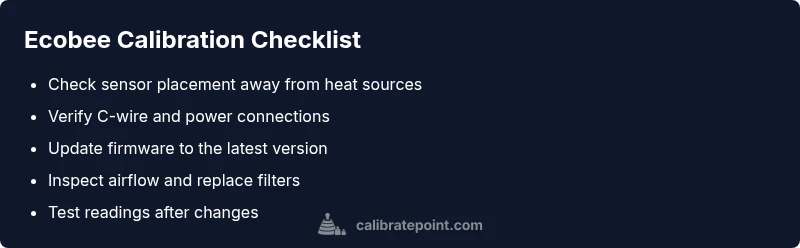
- Verify power and C-wire connections at both thermostat and furnace.
- Update to the latest Ecobee firmware.
- Inspect sensor placement and shield from direct sun/heat sources.
- Check ducts and filters for airflow restrictions.
- Recalibrate after making any sensor or HVAC adjustments.
- Seek professional help if drift persists beyond routine fixes.
When to replace or upgrade components
If calibration drift continues despite all troubleshooting, consider sensor replacement or upgrading to a newer Ecobee model with improved sensing accuracy. In older systems, wiring or control board wear can cause persistent mismatches. A professional evaluation may confirm if a component replacement is warranted for reliable long-term performance.
Steps
Estimated time: 60-90 minutes
- 1
Power cycle and verify wiring
Turn off the circuit breaker for the HVAC system for at least 60 seconds, then restore power. Check that the C-wire is properly connected at both the thermostat and furnace control board. A clean restart often clears minor glitches that trigger calibration loops.
Tip: Label wires before disconnecting to avoid miswiring later. - 2
Assess sensor placement
Ensure the Ecobee thermostat sensor is not in direct sun, behind curtains, or adjacent to a heat source. Relocate any wired remote sensors away from drafts or heat sources; verify that sensor LEDs or status indicators show online health.
Tip: Aim for central, average room conditions to improve readings. - 3
Update firmware and reboot
Check for available Ecobee firmware updates in the app or web portal. Install updates and perform a reboot of the thermostat to apply changes. After reboot, monitor temperature readings for 24–48 hours.
Tip: Keep a log of readings during the post-update period. - 4
Run a controlled recalibration
In the app, initiate a calibration cycle after you have corrected sensor placement and completed the reboot. Compare the thermostat reading against a reliable thermometer in the room for several hours.
Tip: Use a consistent reference thermometer for accuracy. - 5
Optimize airflow and filters
Check and replace HVAC air filters if dirty. Ensure returns and supply vents are open and unobstructed. Poor airflow can cause the system to recalibrate to maintain comfort thresholds.
Tip: Schedule seasonal filter changes to prevent future issues.
Diagnosis: Thermostat keeps calibrating or reports calibration ongoing for extended periods
Possible Causes
- highSensor drift or placement causing inaccurate readings
- mediumAirflow issues affecting temperature measurement
- lowFirmware glitch or outdated software
Fixes
- easyCheck sensor placement and shield from heat sources or direct sun
- easyVerify C-wire and power connections; reseat wires at thermostat and furnace
- easyUpdate Ecobee firmware and perform a soft reset
- mediumInspect ducts, clean or replace filters, and ensure balanced airflow
Questions & Answers
What causes Ecobee to calibrate frequently?
Frequent calibrations are often caused by sensor drift, improper sensor placement, or changes in airflow. Firmware glitches can also trigger calibration cycles. Start with simple sensor and airflow checks before assuming a hardware fault.
Frequent calibrations usually come from sensor drift, placement, or airflow changes. Check placement, update firmware, and test airflow first.
Should I replace sensors if calibration drifts?
If a sensor consistently reports outliers beyond the expected range or remains offline, replacement is warranted. Start with swapping the problematic remote sensor and retesting readings.
If a sensor keeps drifting or goes offline, replacement is a sensible next step after trying fixes.
Can firmware updates affect calibration behavior?
Yes, firmware updates can fix calibration logic or add better sensor management. Always install official updates and note any behavioral changes after installation.
Firmware updates can change how calibrations behave; keeping software current helps.
Is professional help necessary for thermostat calibration?
Not always, but persistent drift after all basic checks warrants a professional evaluation. A qualified HVAC technician can verify sensor health, wiring, and airflow balance safely.
If basic fixes fail, a professional can ensure safe and accurate calibration.
Does sensor placement affect energy efficiency?
Yes. Proper sensor placement improves temperature accuracy, reduces unnecessary calibration cycles, and can contribute to steadier comfort and efficiency.
Good sensor placement helps maintain comfort and efficiency.
What maintenance steps help prevent calibrations?
Regularly update firmware, clean sensors, check airflow, and replace dirty filters. Seasonal HVAC maintenance minimizes calibration triggers.
Keep firmware current, maintain airflow, and inspect sensors to prevent future calibrations.
Watch Video
Key Takeaways
- Start with simple checks before deeper fixes.
- Sensor placement and airflow are common culprits.
- Firmware updates can resolve calibration issues.
- If drift persists, seek professional help to avoid unsafe repairs.