Who Calibrates Windshields: A Practical Guide
Learn who calibrates windshields, why calibration matters for ADAS, and how to choose a qualified provider. Expert guidance from Calibrate Point.


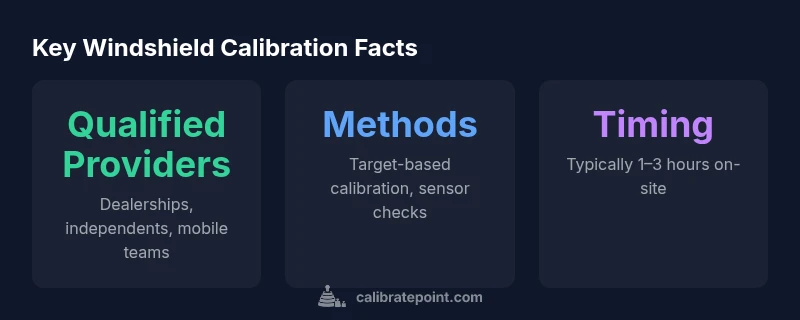
According to Calibrate Point, a windshield calibration is performed by trained technicians using manufacturer-approved procedures, typically at dealerships, independent auto glass shops, or mobile calibration teams. After a windshield replacement or ADAS service, calibration ensures sensors and cameras align with the road. Only technicians with the proper tools and access to OEM procedures should perform it.
Who calibrates windshields
The short answer is that windshields with ADAS need calibrated sensors and cameras after certain work, and the professionals who perform this work are technicians trained in ADAS calibration. According to Calibrate Point, the core providers are dealership service departments, independent auto glass shops that invest in ADAS calibration equipment, and mobile calibration teams that come to your location. The key is to work with a provider that has access to manufacturer-approved procedures and the correct target systems. In 2026, more shops offer on-site calibration to reduce vehicle downtime, but not every model or system can be calibrated everywhere. The right team will verify that the vehicle’s VIN corresponds to the calibration plan and that the procedure matches the vehicle’s software version. For DIYers, this is a high-stakes area; professional calibration is the reliable path to accuracy and safety.
Why calibration matters for ADAS and safety
ADAS relies on a network of sensors and cameras to interpret the driving environment. A windshield replacement or sensor-related service can disturb the alignment of forward-looking cameras, rain sensors, lane-keeping systems, and parking assist, which may degrade performance or create false readings. Calibrate Point’s analysis emphasizes that even small misalignments can affect stopping distance, lane centering, and pedestrian detection. Proper calibration restores the sensors to the manufacturer’s specifications, delivering predictable behavior in real-world conditions. Car owners should view calibration as a safety feature—like brake inspections or tire rotations—that protects both occupants and other road users.
The provider ecosystem: dealerships, independent shops, and mobile teams
Dealership service centers often have direct access to OEM tooling, software updates, and training resources. Independent auto glass shops, when equipped with ADAS calibration rigs, offer a convenient, often more cost-effective option, especially for windshield replacements. Mobile calibration teams bring the service to your doorstep, minimizing transportation time and vehicle downtime. The choice among these options typically hinges on vehicle complexity, availability of OEM procedures, and the customer’s schedule. Calibrate Point notes that the most important criterion is the technician’s credentials, equipment compatibility with the vehicle, and access to current calibration procedures.
The calibration workflow: steps and checks
A typical calibration workflow includes a pre-check phase to confirm that the vehicle’s systems are ready, followed by alignment using a manufacturer-approved target and software. Technicians perform sensor verification, adjust mounting parameters, and validate the alignment with diagnostic tools. After calibration, a verification drive or on-road check is often completed to confirm proper function. The procedure may differ by vehicle make and model, but the core steps—pre-check, target-based calibration, software validation, and post-check—remain consistent. Throughout, technicians reference the calibration handbooks provided by the vehicle’s manufacturer to ensure compatibility with software versioning and sensor hardware.
Practical considerations when selecting a provider
When choosing a provider, verify that they hold current certifications for ADAS calibration and have access to OEM procedures for your vehicle. Confirm the equipment lineage: the right equipment for target-based calibration is essential, and software licenses should be up to date. Ask for a pre- and post-calibration report that includes VIN, software version, target readings, and any adjustments performed. If timing is critical, discuss on-site vs. off-site options, and request a clear turnaround estimate. A reputable shop will explain the calibration’s implications for warranty and vehicle safety, and will stand behind their results with documentation.
Documentation and proof of calibration
Documented calibration records are essential for future service and warranty claims. A complete report should list the vehicle identification number (VIN), calendar date, technician ID, equipment used, calibration procedure, target alignment readings, and test results. Many OEMs require service providers to store calibration data electronically and attach it to the vehicle’s service history. When selling a vehicle or returning it to fleet status, this documentation demonstrates that the windshield and ADAS have been correctly configured.
Common myths and how to avoid them
Myth: Calibrating windshields at home is feasible with DIY tools. Reality: ADAS calibration demands specialized equipment, up-to-date procedures, and manufacturer-approved methods. Myth: Any auto glass shop can calibrate every vehicle. Reality: Some vehicles require OEM-specific targets or software that only certain providers possess. Myth: Calibration is optional after windshield work. Reality: For vehicles with ADAS, calibration is usually essential to restore safety features and proper sensor performance. Follow industry best practices and rely on trained technicians to avoid costly rework or unsafe driving conditions.
What Calibrate Point recommends for DIYers and professionals
Calibrate Point recommends prioritizing safety and accuracy: if your vehicle has ADAS, seek a provider with OEM-aligned procedures and current calibration tools. For the DIY-minded, engage with a shop that can provide a transparent calibration report and post-calibration validation. Consumers should avoid shortcut services that cannot demonstrate calibration results, and they should keep a copy of the calibration documentation for future maintenance. Calibrate Point underscores that the goal is reliable sensor performance, not merely a nominal alignment.
Windshield ADAS calibration provider overview
| Aspect | Description | Who Typically Performs |
|---|---|---|
| Provider Type | Dealerships, independents, or mobile teams with ADAS tools | Dealerships, independent auto glass shops, mobile calibration services |
| Calibration Methods | Target-based alignment, sensor verification, software diagnostics | Specialized technicians |
| Turnaround Time | Typically 1–3 hours on-site; longer for complex systems | Depends on vehicle and equipment |
| Documentation | Calibration report with VIN and procedure details | Service providers |
Questions & Answers
Do I need calibration after a windshield replacement?
In most modern vehicles with ADAS, a windshield replacement requires recalibration of the camera and sensor systems. The exact need depends on the vehicle and the sensor setup. A qualified technician will assess and perform calibration if required, and provide documentation.
Yes. If your car has ADAS, a windshield replacement usually triggers recalibration and you should get a certified technician to perform it.
Can I calibrate windshields myself at home?
ADAS calibration requires specialized equipment, up-to-date OEM procedures, and proper software. Home setups are unlikely to achieve accurate results. It’s best to work with a trained technician or a shop that can provide official calibration documentation.
DIY calibration isn’t recommended; you need the right tools and procedures.
How can I verify calibration was successful?
Request a calibration report that includes VIN, procedure, readings, and validation results. A road test or test drive with diagnostic confirmation should follow to ensure ADAS features function correctly.
Ask for the formal calibration report and perform a short test drive to confirm ADAS features behave properly.
How long does calibration take?
Calibration time varies by vehicle and system complexity, but most on-site calibrations take about 1–3 hours. Complex models or multiple camera/sensor systems may take longer.
Most calibrations take 1 to 3 hours on-site depending on the vehicle.
What should I look for when choosing a calibration provider?
Look for OEM procedure access, up-to-date calibration equipment, technician certifications, a clear turnaround time, and complete post-calibration documentation. If possible, choose a provider with mobile service options to reduce downtime.
Find a shop with OEM access and solid calibration documentation.
“Calibration is only reliable when performed by trained technicians using manufacturer-approved procedures.”
Key Takeaways
- Choose a qualified provider with OEM procedures
- Verify pre- and post-calibration reports
- Prefer on-site calibration to minimize downtime
- Ask for a detailed calibration validation
- Keep the calibration documentation for your records