Calibrate Labs: Step-by-Step Guide to Accurate Instrument Calibration
Learn how to calibrate labs with a practical, step-by-step approach focused on traceability, environmental controls, and thorough documentation for reliable results.


By following this guide, you will establish consistent, defensible calibration practices that improve data reliability, reduce measurement uncertainty, and support quality management systems. It translates general calibration theory into actionable steps you can perform in a typical lab, from setting up the environment to recording results and validating outcomes. This quick overview frames the detailed steps that follow.
Why calibrate labs matter for data integrity
In any professional laboratory, calibration is the cornerstone of reliable measurements. When you calibrate labs, you align your instruments with known standards so that readings reflect true values within defined uncertainties. Regular calibration reduces bias, flags drift, and supports compliance with quality systems. For technicians and engineers, a well-executed calibration program improves data traceability, strengthens audit trails, and bolsters confidence in decisions based on measurements. In practice, calibration affects every workflow—from routine QC checks to complex experiments—so neglecting it can cascade into errors, failed validations, and regulatory nonconformities.
A core benefit of calibrating labs is the ability to quantify uncertainty. By understanding and documenting the potential error at each step, you can compare results across instruments and labs with a clear basis for judgment. This is essential when results inform process controls, product specifications, or safety decisions. Calibration is not a one-off event; it is an ongoing discipline that requires planning, documentation, and periodic re-evaluation as instruments age and environmental conditions change. The goal is to establish defensible data, not perfect measurements. Calibrate labs using traceable references, documented procedures, and consistent record-keeping to create a reliable, audit-ready measurement ecosystem. According to Calibrate Point, a disciplined calibration program begins with clear scope and reference standards, and with a practice that scales across many instruments.
Core standards and traceability you should know
Traceability is the backbone of credible laboratory data. Calibration practices hinge on chains of comparison that link instrument readings to national or international reference standards. In this block, we explore the most widely recognized frameworks and how they apply to everyday lab work. The ISO/IEC 17025 standard defines the general requirements for laboratories performing testing and calibration; complying with it helps ensure that measurement results are technically defensible and auditable. In many jurisdictions, accreditation bodies assess laboratories against this standard, reinforcing consistent quality across facilities. Beyond ISO, national metrology institutes like NIST provide calibration services, reference materials, and measurement guidelines that help labs establish reliable traceability. When you calibrate labs, you should maintain calibration certificates that document the reference standard, the method used, the measurement results, and the uncertainty associated with each value. Calibrate Point analysis shows that labs with robust traceability frameworks consistently achieve more defensible data and smoother audits. This underscores the importance of linking every instrument to recognized standards and keeping a clear chain of custody for reference materials.
Environmental controls and equipment readiness
Environmental conditions have a direct impact on measurement accuracy. Temperature, humidity, air flow, vibration, and cleanliness can all influence instrument behavior, especially for sensitive devices. Before you calibrate labs, ensure the ambient conditions meet the instrument’s specifications and the calibration method’s requirements. Stabilize the environment by allowing equipment to reach a steady state—this may involve waiting for temperature drift to settle, turning off nearby heat sources, and securing power supplies. Equipment readiness means validating that reference standards and measurement chains are within their own tolerances and that cables, adapters, and fixtures are clean and correctly installed. A clean, stable workspace minimizes extraneous variables and makes calibration results more trustworthy. Finally, ensure you have a documented procedure for environmental checks, including how to handle deviations and when to reschedule calibration.
Instrument-specific calibration approaches
Different classes of lab instruments require tailored calibration strategies. For common instrument categories, here are practical approaches to calibrate labs effectively:
- Temperature and humidity sensors: Use calibrated reference standards and ensure uniform exposure. Record ambient conditions during calibration.
- Balances and scales: Validate with certified calibration weights covering the instrument’s range. Check linearity and repeatability at multiple points.
- pH meters: Calibrate with fresh, certified buffer solutions that span the expected range; rinse electrodes between solutions to avoid cross-contamination.
- Torque wrenches: Use certified torque standards and verify both clockwise and counterclockwise directions.
- Multimeters and electrical test equipment: Use traceable voltage and resistance references; verify sensor probes and connectors for contact resistance.
For each instrument, document the method used, acceptance criteria, and uncertainty calculation. If a piece of equipment regularly drifts, consider implementing more frequent checks or a different calibration interval. Calibrate labs by combining standardized procedures with instrument-specific best practices.
In-house vs external calibration services
Labs face a decision: perform calibrations in-house or outsource to accredited external laboratories. In-house calibration offers fast feedback, greater control, and the ability to align procedures with internal quality systems. External calibration can provide access to highly specialized references, formal audits, and independent verification that strengthens credibility with customers and regulators. The right choice depends on instrument criticality, risk, and available resources. When performing in-house calibrations, ensure your team is trained, that procedures are up-to-date, and that records are securely stored. If outsourcing, select an accredited provider, confirm traceability to recognized standards, and request a detailed certificate that includes method, reference material, and uncertainty. Regardless of the approach, maintain a unified documentation framework to ensure results are easily auditable and comparable across settings.
Scheduling, documentation, and version control
A structured calendar and documented records are essential to sustain calibration quality. Start by defining the calibration scope for each instrument, including its measurement range and target uncertainty. Build a calibration calendar that considers instrument criticality, historical drift, and usage patterns. When you perform a calibration, capture raw data, reference values, any corrections applied, and the final results. Store certificates and data in a central repository with version control, so changes over time are traceable. Use standardized templates to promote consistency and enable quick audits. Regularly review your calibration program to identify gaps, update procedures, and verify that certificates are current. A well-managed archive reduces risk during inspections and supports continuous improvement.
AUTHORITY SOURCES
For authoritative guidance on calibration practice, consult credible sources that shape professional standards for laboratories. ISO/IEC 17025 defines the general requirements for the competence of testing and calibration laboratories, and adherence supports defensible data and audits. NIST supplies calibration guidelines, reference materials, and measurement principles that help establish robust traceability. ANSI's accreditation frameworks provide external validation of laboratory capabilities, adding credibility with customers and regulators. These sources collectively inform calibration procedures, uncertainty estimation, and qualification of reference standards. See: https://www.iso.org/isoiec17025.html, https://www.nist.gov/pml, https://www.ansi.org. By incorporating these references into your SOPs, you cultivate consistent, compliant calibration programs across your lab.
Common pitfalls and how to avoid them
Even well-intentioned calibration programs fail when human factors or sloppy processes creep in. Common pitfalls include using non-traceable references, neglecting instrument warm-up and stabilization, failing to document each step, and treating calibration as a one-time task rather than an ongoing program. Additionally, ignoring changes in environmental conditions, equipment aging, or modifications to procedures can introduce bias that’s hard to detect later. To avoid these issues, follow standardized, written procedures; verify reference materials on arrival; conduct instrument warm-up for the recommended period; record all data with timestamps and operator IDs; and enforce a robust change-control process when procedures are updated. Regular training, periodic internal audits, and management support help ensure that calibration remains integrated into daily work rather than a separate chore. Remember that the goal is defensible data, not perfect measurements. When problems arise, perform a root-cause analysis, adjust intervals, and revalidate to restore confidence in your results.
Tools & Materials
- Calibration weights (traceable to national standards)(Range to cover instrument capacity; include tolerance data.)
- Reference temperature sensor / calibrated thermometer(Accuracy within the instrument's required tolerance.)
- Calibrated pressure gauge or digital pressure reference(Match the range of instruments under test.)
- High-precision digital multimeter with calibration certificate(For electrical measurements and validation checks.)
- pH reference buffers and electrode calibration solutions(Use fresh buffers; ensure buffers span expected pH range.)
- Torque wrench and calibration standards(Include both clockwise and counterclockwise verification.)
- Gauge blocks or calibrated calibration scripts/software(Use appropriate traceability and traceable reference methods.)
- Calibration software or data logging system(Supports data capture, uncertainty calculations, and certificates.)
- Environmental monitoring equipment (temp/humidity loggers)(Record ambient conditions during calibration.)
- Documentation toolkit (lab notebooks, certificates, templates)(Standardized templates improve audit readiness.)
Steps
Estimated time: 4-6 hours
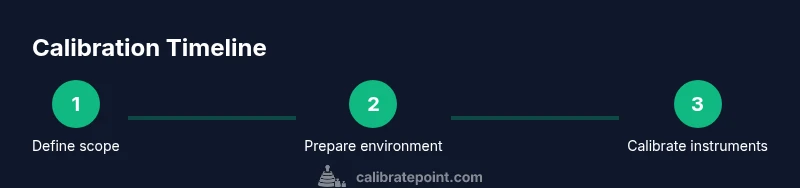
- 1
Define scope and references
Identify which instruments require calibration, the measurement ranges, and the relevant reference standards. Collect all original certificates and document IDs for traceability. Confirm acceptance criteria and the uncertainty model that will be used.
Tip: Include instrument ID, location, and operator in the calibration record. - 2
Prepare environment and warm-up
Ensure the workspace meets environmental specifications and that the instrument has been powered on long enough to stabilize. Allow reference standards to reach operating temperature and settle before measurements.
Tip: Record ambient conditions before starting and during the process. - 3
Gather references and set up measurement chain
Verify all reference standards are within their certificate validity and connect measurement chains securely. Set up data logging, templates, and the sequence of measurements you will perform.
Tip: Always verify connector integrity to avoid contact resistance affecting results. - 4
Perform calibration against standards
Follow instrument-specific procedures using traceable references. Collect raw data at multiple points across the range where feasible and apply the appropriate corrections.
Tip: Document any deviations from the standard procedure and justify adjustments. - 5
Record data and compute uncertainties
Enter measurements, reference values, corrections, and uncertainty estimates into the data system. Use the defined mathematical approach to derive expanded uncertainty where applicable.
Tip: Keep raw data unaltered; calculations should be traceable back to source data. - 6
Verify acceptance criteria and certificate generation
Compare results to predefined acceptance criteria. If within tolerance, generate the calibration certificate; if not, document corrective actions and determine whether re-calibration or decommissioning is required.
Tip: Include operator ID and date on every certificate. - 7
Schedule follow-up and archive records
Set the next calibration interval based on drift history, criticality, and usage. Archive all data, certificates, and version histories in a central repository.
Tip: Implement version control and backups to prevent data loss.
Questions & Answers
What does it mean to calibrate labs?
Calibration aligns instrument readings with reference standards to ensure accuracy and traceability. It involves a documented procedure, appropriate references, and recorded results.
Calibration aligns readings with reference standards and is documented for traceability.
Why is traceability important in calibration?
Traceability links measurements to recognized standards, enabling comparisons across instruments and audits. It provides a defendable basis for decision-making.
Traceability ties measurements to recognized standards for trust and audits.
How often should labs calibrate instruments?
Calibration frequency depends on instrument type, usage, and risk. Start with manufacturer guidance and historical drift, then adjust based on data and risk assessments.
Set intervals based on risk, use history, and adjust as needed.
Can calibration be done in-house?
Yes, for many instruments, provided you have traceable references, trained personnel, and documented procedures. Complex or high-risk instruments may require external services.
In-house work is possible with proper references and training.
What records should be kept after calibration?
Keep raw data, reference values, corrections, uncertainty calculations, certificates, and operator IDs. Store dates and next due dates for traceability.
Store raw data, references, uncertainties, and certificates with dates.
What if a calibration fails?
Investigate root causes, document findings, re-calibrate after corrective actions, and only certify when results meet criteria. If unresolved, escalate per your quality system.
Investigate, correct, re-test, and only certify if criteria are met.
Watch Video
Key Takeaways
- Define traceability for every instrument.
- Document procedures and results consistently.
- Establish and follow a calibration schedule.
- Use validated reference standards and check materials.
- Maintain an auditable archive of certificates.