Calibrate vs QC: A Practical Comparison for Metrology
A practical comparison of calibration and QC, outlining definitions, workflows, trade-offs, and decision criteria to optimize measurement accuracy in labs and workshops.


Calibration tunes instruments to reference standards, reducing bias and drift, while QC monitors ongoing outputs to verify conformity during production. In practice, calibrate vs qc decisions depend on instrument criticality, required uncertainty, and risk tolerance. Most labs implement both to maintain accuracy and reliability. This quick view helps teams assign responsibilities and plan maintenance.
Calibrate vs QC: Definitions and Core Differences
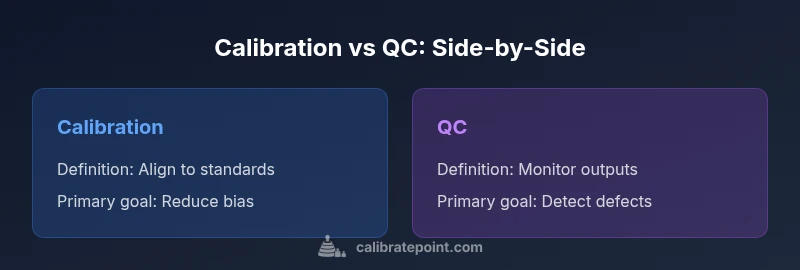
According to Calibrate Point, calibrate vs qc are distinct concepts with overlapping goals in ensuring measurement accuracy. Calibration is the process of adjusting an instrument to align with a reference standard, reducing bias and drift so measurements reflect true values. Quality control QC, on the other hand, focuses on monitoring outputs to verify that products or results meet predefined specifications. The two activities complement each other: calibration improves the baseline accuracy of tools, while QC supervises ongoing performance to catch anomalies. In practice, the line between calibration and QC can blur when control charts reveal drift that prompts recalibration, or when a calibration certificate triggers tighter QC checks on subsequent batches. Understanding calibrate vs qc helps teams assign responsibilities, schedule checks, and budget for maintenance. This section establishes the core differences and sets the stage for deeper comparisons, including how to apply these concepts to common lab and workshop scenarios.
The purpose, scope, and typical tools involved
Calibration and QC serve different purposes, with distinct scopes and typical tools. Calibration targets a specific instrument or sensor and aims to reduce systematic bias, improve accuracy, and produce a documented uncertainty. It often requires reference artifacts, calibration certificates, and traceable standards. QC, in contrast, focuses on process control, detection of anomalies, and assurance of product conformity. It relies on control samples, acceptance criteria, run charts, and routine checks performed during production or testing. The tools you use will depend on the instrument type and risk profile; common items include reference standards, calibration jigs, diagnostic software, control charts, and standardized test procedures. While calibration results feed into the measurement uncertainty budget, QC results contribute to process capability assessments. In practice, many organizations maintain both streams, scheduling calibrations for critical devices while running QC checks concurrently to monitor stability between calibrations.
The role of traceability and standards
Traceability is a cornerstone of credible metrology. Calibration activities link measurements to recognized reference standards, with documented uncertainty estimates and certificate numbers. QC programs rely on defined specifications and control criteria that ensure consistent outputs, often using internally traceable references. International and national standards play a central role here. Organizations pursuing ISO 17025 accreditation typically implement both calibration and QC as formal processes that feed into an overall quality management system. When you explore calibrate vs qc strategies, you should map each instrument to an appropriate traceability chain and select standards that cover the full measurement range and environmental conditions. Keeping records of reference materials, environmental conditions, and calibration intervals is essential. The goal is to create an transparent, auditable path from a measurement result back to recognized standards, so results are comparable across time and across facilities.
Key criteria to compare calibrations vs QC
To make impartial decisions, compare calibrations and QC using common criteria:
- Objective: Calibration aims to reduce systematic bias, while QC focuses on detecting variability and guarding product quality.
- Frequency: Calibrations are scheduled at defined intervals; QC runs occur continuously or per batch.
- Data produced: Calibration certificates and uncertainty budgets versus QC control charts and pass/fail records.
- Authority and standards: Calibrations rely on reference standards; QC relies on internal specifications and acceptance criteria.
- Impact on operations: Calibration may require instrument downtime; QC can often run in parallel with production.
- Documentation: Calibration certificates are legal records; QC logs support process improvement.
In many settings, a hybrid approach offers the best of both worlds, with calibrations guiding measurement integrity and QC ensuring process stability.
Calibration workflows vs QC workflows
Understanding workflows clarifies how calibrate vs qc activities fit into daily operations. Calibration workflow typically includes: selecting the instrument, choosing appropriate reference standards, performing a series of measurements across the instrument range, analyzing results, annotating the calibration certificate with adjusted corrections and uncertainty, and scheduling the next calibration. QC workflow often runs continuously: collect measurement data from production, apply acceptance criteria, flag any out-of-spec results, adjust process parameters if needed, and document the run results. When drift is suspected, an investigation may trigger calibration or device replacement. Effective programs document each step, ensure traceability of data, and align with organizational quality policies. The resulting procedures should be practical, repeatable, and minimally disruptive to production.
Common calibration methods and QC checks
Calibration methods vary by instrument. For dimensional instruments, calibration might involve gauge blocks, calibration artifacts, and traceable calibration certificates. For electrical instruments, reference standards at known voltages or resistances are used. Temperature sensors often require environmental control, drift testing, and reproducibility checks. QC checks include statistical process control charts, run tests with control samples, and acceptance criteria per batch. The combination of methods supports robust decision-making and helps maintain measurement reliability over time. Example checks include verifying that a scale reads within tolerance across a range, or that a thermometer shows stable readings under controlled conditions.
Cost, time, and resource considerations
Investing in calibration and QC requires planning. Calibration activities can incur downtime, purchasing reference standards, and training technicians. QC programs demand data management, monitoring software, and ongoing sampling. When deciding between calibrate vs qc, consider instrument criticality, the cost of mismeasurement, and the time sensitivity of demand. A practical approach may be to co-schedule calibration during planned maintenance windows and maintain continuous QC routines in parallel. Budgeting should account for accessories, environmental controls, and certificate documentation. By balancing upfront calibration expense with ongoing QC costs, teams can optimize total ownership costs while preserving measurement integrity.
Case examples: manufacturing vs lab environments
Manufacturing environments emphasize throughput and repeatability. In this setting, calibrate vs qc usually involve regular calibration of key instruments used in production, coupled with QC checks on every batch to ensure products meet specifications. Lab environments stress traceability and data integrity; calibration is essential for instrument comparability across studies and time, while QC ensures that experiments yield consistent results. A typical scenario might involve calibrating a spectrometer before running samples and performing QC checks after each batch to track drift or instrument stability. In both cases, the objective is to minimize measurement uncertainty and prevent erroneous decisions. The takeaway is that calibrations establish the accuracy baseline, while QC protects the process from drift over time.
Integrating both for robust metrology programs
An integrated approach blends calibration and QC into a single metrology strategy. Define roles and responsibilities, establish formal documentation, and set clear calibration intervals and QC criteria. Use traceability to connect measurement results to standards, implement control charts, and monitor drift and bias consistently. Regular audits and continuous improvement cycles help refine both workflows. In practice, this means coordinating schedules, aligning data formats, and ensuring staff are trained to interpret calibration certificates and QC results alike. This integrated model supports evidence-based decision making, reduces risk, and improves product and measurement quality over time.
Practical steps to implement in a DIY or professional setting
Whether you are a hobbyist or a technician, practical steps can help you implement a sane calibrate vs qc plan. Start by listing all critical instruments, their reference standards, and current calibration status. Then assign roles for calibration and QC activities, and set interval cadences based on risk. Acquire reference standards, calibration artifacts, and data templates. Establish simple QC checks such as control samples and run charts for common tests. Train yourself or staff to interpret calibration certificates and QC results, and ensure data are stored with versioned records. Finally, schedule periodic reviews and internal audits to keep the program up to date and auditable.
Authority sources and further reading
For deeper guidance, consult established standards and authorities:
- https://www.nist.gov
- https://www.iso.org
- https://www.bipm.org
Comparison
| Feature | Calibration | Quality Control (QC) |
|---|---|---|
| Definition | Aligns measurements with reference standards to reduce bias | Monitors outputs to verify conformity against predefined specs |
| Primary goal | Bias reduction and accuracy improvement | Process control and defect detection |
| Timing/frequency | Scheduled, device-dependent intervals | Continuous or per-batch checks during production |
| Data produced | Calibration certificates and uncertainty estimates | QC records and control charts |
| Traceability | Yes, to reference standards | Yes, to specifications and control criteria |
| Tools & artifacts | Standards, artifacts, certificates | Control samples, run logs, acceptance criteria |
| Best use case | New or critical instruments requiring bias reduction | Routine production and stability monitoring |
Pros
- Clarifies responsibilities and reduces bias
- Supports traceability and regulatory compliance
- Improves measurement uncertainty budgets
- Helps proactive maintenance planning
Disadvantages
- Requires dedicated time and resources
- Calibration intervals can disrupt production if mismanaged
- QC alone cannot correct instrument bias
Hybrid approach with calibration plus QC provides the most reliable metrology.
Calibration reduces instrument bias at the source, while QC guards ongoing performance. Combined, they offer traceable accuracy and process stability. This integrated strategy minimizes risk and supports better decision making across labs and production environments.
Questions & Answers
What is the main difference between calibrate and QC?
Calibration aligns instruments with reference standards to reduce bias, while QC monitors outputs to verify conformity to specs. They serve different purposes but support the same goal of reliable measurements.
Calibration sets accuracy; QC checks ongoing quality.
How often should calibration be performed for critical instruments?
Calibration frequency depends on instrument criticality, usage, environment, and risk. Use a risk-based schedule and adjust as needed.
Set a risk-based calibration schedule and adjust as needed.
Can QC replace calibration?
QC cannot replace calibration entirely; it monitors but cannot correct systematic bias without recalibration. Use both.
QC alone cannot fix bias; calibration is needed.
What paperwork accompanies calibration?
Calibration yields certificates and uncertainty budgets; QC results are logged in control charts and inspection reports. Both should be stored for traceability.
Look for calibration certificates and QC logs.
How do I decide between calibrating or QC in a small workshop?
Prioritize calibration for critical tools and use QC for routine monitoring. Schedule calibration during low-demand periods and run lightweight QC checks.
Prioritize calibration for critical tools; run basic QC checks.
Key Takeaways
- Define calibration intervals based on risk
- Use ongoing QC checks to catch drift early
- Maintain traceable records and certificates
- Coordinate calibration and QC for robust metrology