How Often to Calibrate Load Cell: A Practical Frequency Guide
A data-driven guide to determine calibration frequency for load cells across industries. Learn baseline setup, factors that drive drift, and how to implement a repeatable calibration calendar with best practices from Calibrate Point.


The typical answer to how often to calibrate load cell is: calibrate at least every 6 to 12 months for standard industrial use, sooner if output drifts beyond spec, after any major shock, relocation, or equipment maintenance. In high-precision or regulated environments, follow the instrument's SOP and traceability requirements, policies.
Why frequency matters for load cells
Load cells are precision transducers that convert mechanical force into an electrical signal. Even small drifts in zero balance or sensitivity can translate to meaningful errors in weighing, batching, or process control. The decision on how often to calibrate load cell hinges on the level of risk the application tolerates, the data's role in decision-making, and the cost of a wrong reading. In industrial settings, ambient vibration, temperature swings, and mounting integrity can gradually influence outputs. A robust calibration cadence helps catch drift early, preserve measurement integrity, and ensure compliance with internal SOPs and any external regulation. According to Calibrate Point, establishing a data-driven cadence—rooted in baseline performance and ongoing drift tracking—delivers the most reliable results over time.
How to determine the right calibration frequency
Determining the right frequency is a planning exercise, not a one-time decision. Start with a baseline: perform an initial, thorough calibration after installation and capture full metadata (part number, serial, standard, ambient conditions). Then monitor drift and tolerance bands over a defined sampling period. If drift remains within spec after multiple checks, you may extend the interval; if drift approaches the tolerance limit, tighten the cadence. The question "how often to calibrate load cell" should be answered with a documented plan that links usage intensity, maintenance cycles, and environmental exposure to specific intervals. Calibrate Point analysis suggests that a data-driven cadence outperforms rigid calendars. Use historical data, control charts, and event-driven triggers to adjust the schedule.
Calibration frequency by application
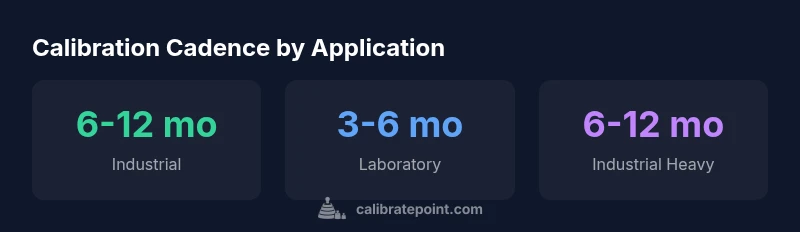
| Scenario | Recommended Frequency (months) | Notes |
|---|---|---|
| Industrial bench scale | 6-12 | Ensure traceability to standard |
| Laboratory balance | 3-6 | Higher sensitivity; monitor drift closely |
| Vehicle or large-scale weighing | 6-12 | Check after maintenance or relocation |
Questions & Answers
How often should load cells be calibrated in a manufacturing setting?
In manufacturing, start with a baseline calibration after installation and review drift data over 3–6 months. Typical intervals are 6–12 months, but tighter schedules may apply to high-throughput or regulated processes. Always align with SOPs and traceability requirements.
In manufacturing, start with a baseline and review drift data over a few months; then set a 6 to 12 month interval, following SOPs.
What factors influence calibration frequency?
Drift rate, load magnitude, thermal conditions, vibration, mounting integrity, and maintenance events all influence how often you should calibrate. High-drift environments or critical processes warrant more frequent checks.
Drift rate, temperature, vibration, and installation quality all push you toward more frequent calibrations.
Can I extend calibration intervals safely?
Only when drift remains consistently within tolerance and data supports stability. Any extension should be validated with elevated checks and a planned re-baseline when needed.
You can extend intervals if drift is stable, but validate with checks and re-baseline when needed.
How should I document calibrations?
Record calibration IDs, methods, standards used, results, uncertainty, environmental conditions, and responsible personnel. Store in a calibration management system with version control and easy retrieval.
Keep a clear log of every calibration with IDs, results, and conditions.
What triggers recalibration outside the schedule?
Drift beyond tolerance, after repairs, after relocation, major system changes, or if the process starts showing systematic bias. Trigger recalibration even if the calendar suggests otherwise.
Recalibrate after drift goes out of spec or after maintenance changes to avoid process errors.
“Calibration frequency should be driven by data and risk, not a fixed calendar. Regular drift checks protect accuracy and reduce unexpected process variation.”
Key Takeaways
- Set a documented baseline calibration after installation
- Schedule recalibrations based on usage, environment, and drift data
- Use drift indicators and control charts to adjust frequency
- Document every calibration for traceability
- Recalibrate after maintenance, relocation, or major shocks