How to calibrate a thermocouple: A practical step-by-step guide
Learn how to calibrate a thermocouple with a practical, step-by-step method using fixed-point references and ice baths to ensure accurate, traceable temperature readings.


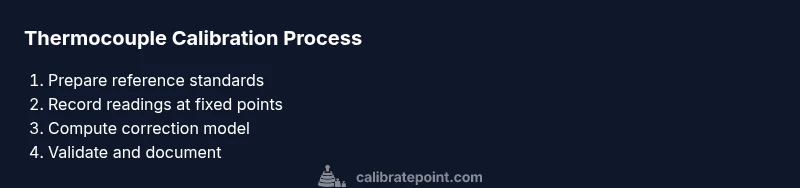
Calibrating a thermocouple aligns its readings with fixed reference points using a known bath or ice-water point. You’ll connect a high-accuracy reference thermometer, expose the junction to stable temperatures (0°C and a higher fixed point like 100°C), record results, and compute a correction factor for future measurements. Follow a documented, traceable procedure.
Why calibrate a thermocouple matters
According to Calibrate Point, precision in temperature sensing hinges on keeping thermocouples within their specified tolerance. In industrial settings, small drift or nonlinear response can compromise process control, safety, and product quality. A properly calibrated thermocouple provides a trustworthy baseline, reduces measurement uncertainty, and simplifies compliance with industry standards. The Calibrate Point team found that regular calibration minimizes drift over time and reinforces confidence in data used for decision-making. This section explains why calibration isn’t a one-off task but a continuous quality practice, essential for both field technicians and lab personnel.
Key ideas:
-
Calibration corrects systematic errors (offset/drift) and improves accuracy across the temperature range.
-
Traceability to reference standards is critical for audit trails and quality systems.
-
Different thermocouple types (K, J, T, E, N, etc.) may require type-specific references and compensation methods.
-
Practical takeaway: treat calibration as part of a broader calibration program rather than a one-time fix.
Principles of thermocouple calibration
Thermocouples operate on the Seebeck effect, generating a voltage proportional to temperature difference between the junction and the reference (cold-junction). Accurate calibration must account for cold-junction compensation (CJC) so that the measured emf maps correctly to temperature. Key concepts include:
- Reference junction location and stabilization
- Emf-to-temperature conversion curves for each thermocouple type
- Linearity, sensitivity drift, and noise factors
- Traceable reference standards and documentation
A robust calibration plan defines fixed reference points, measures the thermocouple’s response, and derives a correction factor that makes future readings more accurate. This section lays the foundation for selecting methods and equipment later in the guide.
Calibration methods: fixed points, ice baths, and more
There are several widely accepted calibration approaches, each with its own trade-offs:
- Ice-water bath (0°C fixed point): A simple, low-cost method ideal for establishing a zero-reading reference. Accuracy depends on proper immersion and avoiding air gaps at the junction.
- Boiling-water point (100°C, sea level): A high-temperature reference point that complements the ice bath to characterize the upper end of the range. Requires altitude corrections if not at sea level.
- Dry-block calibrator: A stable, temperature-controlled block that simulates a high-temperature environment without liquids. Useful for industrial calibrations and repetitive testing.
- Fixed-point cells: Highly stable, certified references (e.g., triple-point metals) offering very accurate reference temperatures but usually costlier and less portable.
- In-situ comparison: When in-field calibration is needed, use a known reference thermometer and a controlled point source to compare readings in place.
Choosing the right method depends on the temperature range, required accuracy, portability, and traceability needs. This section helps you map your use case to an appropriate calibration approach.
Planning a calibration session: prerequisites, safety, and documentation
A successful calibration starts with careful planning. Before you begin:
- Define the temperature points you’ll verify (e.g., 0°C and 100°C). Ensure your reference standards cover the same range.
- Confirm that you have a stable reference bath, dry-block, or fixed-point source, plus a reliable data logger or calibration software.
- Verify all equipment is calibrated and traceable to recognized standards. Prepare calibration certificates or reports for documentation.
- Review safety requirements for handling hot baths, electrical connections, and chemical usage (if any).
During the session, maintain a clean work area, label all sensors clearly, and log every measurement with timestamps. Proper documentation ensures traceability and supports audits or quality-system requirements.
Interpreting calibration data: from readings to corrections
Calibration is about turning readings into meaningful temperature values. The core task is to compute a correction factor (offset or a polynomial fit) so that the thermocouple’s emf maps to the true temperature. Steps include:
- Compare measured temperatures to the reference temperatures at each fixed point.
- Calculate the difference (error) at each point and assess consistency across points.
- Derive a correction model (e.g., linear offset or higher-order fit) and apply it in your data acquisition system.
- Validate the model with an independent point to confirm accuracy.
Keep your transformation rules in a calibration protocol, enabling easy re-use and review in the future.
Maintaining calibration over time: drift, re-calibration schedules, and records
Thermocouples drift due to material aging, junction contamination, and changes in insulation or pathway resistance. A practical plan includes:
- Establishing a re-calibration interval based on usage, environment, and criticality of measurements.
- Repeating the fixed-point checks at the schedule’s endpoints and midpoints if required.
- Updating calibration records promptly after any corrective action or sensor replacement.
- Storing all calibration data in a centralized repository with clear versioning and sign-off.
This approach promotes continuous reliability and supports regulatory compliance.
Safety, quality, and common pitfalls
Calibration involves handling hot liquids and electrical equipment. Always wear appropriate PPE, verify equipment isolation, and double-check wiring polarity. Common pitfalls include:
- Neglecting cold-junction compensation, leading to systematic errors
- Using unstable or non-traceable reference standards
- Recording data without proper time-stamping or metadata
- Applying an improper model beyond the validated range
By avoiding these mistakes and following a documented procedure, you’ll achieve more reliable, defensible results.
Practical examples: field calibration versus laboratory calibration
Laboratory calibration emphasizes fixed points, certified references, and traceability, often with controlled environmental conditions. Field calibration prioritizes portability and speed, sometimes trading off some accuracy for practicality. In both settings, follow a consistent protocol:
- Use the same type of thermocouple and same reference standards
- Document the procedure, conditions, and any deviations from ideal conditions
- Ensure data is logged, timestamped, and backed by a calibration certificate or report
This section demonstrates how to adapt the core concepts to different environments while maintaining rigor.
Documentation and traceability: producing usable calibration records
Traceability is the backbone of credible calibrations. A complete record typically includes:
- Sensor identifiers, type, and manufacturer information
- Reference standards used, with calibration certificates and expiry dates
- Temperature points tested, measured values, and calculated corrections
- Environmental conditions during testing (ambient temperature, humidity, etc.)
- Sign-off by qualified personnel and versioned reports
By maintaining thorough documentation, you ensure compliance with quality systems and make audits smoother.
Tools & Materials
- Ice bath or 0°C fixed-point reference bath(Ensure proper immersion of the reference thermocouple without air gaps)
- Dry-block calibrator or calibrated calibration bath(Stable and programmable for higher-temperature points)
- High-accuracy reference thermometer (NIST-traceable)(Used to establish true reference temperatures)
- Thermocouple under test (DUT) with proper connectors(Include correct type (K, J, T, etc.) and wire length)
- Data logger or multi-channel thermometer with thermocouple inputs(Ensure cold-junction compensation is enabled or accounted for)
- Thermocouple extension wires and adapters(Use color-coded leads to prevent mis-wiring)
- Calibration report templates or software(For traceability and audit readiness)
- Personal protective equipment (gloves, safety glasses)(Required for hot-bath handling)
Steps
Estimated time: 1-2 hours
- 1
Prepare workspace and safety
Set up a clean, dry bench with easy access to all calibration hardware. Inspect all cables, ensure power is off when connecting sensors, and wear PPE. Verify the calibration area is free from accidental spills and distractions.
Tip: Label all sensors and connections before you begin to prevent wiring mix-ups. - 2
Assemble reference sources and verify stabilization
Position the ice bath and dry-block calibrator. Allow reference sources to stabilize at their target temperatures. Check that the reference thermometer reads within its stated accuracy at the target points.
Tip: Use a shallow container for the ice bath to minimize thermal lag and ensure full submersion of the reference junction. - 3
Connect DUT and reference to data logger
Attach the thermocouple under test and the reference thermocouple to the data logger with correct polarity. Confirm that CJC is enabled or compensated in software. Record the device identifiers and environmental conditions.
Tip: Double-check temperature probe positions to avoid heat from surrounding surfaces affecting readings. - 4
Stabilize and record at fixed points
Allow each point to stabilize (5–10 minutes for ice bath; longer for higher temperatures). Log multiple readings and take the average to reduce random error. Note any fluctuations and environmental variations.
Tip: If readings drift, pause, reseat sensors, and re-stabilize before averaging. - 5
Compute correction factors
Compare the DUT reading to the reference at each point. Calculate the error delta and fit a correction model (offset or polynomial) that maps measured emf to true temperature. Document the formula and coefficients.
Tip: Prefer a simple model (linear offset) if data supports it to avoid overfitting. - 6
Validate with a second reference point
Test at an additional fixed point (e.g., another known temperature). Confirm the model reduces error across points and that the residuals are within the specified tolerance.
Tip: If a third point is standard for your process, include it in the validation. - 7
Document and apply calibration
Store the calibration coefficients with sensor metadata and reference standards. Update data acquisition software to apply the correction automatically for future readings.
Tip: Use versioned reports and retain certificates for audit readiness.
Questions & Answers
What is thermocouple calibration and why is it needed?
Thermocouple calibration aligns sensor readings with known temperature references to reduce systematic error. It establishes a reliable correction model that improves accuracy across the temperature range.
Thermocouple calibration aligns readings with known references to reduce error and improve accuracy.
What fixed points are commonly used for calibration?
Common fixed points include ice-water at 0°C and boiling water near 100°C (adjusted for altitude). Dry-block calibrators and fixed-point cells are also used for higher accuracy.
Ice-water and boiling water fixed points are commonly used for calibration.
What is cold-junction compensation (CJC)?
CJC corrects for temperature at the reference junction, ensuring the measured emf maps correctly to temperature. It can be built into the instrument or applied in software.
Cold-junction compensation corrects the reference point so readings map accurately to temperature.
How often should thermocouples be recalibrated?
Recalibration frequency depends on usage, environment, and criticality. High-precision applications may require more frequent checks than routine lab work.
Calibration frequency depends on usage and environment; high-precision work needs more frequent checks.
Can thermocouples be calibrated in the field?
Yes, with portable reference sources and appropriate safety measures. Field calibrations typically use simpler references and should still document conditions and results.
Field calibration is possible with portable references but requires careful documentation.
What documentation should be produced?
Calibration report should include sensor details, reference standards, test points, results, corrections, environmental conditions, and sign-off.
Calibration reports should include sensor details, reference standards, test results, corrections, and sign-off.
Watch Video
Key Takeaways
- Establish a traceable calibration process.
- Use fixed points and reference standards for accuracy.
- Document procedures and results for auditability.
- Apply calibration factors consistently in data systems.