How to Calibrate a Thermometer: Step-by-Step Guide
Learn the proven two-point method to calibrate a thermometer and ensure accurate readings for cooking, lab work, or professional tasks. This Calibrate Point guide covers ice-water and boiling-water references, tools, steps, and common pitfalls.


By following a two-point calibration using ice water and boiling water, you can establish a proven offset for most thermometers. This approach works for digital and glass models and supports accurate readings in kitchen, lab, and field settings. This guide from Calibrate Point walks you through supplies, steps, and checks to ensure reliability.
Why thermometer calibration matters
According to Calibrate Point, thermometer calibration is essential for accurate readings in any field. The Calibrate Point team found that small offsets can accumulate over time, leading to incorrect decisions in cooking, medical contexts, laboratory measurements, and industrial processes. A misread temperature can affect food safety, product quality, or patient outcomes, so calibration is not optional—it's a reliability practice. Calibration builds confidence, reduces drift, and helps you track instrument performance over its life cycle. In everyday use, a well-calibrated thermometer yields more consistent results, whether you're monitoring oven temperatures, refrigerant storage, or incubation conditions. Remember that calibration is not a one-and-done event; periodic checks catch drift from aging sensors, environmental exposure, or device wear. In this guide we focus on a practical, repeatable approach you can perform with common household or workshop tools, while still meeting the expectations of DIY enthusiasts and professional technicians. The aim is to empower you to interpret readings correctly and maintain traceability for your records.
The two-point calibration concept
A two-point calibration uses two fixed, known temperatures to define an instrument’s zero offset and slope over a useful range. For most thermometers, the ice-water point (0°C) and the boiling-water point (100°C at sea level) establish the reference endpoints. With these anchors, you can calibrate a thermometer by comparing its readings to the known values and calculating the offset at each end. The method assumes the sensor responds linearly between the two ends, which is a reasonable approximation for many instrument types. While no calibration is perfect at all temperatures, this two-point approach dramatically improves accuracy across typical operating ranges. It also provides a straightforward basis for documenting performance and for communicating results in professional settings. In practice, you’ll perform the test in sequence, note readings, and decide whether adjustments are possible or whether offset compensation is the better path. This is why two-point calibration is the recommended starting point for both home cooks and technicians who seek traceable temperature data.
Prepare reference points: ice water and boiling water
The ice-water reference at 0°C is created by mixing ice with water until a slushy bath forms, ensuring the mixture is at a steady 0°C. The boiling-water reference, typically around 100°C at sea level, provides the upper anchor. Altitude changes the boiling point, so note local conditions and adjust expectations accordingly. Before testing, allow both reference baths to come to rest and avoid vigorous stirring that can momentarily alter temperatures. Place the thermometer under test in the ice bath, then in the boiling bath, using proper safety precautions. Record readings carefully and compare them to the fixed points. This is the core of the calibration workflow that lets you quantify offset and, if supported, apply a corrective adjustment to future readings. You can calibrate a thermometer by following a disciplined, documented process that minimizes drift and improves confidence across tasks.
Safety considerations and environmental factors
Handling hot water and ice baths requires basic safety practice. Use heat-resistant gloves or tongs when transferring hot vessels, and keep hands away from steam. Work on a stable surface, away from children or pets, to prevent accidents. Temperature reference accuracy can also be affected by air currents, container material, and the depth of immersion. For example, if the thermometer is not fully submerged or is touching the container wall, readings can be biased. Record ambient temperature and ensure the test environment is reasonably stable during each measurement phase. If your location has a high-altitude or industrial context, account for environmental factors that can skew results, such as pressure differences or radiant heat from nearby equipment. Adopting a safe, methodical approach protects you and yields more reliable data.
Step-by-step calibration workflow overview
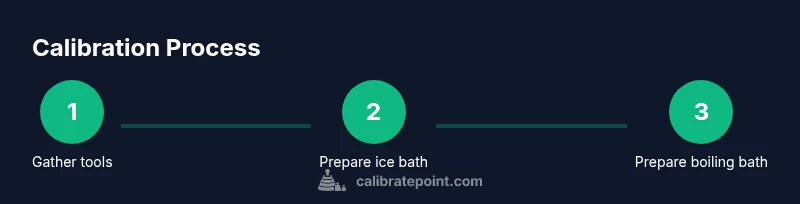
A typical two-point calibration follows a repeatable sequence: prepare the reference baths, test the thermometer at each point, compute offsets, apply adjustments if possible, and re-test to confirm. This workflow supports both field work and lab routines and is suitable for many thermometer types, including digital probes, infrared devices, and glass thermometers. Start by assembling tools, then create the ice-water bath and the boiling-water bath. Immerse the probe as specified by the manufacturer, wait for stabilization, and record readings. Use the data to determine offsets and assess whether your device supports offset calibration. If not, maintain a log and plan for regular rechecks. The overall goal is to keep readings within an acceptable tolerance range across your typical operating temperatures, ensuring decisions remain consistent and defensible. By the end, you should have a clear plan for recalibration intervals and documentation.
How to interpret offset readings and maintenance
After testing, compare each reading to its reference. The difference is the offset. A stable, small offset at both ends indicates good linear performance; a large or inconsistent offset suggests drift, a worn sensor, or environmental influence. For devices that support software or hardware offset adjustments, apply the correction and re-test to confirm. If adjustments are not possible, document the offset and apply it in your calculations going forward. Maintain a calibration log with dates, operator names, temperatures, readings, and outcomes. Regular checks help catch drift early and keep your process compliant with quality standards. Remember to clean probes between tests and allow instruments to return to ambient temperature before the next measurement cycle, to avoid carryover bias.
Digital vs glass thermometers: calibration nuances
Digital probes and infrared devices often include built-in offset correction, while glass thermometers may require manual interpretation of results. For glass thermometers, ensure the liquid column returns to baseline and that the scale is clean and legible. Digital devices may log results automatically; if your device lacks an offset feature, rely on external calculations and recalibrate on a fixed schedule. Infrared thermometers can be affected by surface emissivity and environmental heat; always follow manufacturer guidance for emissivity settings and surface selection. Regardless of type, use the same immersion depth unless the manufacturer specifies otherwise, and avoid rapid temperature changes that can introduce hysteresis. A consistent procedure across device types improves reliability and makes your data more defensible in professional contexts.
Maintaining calibration: routine checks and storage
Set a routine for calibration checks—monthly for high-use instruments, quarterly for occasional users, or per regulatory requirements. Store probes in their protective cap or case and keep them away from dust, moisture, and direct sunlight. If the device is moved between environments, re-check calibration after a relocation, especially when changing from hot to cold environments or vice versa. Maintain a simple log: date, operator, reference temperatures, readings, offsets, and any adjustments made. Over time, you’ll notice patterns that can inform instrument replacement or maintenance planning. Regular calibration alongside good storage practice prolongs instrument life and preserves measurement integrity.
Authority sources and further reading
Key references for thermometer calibration include official measurements and standards from credible institutions. For foundational concepts and best practices, see: https://www.nist.gov/pml/weights-and-measures and https://www.osha.gov (calibration and measurement safety). For educational context and extended discussions, explore university extension resources and standardization publications from major bodies. These sources help you align your procedure with recognized practices and maintain traceability in your records.
Tools & Materials
- Thermometer to calibrate(Model type (digital, infrared, glass) and purpose of calibration)
- Calibrated reference thermometer(Used to verify ice-point and boiling-point references)
- Ice(Crushed ice works best to form a stable slurry)
- Water(Tap or distilled water for the ice bath)
- Kettle or pot for boiling water(Rolling boil; take care with steam and splashes)
- Beaker or tall glass(Deep enough to immerse the probe without touching walls)
- Tongs or heat-resistant gloves(Safety when handling hot containers)
- Notebook and pen(Record readings, times, and offsets meticulously)
- Cleaning supplies (isopropyl alcohol, lint-free cloth)(Sanitize probes before and after tests)
Steps
Estimated time: 60-90 minutes
- 1
Gather and inspect equipment
Collect all items and inspect for damage or wear. Wipe probes with alcohol to remove residues that could bias readings. Verify the manufacturer’s guidance for immersion depth and safety features before starting.
Tip: Inspect probes and reference instruments for nicks or cracks; damage alters accuracy. - 2
Prepare ice-water reference bath
Fill a suitable container with crushed ice and cold water to create a slushy bath near 0°C. Stir gently and let it settle for 30–60 seconds before testing to minimize transient readings.
Tip: Stirring helps ensure a uniform temperature zone and reduces bias from localized hot spots. - 3
Prepare boiling-water reference bath
Boil water in a kettle or pot, ensuring the container remains accessible but safe. Let the water reach a rolling boil and have a separate vessel ready for immersion.
Tip: Be cautious with steam and boiling water; use tongs and heat-resistant gloves. - 4
Test at ice-point and record
Submerge the thermometer probe in the ice bath as specified by the device, and wait for stabilization. Record the reading from both the test thermometer and the reference thermometer.
Tip: Allow 30–60 seconds for stabilization; readings that settle slowly indicate immersion depth effects. - 5
Test at boiling-point and record
Immerse the probe in the boiling water bath and wait for stabilization. Compare readings with the reference thermometer and note any offset at this high end.
Tip: Keep a safe distance from steam; ensure immersion depth matches the manufacturer’s guidance. - 6
Calculate offset and adjust if possible
Compute offsets at each end. If your device supports offset calibration, enter the correction values and re-test to confirm. If not, document the offsets for future calculations.
Tip: Prefer offset adjustments when available; otherwise, maintain a clear log for post-processing. - 7
Re-test at a mid-range temperature
Test at a mid-range temperature (e.g., ~25–30°C) to verify linearity across the working range. Record the reading and compare against expectations derived from your two-point calibration.
Tip: Mid-range checks help detect nonlinearity and drift not captured by endpoints. - 8
Document, review, and schedule next check
Compile results, offsets, and any adjustments into a calibration log. Schedule the next check based on usage, environment, and regulatory demands.
Tip: Keep a separate log for each instrument; include operator name and the date.
Questions & Answers
What is thermometer calibration?
Thermometer calibration aligns readings with known reference points to correct bias and drift. It improves accuracy, enables traceability, and ensures repeatable results across measurements.
Thermometer calibration aligns readings with known references to correct bias and drift, improving accuracy and repeatability.
Do I need both ice water and boiling water references?
Using both endpoints reduces uncertainty and helps verify linear response. Ice water provides the lower bound near 0°C, while boiling water bounds the upper limit. Altitude may affect the boiling point, which should be noted.
Yes, both references help ensure accuracy and detect nonlinearity; note altitude effects on boiling temperature.
Can I calibrate an infrared thermometer this way?
Yes, infrared devices can be calibrated, but optics, emissivity, and surface conditions affect readings. Always follow manufacturer guidance and consider cross-checking with a contact thermometer.
Infrared devices can be calibrated, but watch for emissivity and surface effects; use manufacturer guidance and cross-check with a contact thermometer.
How often should calibration be performed?
Calibration frequency depends on usage, environment, and requirements. High-use environments may require monthly checks; occasional use may be quarterly or semi-annually.
Frequency depends on use; intense use means more frequent checks, while light use can be less frequent.
What if readings differ between references?
If reference readings disagree, verify immersion depth, stabilize times, and recheck. Persistent differences may indicate sensor drift or contact issues; document and consider servicing.
If readings disagree, recheck technique and stability; persistent differences may require service.
Is calibration the same for glass and digital thermometers?
The principles are the same, but adjustment methods differ. Glass thermometers rely on interpreting the liquid column, while digital devices often use software offsets.
Principles are the same, but adjustment methods vary by device type.
Watch Video
Key Takeaways
- Coordinate a two-point baseline with ice and boiling references
- Document offsets clearly for traceability
- Use built-in offset calibration when available
- Account for altitude effects on boiling temperature
- Maintain a calibration log and schedule regular checks