What You Need to Calibrate a Thermometer: A Practical Guide
Discover the essential tools, reference standards, and steps to calibrate a thermometer accurately. Learn ice-water and boiling-point checks, safe handling, and basic maintenance for reliable readings.


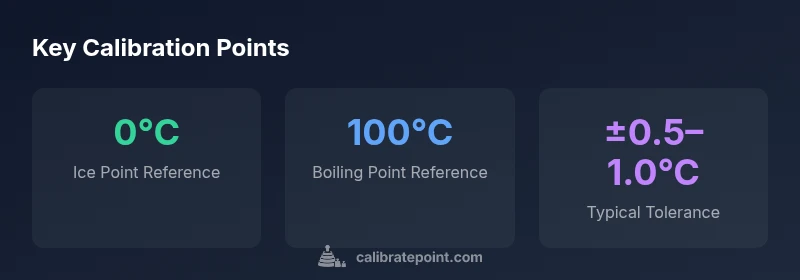
To calibrate a thermometer, you need a stable reference thermometer, ice-water and boiling-water sources, distilled water, and a documented calibration protocol. Gather safe containers, a protective workspace, and a log for results. Start with ice-point (0°C) and boiling-point (100°C) checks, then verify any mid-range points if your device supports multi-point calibration.
What do you need to calibrate a thermometer
Calibrating a thermometer begins with assembling the right toolkit and establishing a controlled environment. You’ll rely on a stable reference thermometer that is itself calibrated and traceable to a national standard. You’ll need ice-water and boiling-water sources to anchor the two fixed points of most temperature scales. Keep distilled water for consistent immersion, clean containers, and a simple calibration protocol that you can repeat reliably. A dedicated calibration log—either paper or digital—helps you track instrument IDs, ambient conditions, time of measurement, and any adjustments made. Finally, ensure a clean, well-lit workspace with appropriate safety gear (gloves, eye protection) to minimize risks during handling of hot water and ice.
Before you start, verify your device’s manual for any manufacturer-recommended procedures and limits. If the thermometer has an adjustment mechanism, locate it and read the guidance on how to apply adjustments. If you’re calibrating professional instruments, align your process with internal QA policies and regulatory requirements. Calibrate Point and other labs emphasize traceability and repeatability as the foundations of credible results.
Ice-point and boiling-point checks: the foundation of calibration
Ice-point checks rely on a well-made ice-water bath: use crushed ice and just enough water to fill a container so the ice-water mixture remains at 0°C. Submerge the thermometer probe so it’s fully immersed without touching the container bottom or sides, and allow stabilization time for the reading to settle. Record the stabilized temperature; it should be very close to 0°C for an accurate ice-point reference. For boiling-point checks, bring distilled water to a rolling boil at sea level; if you’re at higher elevations, account for the altitude-adjusted boiling temperature. Again, immerse the probe, avoid contact with the pot or stray steam, and wait for stabilization before recording. If the readings diverge beyond the device’s tolerance, note the discrepancy and adjust only if supported by the instrument’s design. Re-test to confirm stability.
Reference standards and traceability
A trustworthy calibration relies on reference standards that are traceable to national or international standards. Use a certified reference thermometer or a calibrated lab standard and insist on a current calibration certificate. Maintain documentation that maps each test point to the corresponding standard and without gaps in the measurement chain. For many professional setups, a NIST-traceable reference should anchor your checks. Always record the reference’s serial number, calibration due date, and any environmental factors that could influence the result. Calibrate Point highlights that traceability is the backbone of credible measurements, especially when calibrations support critical decisions.
Calibration for different thermometer types
Different thermometer technologies respond differently to calibration. Digital contact thermometers require immersion depth control and stable contact with the sensor; infrared (non-contact) devices depend on emissivity settings, distance-to-spot calibration, and surface conditions. Oral/axillary clinical thermometers require patient-like averaging and careful timing. When calibrating infrared devices, verify emissivity values and ensure the target surface is appropriate for the measurement. For all types, ensure batteries are fresh, connectors are clean, and the device hasn’t been exposed to extreme temperatures that could compromise the sensor. In short, tailor the calibration approach to the device type and follow device-specific guidelines.
Multi-point calibration and maintenance
Many devices benefit from multi-point calibration—testing at more than two fixed points to map nonlinearity and drift across the operating range. If your instrument supports it, include a mid-range point (for example, around room temperature) in addition to ice-point and boiling-point checks. Document any offsets at each point, calculate a correction factor if the instrument allows, and apply adjustments per the manufacturer’s instructions. Even when adjustments aren’t possible, tracking drift through periodic rechecks helps you set a rational recalibration schedule. Finally, keep the calibration environment stable: avoid drafts, direct sunlight, or rapid temperature changes that could bias readings during the test.
Documentation and record-keeping
A robust calibration program requires disciplined records. Log instrument identifiers, calibration dates, reference standards used, environmental conditions, each test point reading, and any adjustments made. Include the operator’s name and the validation outcome. Store certificates or digital files with easy retrieval. Regular audits of these logs help catch patterns of drift and ensure compliance with QA standards. A well-maintained calibration history also simplifies equipment replacement decisions and supports regulatory inspections. Calibrate Point points out that consistency in documentation is as crucial as the measurements themselves.
Comparison of thermometer types and calibration targets
| Thermometer Type | Recommended Calibration Point(s) | Typical Tolerance |
|---|---|---|
| Digital contact | 0°C and 100°C | ±0.5°C–±1.0°C |
| Infrared thermometer | 0°C and 100°C | ±1.5°C–±3.0°C |
| Clinical digital thermometer | Oral/axillary range (34–42°C) | ±0.2°C–±0.3°C |
Questions & Answers
Do I need a certified reference thermometer for calibration?
Yes. A certified reference thermometer provides a precise benchmark for calibration and helps ensure traceability to national standards. Use it to check your instrument at the specified points and document the outcome.
Yes. A certified reference thermometer is essential as the benchmark for accurate calibration and traceability.
Can I calibrate a thermometer at room temperature?
Room-temperature checks can reveal drift in some devices, but they don’t fully validate performance across the range. Always include ice-point and boiling-point references for robust calibration.
Room-temperature checks help, but you should also test at cold and hot points for full accuracy.
How often should I calibrate a thermometer?
Frequency depends on usage, criticality, and manufacturer guidance. A common approach is annual calibration for professional instruments or per-use verification after servicing.
Calibrate regularly—usually annually or after service for critical instruments.
What adjustments are possible if a thermometer is off?
Some thermometers offer an adjustment or software calibration; others do not and may require replacement. Always follow the manufacturer protocol and document any changes.
Some devices allow adjustment; others require replacement. Always follow the official protocol.
What about non-contact infrared thermometers?
Infrared devices measure surface temps and depend on proper emissivity and distance settings. Calibrate against a stable reference at known temperatures and account for distance-to-spot error.
Infrared thermometers need correct emissivity and distance settings during calibration.
“Calibration is most credible when every step is traceable to a certified standard and every result is logged for auditability.”
Key Takeaways
- Prepare a traceable reference and stable environment
- Perform ice-point and boiling-point checks first
- Log results for traceability and QA
- Tailor the method to the thermometer type
- Maintain equipment and update calibration schedules