How to Know If a Thermometer Is Calibrated
Learn how to verify thermometer calibration using ice-water and boiling-water references, understand tolerances, and follow a step-by-step workflow to recalibrate or replace as needed. A practical guide from Calibrate Point for DIYers and pros.


Knowing if a thermometer is calibrated means confirming its readings match reliable references. A quick two-reference test uses ice water (0°C) and boiling water (100°C at sea level). Compare the thermometer to these references; if it stays within the device’s tolerance, it’s calibrated. If not, recalibration or service is needed. According to Calibrate Point, regular checks protect accuracy.
Why Knowing If a Thermometer Is Calibrated Matters
Accurate temperature measurements underpin safe cooking, precise chemical work, equipment maintenance, and quality control across many trades. When a thermometer drifts, it can lead to under- or over-heating, unsafe food, misreadings in lab procedures, and poor product quality. According to Calibrate Point, reliable temperature readings start with proper calibration, and small drifts compound over time if left unchecked. The Calibrate Point team found that routine calibration checks dramatically reduce measurement errors in everyday tools, which translates to fewer wasteful runs and safer outcomes. In professional settings, traceability to reference standards is essential, and calibration data should be documented for audits and compliance. In short, calibration is not a luxury—it's a prerequisite for trustworthy measurements.
Ice-Water and Boiling-Water Checks: The Two-Reference Method
Two reference points provide a straightforward reality check for many thermometers: a frozen mixture of ice and water (ice bath) and boiling water. Using an ice bath, you expect readings near the ice-water reference, while the boiling-water check should align with the high reference at sea level. These checks are quick, repeatable, and require minimal equipment. If your device reads within its stated tolerance on both references, it’s considered calibrated for ordinary tasks. If it fails one or both checks, you should document the deviation, recalibrate if possible, or replace the instrument. Calibrate Point’s practical guidance emphasizes consistency—always verify readings under the same ambient conditions and with the same reference materials.
Testing Digital vs Analog Thermometers
Digital thermometers rely on electronic sensors that can drift with age, battery performance, or exposure to temperature cycles. Analog thermometers (mercury or alcohol) rely on a liquid column that can change with mechanical wear or glass expansion. In both cases, the two-reference test remains valid, but you may need to adjust differently. Digital devices often feature a user-calibration mode or a software offset; analog devices typically require a mechanical or built-in adjustment, or a field replacement. Regardless of type, perform the ice-water and boiling-water checks, then compare results against the instrument’s documentation. The overarching principle is consistency and traceability to a known standard, which keeps measurements trustworthy across uses.
Understanding Tolerance and Drift: What Counts as Accurate
A thermometer’s tolerance is defined by the manufacturer and depends on the device class, precision, and intended use. When you perform reference checks, you are validating that readings fall within that tolerance. If drift exceeds the stated tolerance, you should recalibrate, adjust if your model permits, or replace the instrument. Note that environmental factors—such as ambient temperature, airflow, and condensation—can influence readings during checks, so perform tests in stable conditions and after the device has acclimated. Documenting conditions helps you distinguish real drift from transient fluctuations. The key concept is that accuracy is relative to a reference and a stated tolerance, not an absolute universal number.
Practical Workflow: How Often to Check and What to Do Next
Establish a calibration routine that aligns with usage intensity, criticality of readings, and environmental stability. In kitchens, labs, or fieldwork, a monthly or quarterly check might be appropriate for some devices, while medical-grade thermometers may require more frequent checks. Start with the ice-water and boiling-water checks, logging the readings, ambient conditions, and any adjustments made. If your instrument adjusts, recheck after calibration to confirm stability. If drift remains after recalibration, consider service or replacement. The habit of recording results creates a reliable history that simplifies audits and future maintenance.
Tools and Reference Materials You’ll Need
Having the right tools on hand makes calibration straightforward and repeatable. A reference thermometer with traceability to a recognized standard is ideal. You’ll also need a clean ice-water bath and a stable boiling-water source at sea level. A calibration log or notebook helps keep a consistent record of readings and actions. Optional items include a stand or clamp to hold thermometers during tests, a timer to ensure proper immersion times, and a heat-resistant glove for handling hot water. Keeping the water volumes and immersion times consistent minimizes variability and improves comparability across tests.
Common Pitfalls and Safety Notes
Avoid testing near the boiling point if your device can’t tolerate immersion in hot solutions; use protective gear and tools. Never use damaged glass thermometers in hot water, as breakage can cause injury. Make sure the ice bath contains enough ice to maintain a stable 0°C reading, and avoid dilution of the ice by water that’s too runny. Ensure that the thermometer is stable and not touching container walls or ice surfaces, which can skew results. When documenting results, be precise about ambient conditions and the exact temperatures observed. These precautions reduce measurement noise and prevent misinterpretation of drift.
A Practical Look at Different Thermometer Types
Digital thermometers often provide fast readings and app-based logs, but their accuracy depends on the sensor and battery. Infrared thermometers measure surface temperature and can drift with lens cleanliness and distance-to-target. Traditional mercury thermometers remain highly stable but require careful handling and disposal. Regardless of type, begin with ice-water and boiling-water checks to establish a calibration baseline. If you find drift with any device type, follow the manufacturer’s recalibration steps if available, or consult a professional service.
The Verdict: Making Calibration Part of Routine Maintenance
Calibration is not a one-off task but a maintenance habit. By integrating ice-water and boiling-water checks into your regular workflow, you maintain confidence in every temperature reading. The Calibrate Point team recommends building a simple calibration log that records the device, test conditions, observed values, and any adjustments or replacements. When in doubt, seek professional calibration services to ensure traceability to recognized standards. The overarching goal is consistent, reliable temperature measurement across tools and tasks.
Conclusion: The Final Takeaway (Calibrate Point Perspective)
In practice, knowing whether a thermometer is calibrated boils down to a disciplined, repeatable procedure: reference checks, proper documentation, and timely action on deviations. Calibrate Point’s guidance emphasizes that routine verification protects accuracy, reduces waste, and supports safe decision-making. By adhering to these steps, you’ll extend the life of your instruments and keep measurements trustworthy for professional and personal projects alike.
Tools & Materials
- Reference thermometer (NIST-traceable preferred)(Use a device with documented calibration traceability)
- Ice-water bath(Container with ice and water to maintain ~0°C, stable for several minutes)
- Boiling-water bath(Kettle or pot to generate rolling boil; use caution)
- Test thermometer(The instrument you are evaluating)
- Calibration log(Notebook or digital log to record readings and actions)
- Thermometer stand or clamp(Optional to hold devices during immersion for stability)
- Heat-resistant gloves(For safe handling of hot containers)
Steps
Estimated time: 60-90 minutes
- 1
Gather tools and set up workspace
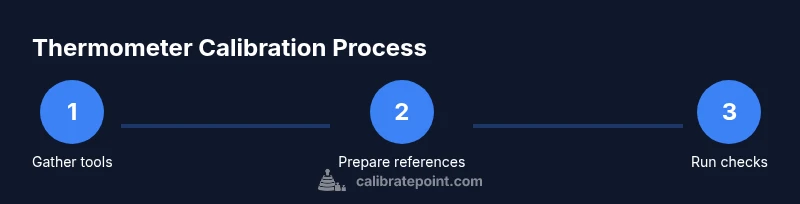
Collect the reference thermometer, your test thermometer, ice, and a kettle. Clear the area of clutter to prevent accidental spills. Prepare the calibration log and ensure adequate lighting. This step reduces surprises and sets a repeatable baseline.
Tip: Check that the ice bath fills the container without floating upward; stable immersion improves consistency. - 2
Prepare an ice-water reference
Fill a container with crushed ice and add just enough water to reach a slushy consistency. Allow the mixture to settle and stabilize for several minutes before testing. The goal is a near-0°C reference point that remains stable during immersion.
Tip: Do not use melted ice water for the reference; it raises the temperature and skews results. - 3
Prepare a boiling-water reference
Set a kettle or pot to a rolling boil and keep the reference vessel ready. Let the water settle for a moment after boiling to reduce vigorous air currents that can affect readings. The goal is a reliable high-temperature reference near 100°C at sea level.
Tip: Use caution: boiling water can cause severe burns; use tongs and protective gear. - 4
Test the thermometer in ice water
Immerse the thermometer probe in the ice-water bath without touching sides or bottom. Wait until the reading stabilizes, then record the value. Compare this reading to the ice-point reference; if it matches within the device’s tolerance, note the result in your log.
Tip: Stabilization times vary; if the reading wavers, wait longer before recording. - 5
Test the thermometer in boiling water
Immerse the thermometer probe in the boiling water, avoiding contact with the pot or steam. After stabilization, record the reading. Compare it to the boiling-water reference and check for consistency with the ice-water result.
Tip: Avoid touching the steam or hot surfaces; keep hands and face safe from splashes. - 6
Evaluate drift and decide on action
If readings drift beyond the device’s tolerance on either reference, determine whether the instrument can be recalibrated or if it needs replacement. Document the drift direction, magnitude, and the actions taken.
Tip: Scale the action by risk: use higher-risk applications with tighter tolerances as the deciding factor. - 7
Recalibrate or replace and re-verify
If recalibration is available for your device, follow the manufacturer’s procedure and perform a new ice-water and boiling-water check. If no recalibration is possible, retire or replace the instrument and adjust your calibration log accordingly.
Tip: Always verify after recalibration to ensure the drift is resolved. - 8
Document results and maintain the log
Record the device identity, test conditions, readings, tolerance, and any adjustments. Store the log with other equipment maintenance records for traceability and future audits.
Tip: A well-maintained log makes trend analysis and replacements easier over time.
Questions & Answers
What is thermometer calibration?
Calibration is the process of adjusting or confirming a thermometer's readings against a known reference to ensure accuracy.
Calibration aligns readings with a known reference so temperatures are trustworthy.
How often should I calibrate a thermometer?
Frequency depends on usage, environment, and requirements; follow manufacturer guidance and log checks regularly.
Use a routine schedule based on how often you use the thermometer and the environments you test in.
Can all thermometers be calibrated?
Most thermometers support calibration or adjustment, but some inexpensive models may require replacement if drift is significant.
Some devices can be recalibrated, others may need replacement.
What if I don’t have a reference thermometer?
If you lack a reference, use manufacturer-provided test methods or seek professional calibration services for traceable results.
Without a reference, it’s hard to judge accuracy—use manufacturer methods or seek service.
Does ambient temperature affect readings?
Yes, ambient conditions can influence readings; allow the device to acclimate and test in a controlled environment.
Ambient conditions matter; keep readings stable and use a controlled space.
Watch Video
Key Takeaways
- Test with ice-water and boiling-water references for calibration fit.
- Log results and actions to establish a calibration history.
- Always compare readings to the device’s stated tolerance.
- Calibrate or replace when drift exceeds tolerance.