How to calibrate a differential pressure sensor
Learn how to calibrate a differential pressure sensor with a practical, step-by-step method, essential tools, and best practices for accuracy and traceability.


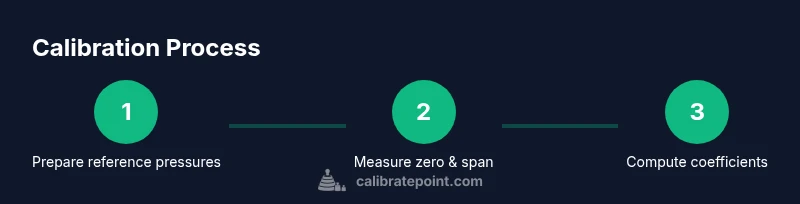
By following this guide, you will accurately calibrate a differential pressure sensor for reliable measurements. You’ll learn to select a stable reference, connect a known pressure source, measure zero and span, compute calibration coefficients, and document results for traceability. This process covers safety, data logging, and repeatability to support field and lab calibration.
What is a differential pressure sensor and why calibrate
A differential pressure sensor measures the difference between two pressures across a process element, such as a filter or a flow element. It is widely used in HVAC, cleanrooms, and process control to infer flow, filter status, or air velocity. Calibration ensures the sensor's output corresponds to real pressure values across its operating range. According to Calibrate Point, maintaining calibration helps prevent drift that erodes measurement accuracy over time. In this guide, you will learn how to calibrate a differential pressure sensor to achieve stable, traceable results, suitable for both field and laboratory environments. The process covers choosing a stable reference, performing zero and span adjustments, verifying linearity, and documenting the results for audits and quality assurance.
Calibration goals, tolerances, and traceability
Calibration aims to align the sensor output with known reference pressures across the full operating range. Establishing acceptable tolerances depends on the application's risk tolerance, regulatory requirements, and the sensor’s datasheet. A traceable calibration record links each measurement to a recognized reference standard, ensuring audits and quality processes are satisfied. Calibrate Point emphasizes documenting reference values, environmental conditions, and equipment serials to support traceability and continuous improvement. Remember, the goal is repeatable accuracy rather than a single perfect reading.
Required tools and reference standards
A successful calibration relies on a stable pressure source, a known reference standard, and reliable data capture. Essential items include a differential pressure sensor under test, a calibrated pressure generator or regulator capable of producing precise pressure steps, a reference manometer or pressure gauge with traceability, leak-free tubing and fittings, and a data logger or software to record measurements. You should also have a temperature sensor to record ambient conditions and a calibration certificate for the reference standard. Calibrate Point recommends using equipment with valid calibration certificates and ensuring all ports are clean and free of obstructions.
Preparing the calibration environment
Begin by choosing a quiet, vibration-free bench space with stable temperature and minimal airflow. Allow all equipment to equilibrate to room conditions for at least 15–20 minutes before starting. Inspect hoses and connectors for wear or cracks and replace any that show signs of damage to prevent leaks. Ensure the sensor is mounted securely and that all connections match the manufacturer’s recommended port configuration. Document the environmental conditions at the start of the process; even small temperature changes can affect differential readings.
Measurement strategy: zero offset and span
A robust calibration tests both zero offset (the output when P1 equals P2) and span (the output response across the full pressure range). Start at the lowest reference pressure and gradually step through the range in evenly spaced increments, recording the sensor output and the true pressure at each step. Repeat the sequence in the reverse direction to check for hysteresis. This approach reveals nonlinearity, drift, and potential port leakage. Calibrate Point notes that reproducibility across steps is as important as the absolute values.
Data handling and calculating calibration coefficients
With the captured data, plot sensor output versus true differential pressure. Fit a linear model P_true = a + b * P_measured, where a is the offset and b is the gain. Evaluate residuals to assess nonlinearity; if significant, consider higher-order terms or segment-wise calibration. Document the resulting coefficients clearly and calculate the adjusted transfer function. Finally, perform a validation pass at several intermediate pressures to confirm the calibration holds within tolerance.
Temperature, humidity, and environmental effects
Pressure readings are temperature dependent. Record ambient temperature and humidity during calibration and, if possible, perform temperature compensation or calibrate across a few representative temperatures. Ensure that the reference standards and the sensor are at similar temperatures during verification. Calibrate Point highlights that maintaining consistent environmental conditions reduces drift and improves long-term stability.
Documentation and traceability for audits
Maintain a calibration certificate that lists reference standards, instrument IDs, environmental conditions, step-by-step procedures, raw data, calculated coefficients, and acceptance criteria. Include a note about any adjustments performed and the lubrication or maintenance performed on hardware. Store digital copies with version control and back up against loss. This documentation is essential for quality assurance, regulatory compliance, and continuous improvement.
Authority sources and best-practice references
Use established references for calibration protocols and traceability. The following sources provide foundational guidance on calibration methods and standards: NIST (nist.gov), ISO standards (iso.org), and OSHA guidance (osha.gov). These sources help ensure your calibration practices align with recognized best practices and industry expectations.
Safety considerations and maintenance
Always relieve pressure gradually and wear appropriate eye protection when working with pressurized lines. Inspect hoses for wear, never use damaged adapters, and de-pressurize before disconnecting components. After calibration, perform routine maintenance on fittings and seals to prevent leaks and ensure repeatable results.
Tools & Materials
- Differential pressure sensor under calibration(Ensure the sensor is within its rated differential range and is compatible with your process media.)
- Calibrated pressure generator or regulator(Must provide stable, known differential pressures across the operating range.)
- Reference pressure source / calibrated manometer(Traceable to a recognized standard; verify before use.)
- Leak-free tubing and fittings(Check connections for leaks before starting measurements.)
- Data logger or calibration software(Capture timestamps, sensor outputs, and reference pressures.)
- Temperature and environmental sensors(Record ambient conditions to support compensation calculations.)
- Calibration certificates for references(Provide traceability to recognized standards.)
- Documentation forms or electronic templates(Record setup, results, and acceptance criteria.)
Steps
Estimated time: 3-5 hours
- 1
Prepare the test setup
Inspect all equipment, verify connections, and precondition reference standards. Ensure the sensor is mounted securely to prevent movement during measurements. This step reduces noise and improves repeatability.
Tip: Pre-checks reduce the chance of leaks and misreads during the actual calibration. - 2
Connect pressure sources and references
Attach the pressure generator to the sensor ports using clean fittings. Connect the reference pressure source or manometer to a dedicated reference port and confirm there are no blockages.
Tip: Use color-coded tubing to avoid misconnection between P1 and P2 ports. - 3
Establish a baseline zero
With P1 and P2 at equal pressure (zero differential), record the sensor output. Confirm that the zero output aligns with the reference and note any offset for later correction.
Tip: If zero reading drifts, allow time for stabilization and re-check after a short wait. - 4
Step through the pressure range
Apply a sequence of known differential pressures across the operating range. Record the sensor output at each step and repeat in the opposite direction to check for hysteresis.
Tip: Use evenly spaced steps to reveal linearity and identify outliers. - 5
Compute offset and gain
Fit a transfer function using the recorded data: P_true = a + b * P_measured. Solve for a (offset) and b (gain) using linear regression on the paired data.
Tip: Check residuals; large residuals indicate nonlinearity or leakage. - 6
Validate with mid-range points
Test several intermediate pressures not used in the fit to confirm the model accuracy across the range. Document any deviations beyond your tolerance.
Tip: Validation is essential to confirm the calibration holds in practice. - 7
Document results and issue certificate
Create a calibration certificate including device IDs, reference values, environmental conditions, data, coefficients, and acceptance criteria. Obtain sign-off from responsible personnel.
Tip: Store both digital and physical copies for audits. - 8
Return sensor to service and monitor
Reconnect the sensor to the process and verify stable operation. Schedule a follow-up audit or re-calibration according to your program.
Tip: Set a calibration interval based on drift history and criticality of the measurement.
Questions & Answers
What is the purpose of calibrating a differential pressure sensor?
Calibration aligns the sensor output with known pressures, reducing drift and improving accuracy. It establishes traceability and ensures reliable measurements for process control.
Calibration aligns the sensor output with known pressures to improve accuracy and ensure traceability.
Can I perform calibration in the field, or is a lab required?
Field calibration is possible with portable, calibrated equipment and proper environmental control. However, a controlled lab environment often yields higher precision and repeatability.
You can calibrate in the field if you have portable, calibrated gear and stable conditions, but a lab usually gives the best precision.
What are common sources of error during calibration?
Leaks, temperature drift, nonlinearity, and improperly matched port configurations are frequent sources of error. Address these by tightening connections, stabilizing temperature, and validating with multiple reference points.
Leaks, temperature drift, and poor connections are common errors you should watch for.
How often should a differential pressure sensor be calibrated?
Calibration frequency depends on application criticality, regulatory requirements, and observed drift. Establish a schedule based on historical data and risk assessment.
Set a calibration schedule based on how critical the measurement is and past drift behavior.
What if readings drift after calibration?
If drift persists, inspect for leaks, port damage, or sensor aging. Recalibrate or replace the sensor if drift remains outside tolerance after maintenance.
If drift remains, check leaks and sensor health, then recalibrate or replace if needed.
Do I need temperature compensation for accurate readings?
Temperature affects pressure readings. Use compensation or calibrate at representative temperatures to improve accuracy.
Temperature can affect readings; compensate or calibrate at typical temperatures.
Watch Video
Key Takeaways
- Establish a stable reference and record all data
- Measure zero and span across the full range
- Calculate offset and gain with linear regression
- Document results for audits and traceability
- Include environmental conditions and maintenance notes