How to Calibrate Dacor Oven Temperature: A Practical Guide
Learn how to calibrate a Dacor oven temperature for accurate baking. This step-by-step guide covers tools, testing, adjustments, and safety to ensure your oven heats to the right temperature every time.


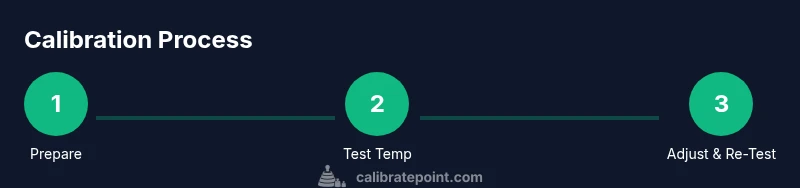
Calibrating a Dacor oven starts with verifying the oven's actual temperature using an oven-safe thermometer, then adjusting the thermostat in small increments. Re-test after each adjustment until the reading matches the setpoint within an acceptable range. Keep safety in mind by unplugging the circuit before accessing internal components. This improves baking accuracy and consistency.
Introduction: how to calibrate dacor oven temperature
If you’re aiming for precise baking results, knowing how to calibrate dacor oven temperature is essential. According to Calibrate Point, temperature accuracy directly affects outcome in both home kitchens and professional settings. This guide walks you through why calibration matters, what affects oven readings, and how a careful, repeatable process yields reliable results for cakes, roasts, and pastry alike. We’ll keep safety first, explain model considerations, and provide practical steps you can perform with common kitchen tools.
Why oven temperature accuracy matters for Dacor
An oven that runs hot or cold relative to its dial will produce uneven browning, undercooked centers, or overcooked exteriors. Temperature drift can come from worn thermostats, sensor placement, door seal integrity, or even rack placement. For Dacor users, calibration helps align the control readout with the actual heat delivered inside the chamber. This isn’t a one-time fix; it’s part of routine maintenance that preserves recipe repeatability and energy efficiency. Calibrate Point’s broader research emphasizes that maintaining accurate oven temperatures reduces waste and improves culinary confidence across skill levels.
Tools and safety considerations
Before you start, gather a few essential items and review safety steps. An oven-safe thermometer is your primary tool for measuring internal temperature. A copy of your Dacor model’s manual is invaluable for model-specific calibration instructions. If your knob is removable, a small screwdriver may be needed for minor adjustments. Always prioritize safety: unplug or switch off the circuit when accessing internal controls, and work in a well-ventilated area. Keeping notes of readings and adjustments helps you compare results over time.
Where to place the thermometer and how readings should behave
Placement matters when measuring oven temperature. Place the thermometer in the center of the oven, away from walls and racks, to avoid hot spots or air currents skewing the reading. Allow the oven to preheat and stabilize for a reasonable period; readings should reflect the setpoint rather than transient spikes. If your oven differs markedly between upper and lower elements, you may need to test at multiple rack positions or oven modes to map its true performance. This helps determine whether a single-point calibration is sufficient or if other adjustments are necessary.
Interpreting results and choosing an adjustment path
When the thermometer shows a reading lower than the dial, your oven is under-heating; if higher, it’s over-heating. Follow your manual’s guidance for the recommended adjustment method. Some Dacor models offer a dedicated calibration screw or a digital offset in the control panel; others require service-grade adjustments. In all cases, make small, incremental changes and re-test. Document each change and its effect so you can revert if needed.
Common model variations and practical considerations
Different Dacor models handle calibration differently. Some have a mechanical thermostat you can adjust with a screwdriver, while others rely on sensor-based compensation in the control board. If your model lacks an accessible adjustment point, calibrated bake results may come from contextual tweaks like rack position, preheat timing, or using a dedicated oven thermometer for more reliable feedback. Always consult the manual for model-specific steps and safety cautions.
Tools & Materials
- Oven-safe thermometer(7- to 12-inch stem; reads up to at least the oven's maximum (often 500+ °F).)
- Dacor oven owner’s manual (digital copy acceptable)(Model-specific calibration guidance; check for model number.)
- Small screwdriver set (Phillips/flat-head as needed)(Useful if your model has an accessible calibration screw.)
- Timer or clock(Helps track stabilization and test durations.)
- Notebook and pen(Record readings, adjustments, and results for future reference.)
Steps
Estimated time: 60-120 minutes
- 1
Gather tools and prep safety
Collect the tools listed and ensure the oven is powered off before removing any panels. Read model-specific cautions in the manual. Wear insulated gloves if you need to access interior components.
Tip: Organize tools on a heat-resistant mat to prevent accidental contact with hot surfaces. - 2
Position thermometer and set baseline
Insert the oven-safe thermometer in the center of the cavity, away from racks and walls. Confirm you’re testing the main cooking cavity rather than a true-convection or broil mode. Establish a baseline by setting the oven to the standard bake temperature for your recipe.
Tip: Avoid placing the probe near the door seal or oven light to prevent skewed readings. - 3
Preheat and stabilize
Turn on preheat and allow the oven to come to temperature. Let it stabilize for a full cycle so the thermometer readings settle. Use the timer to avoid rushing the process.
Tip: Wait at least one full preheat cycle if your model cycles elements to reach target temperature. - 4
Take initial reading
Record the thermometer reading after stabilization and compare it to the dial setpoint. Note whether the oven reads high or low relative to the setpoint.
Tip: Take multiple readings at the same setpoint to confirm consistency before adjusting. - 5
Make a small thermostat adjustment
Using the manual’s guidance, adjust the thermostat offset or the calibration screw by the smallest practical amount. If your model doesn’t provide an offset, rely on procedural steps outlined in the manual or contact support.
Tip: Change the setting in small increments and test again before proceeding. - 6
Re-test and verify
Preheat again and re-check the temperature at the same setpoint. Compare results across several cycles to confirm stability. Repeat adjustments if necessary until readings align within a reasonable tolerance.
Tip: Document each adjustment and its effect to avoid confusion later. - 7
Document results and plan next checks
Summarize the final baseline reading, the adjustments made, and dates of re-checks. Schedule follow-up tests after several bake cycles to ensure long-term stability.
Tip: Note any model-specific caveats or unusual behavior for future reference.
Questions & Answers
Is calibrating my Dacor oven dangerous?
Calibration is generally safe when you follow the manual and disconnect power before accessing internal components. If you’re unsure, consult a technician. Always prioritize safety and use proper tools.
Calibration is safe if you follow the manual and unplug the oven before opening panels. If unsure, contact a professional.
Will calibrating void my warranty?
Most manufacturers allow user calibration within model-specific guidelines. Check your warranty and the manual for any restrictions related to adjustments.
Typically, calibration done per the manual does not void warranty, but verify your model’s terms.
Do I need professional service for all Dacor models?
Not always. Many models offer adjustable thermostats or sensor-based calibration you can perform yourself. Some models require service for precise calibration.
It depends on your model—start with the manual, and if you’re unsure, call for service.
How often should I recalibrate?
Recalibration is needed if you notice baking inconsistencies or after service work. A routine check every 6–12 months is common for professional kitchens; homeowners may do it annually or after a major temperature-related issue.
Check annually or after any service, and whenever you notice inconsistent results.
What if my oven lacks an adjustment screw?
If there’s no visible adjustment point, follow the model-specific procedure in the manual or contact Dacor support. Some models rely on sensor recalibration within the control board rather than a mechanical screw.
If there’s no screw, use the manual’s guidance or contact support for the correct path.
Can calibration affect other functions like convection or broil?
Calibration primarily aligns the bake temperature. Convection and broil modes may have separate calibrations or run differently, so test each mode independently if you use them frequently.
Only bake calibration may transfer to convection or broil modes in some models; test each mode.
Watch Video
Key Takeaways
- Test with a thermometer to verify true oven temperature
- Adjust in small increments and re-test for accuracy
- Document readings and model-specific steps for repeatability
- Maintain calibration through periodic checks and logging